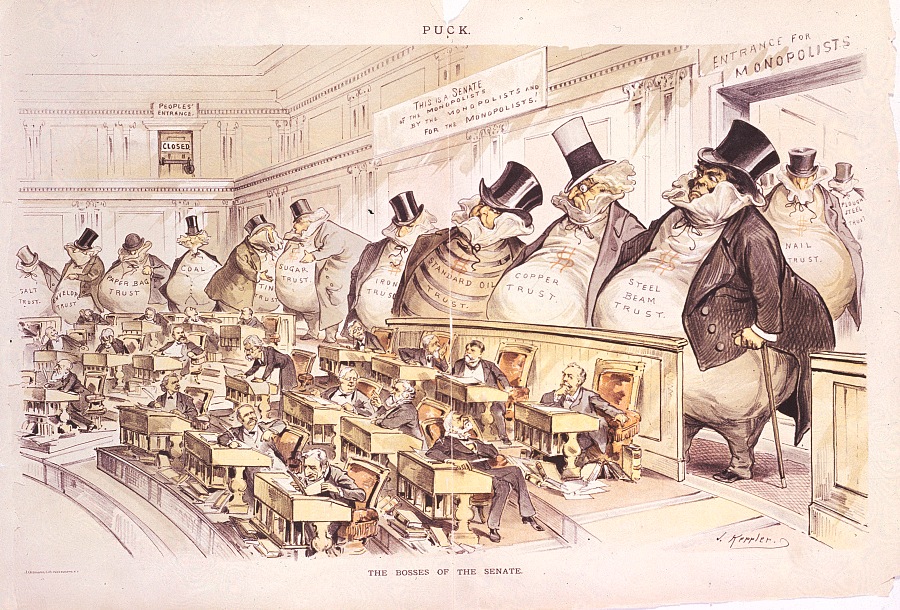

Well over 100 members of Congress are on their way out. Until January 3, they still vote on bills worth billions to the industries that may hire them next.
corporatocracy (noun) — a system of government in which corporations, financial institutions, or other business entities hold effective political power, either by directly controlling the state or by exerting decisive influence over the officials and institutions that do.
revolving door (noun) — the movement of people between government jobs and the industries they once oversaw or wrote laws for, especially lawmakers and staff who leave office to lobby their former colleagues.
On November 3, voters fired more than 30 sitting members of Congress. Before that, at the end of primary season, NPR counted 99 seats, 83 in the House and 16 in the Senate, already guaranteed to have someone new in January because of retirements, resignations, runs for other office, and primary losses.
Every one of those departing members still has a vote until January 3. And the lame-duck agenda is packed with bills that powerful industries badly want: a sweeping energy permitting bill backed by both the oil and gas industry’s top lobbying group and the clean energy industry’s; a college sports bill that has drawn tens of millions of dollars in lobbying; a defense bill; government funding; and, once again, the fight over hemp.
So here’s the question nobody in Washington likes to ask out loud: how many of the people casting those votes are also lining up their next paycheck from the industries on the other side of them?
The job hunt starts before the job ends
The rules allow more of it than most people think.
In the Senate, the rules bar senators from negotiating a job involving lobbying “until after his or her successor has been elected.” In nearly every state, successors were elected on November 3. From that point on, a departing senator may talk jobs with a lobbying firm while still voting on the bills that firm’s clients care about. The Senate rule requiring a public statement about other private job talks also applies only until a successor is elected.
That now includes Texas’s own John Cornyn, who lost his primary runoff to Ken Paxton in May and serves until January.
In the House, members can negotiate future employment at any time, as long as they notify the House Ethics Committee within three business days and recuse themselves from votes where the talks create a conflict or the appearance of one. Since 2009, that has applied to lame-duck members too. The notice goes to the committee; it becomes public only when a member recuses.
Both chambers tell members to avoid even the appearance of a conflict. Whether that means anything depends on who is watching.
The cooling-off period that barely cools anything
After they leave, federal law imposes a “cooling-off period”: one year before former House members can lobby Congress, two years for former senators.
The loopholes are well worn. A 2019 Public Citizen study found that former members can lobby federal agencies immediately, since the ban covers only Congress. They can also call themselves “strategic consultants,” advising the registered lobbyists who make the actual calls. Public Citizen calls this the “Daschle loophole,” after former Sen. Tom Daschle, who worked for firms for over a decade before registering as a lobbyist in 2016.
The pay is the point
A member of Congress earns $174,000 a year. The jobs waiting on the other side pay several times that.
Using tax records and ethics filings, journalist Lee Fang documented what some former members earned after leaving:
- Ken Salazar (D-Colo.), former senator: $3,489,255
- Jim Nussle (R-Iowa), former representative, at the Credit Union National Association: $2,633,557
- Pat Tiberi (R-Ohio), former representative, at the Ohio Business Roundtable: $1,046,747
- Mike Rogers (R-Mich.), former representative: $987,337
Both parties are on that list. Both parties are on every list.
A record year for the revolving door
It isn’t just members. Their senior staff, the people who actually write the bills, go too.
LegiStorm, which tracks congressional staff, counted 866 members of Congress and congressional staffers who moved to K Street in 2025, a 60% increase over 2024 and a record. The split: 440 Republicans (50.8%) and 384 Democrats (44.3%). By August 31 of this year, another 388 had made the move, 52.1% Republicans and 45.9% Democrats.
Republicans have held a slight edge every year since 2022. Democrats are right behind them. The door swings both ways for both parties.
Fundraising on the way out
Even members who aren’t coming back keep raising money through leadership PACs, and lobbyists with business before Congress are among the people asked to give.
In May, Bloomberg Government reported that Texas Rep. Marc Veasey, a Democrat who chose not to seek reelection after redistricting split his district, invited lobbyists and business PAC donors to a July fundraiser at a Southern California resort and the nearby Del Mar Thoroughbred Club. The money went to his leadership PAC, which held about $36,000 as of March 31.
There’s nothing illegal about it. That’s the problem.
The bipartisan photo op
There’s a ritual in Washington. Voters demand a reform that would cost lawmakers money. One Democrat and one Republican, ideally from opposite ends of their parties, step up together to announce it. The press calls it a rare moment of unity. Then the bill disappears.
The lifetime lobbying ban has been through this ritual before. In May 2019, Rep. Alexandria Ocasio-Cortez tweeted that a departing member “shouldn’t be allowed to turn right around & leverage your service for a lobbyist check.” Texas Sen. Ted Cruz answered, “Here’s something I don’t say often: on this point, I AGREE with @AOC,” adding that he had long called for a lifetime ban. She replied, “Let’s make a deal.” He replied, “You’re on.” A year and a half later, neither had introduced the bill.
Now it’s back. In May, Sen. Elizabeth Warren (D-Mass.) and Sen. Rick Scott (R-Fla.) introduced the bipartisan BLAST Act. It would permanently bar former members from becoming lobbyists and from being paid to influence their former colleagues without registering, thereby closing the “strategic consultant” loophole. In the House, Reps. Joe Neguse (D-Colo.) and Alexandria Ocasio-Cortez have proposed their own lifetime ban.
The congressional stock trading ban has followed the same script. Texas Republican Chip Roy and Virginia Democrat Abigail Spanberger first introduced their TRUST in Congress Act in 2020 and have since reintroduced it repeatedly without a floor vote. Roy tried again in 2025, this time with Rhode Island Democrat Seth Magaziner. This week, the House Freedom Caucus was still listing a stock trading ban among its lame-duck demands, which tells you it still isn’t law.
The announcement is the product. Both parties get credit for caring, and neither has to vote against its own future paycheck. When a reform has sponsors in both parties and still never reaches the floor, ask who benefits from the delay. Usually, it’s the people who would have to vote on it.
When the optics line up
No one can prove a vote was traded for a job. It’s never in writing. But the pattern repeats often enough that you can judge it for yourself, and so does what comes after.
Billy Tauzin (R-La.). As chairman of the House Energy and Commerce Committee, Tauzin was a chief architect of the 2003 Medicare drug law. It gave seniors drug coverage but banned Medicare from negotiating drug prices. While retiring from Congress, he announced he would lead PhRMA, the drug industry’s lobbying group, in a job reported to pay about $2 million a year.
What it bore: In 2009, Tauzin brokered an $80 billion cost-savings deal with the Obama White House during the health care overhaul, which helped the drug industry head off deeper cuts. He was paid $11.6 million in 2010, far more than other top health care lobbyists that year. The ban on Medicare negotiation he helped write lasted until 2022, and the first negotiated prices didn’t take effect until January 2026, more than two decades after his bill passed.
Chris Dodd (D-Conn.). In 2010, the retiring senator said he would not become a lobbyist: “No lobbying, no lobbying.” Weeks after leaving the Senate in 2011, he became chairman of the Motion Picture Association of America, Hollywood’s top lobbying group, at a reported $1.2 million a year. By 2012, his first full year, he was making more than $3 million.
What it bore: Dodd’s first big fight was the movie industry’s push for the Stop Online Piracy Act and the PROTECT IP Act. When an internet-wide blackout led by Wikipedia and Google helped shelve both bills, Dodd went on Fox News and warned Democrats, “Don’t take us for granted,” appearing to threaten to withhold campaign contributions from politicians who didn’t support the bills. That one didn’t work. Voters and the internet beat him. But the attempt showed exactly how the game is played.
Joe Crowley (D-N.Y.) and Bill Shuster (R-Pa.). Crowley, chairman of the House Democratic Caucus, lost his 2018 primary to Ocasio-Cortez and served out the lame duck. Shuster spent his last six years chairing the House Transportation and Infrastructure Committee. Weeks after both left in 2019, they joined lobbying firm Squire Patton Boggs together. Shuster said the firm let them work on “prioritizing an infrastructure agenda.” The firm already employed former House Speaker John Boehner and former Senate Majority Leader Trent Lott.
What it bore: Crowley registered as a lobbyist in 2021. That year, SIFMA, the Wall Street trade group whose members range from BlackRock and JPMorgan to Amazon Web Services and IBM, hired him. At the same time, it opposed President Biden’s plan to raise taxes on the ultrawealthy, so the former chairman of the House Democratic Caucus was lobbying against his own party’s agenda. He later moved to the law firm Dentons, where his clients have included an air ambulance company and a cryptocurrency firm.
Shuster went to work on the same issues he used to oversee. The watchdog group CREW found he lobbied for the Los Angeles County Metropolitan Transportation Authority, and that new clients with transportation interests signed with the firm around the time he arrived. In 2025, Somerset County, Pennsylvania, hired him at $12,500 a month to push Washington for federal highway money.
These are just a few. There are many more. Of the lawmakers who left Congress in 2019 and took private jobs, Public Citizen found that 59%, or 26 of 44, went to work for lobbying firms, consulting firms, trade groups, or business groups that try to influence federal policy. Congress’s own ethics rules tell members to avoid not just a conflict of interest, but the appearance of one. A Republican and a Democrat. A chairman of the committee that oversees drug companies and a chairman of the committee that oversees infrastructure. Every time, the job lines up with the work, and the appearance is all anyone ever needs to see.
Why this matters now
None of this proves any member is trading votes for a job, and I’m not claiming any member is. Proof will never be there. The pattern always is. And the system doesn’t require proof. It only requires a departing lawmaker, a bill an industry wants, and a rulebook that lets the job talks begin before the votes are over.
For the next seven weeks, the people voting on energy permits, college sports, defense spending, and hemp include dozens who will never face voters again. Some of them will be on K Street by spring. That’s not a conspiracy. It’s the schedule.
Call to Action
- Call your senators and representatives through the U.S. Capitol Switchboard at (202) 224-3121. Ask them to cosponsor a lifetime lobbying ban for former members: the BLAST Act in the Senate, or the Neguse/Ocasio-Cortez bill in the House.
- If your member is leaving, ask their office directly whether they have started any job negotiations and whether they will recuse from related votes. Lame ducks still answer constituent calls until January 3.
- Watch the lame-duck votes, especially on permitting, college sports, and hemp, and note how departing members vote. Then watch where they work next year.
- If your member won on November 3, ask them to pledge publicly never to lobby Congress after they leave office. A promise on the record now is one voters can hold them to later.
Sources
- CNN, "2026 Midterm Election Results" (Nov. 5, 2026). https://edition.cnn.com/2026/11/05/politics/live-news/midterm-election-congress
- NPR, "Who in Congress is not running for reelection in 2026?" (Sept. 16, 2026). https://www.npr.org/2026/09/16/nx-s1-5971264/congress-retirement-2026-house-senate-primary-defeat
- Associated Press via OPB, "Senate advances sweeping energy legislation in first major action since midterm elections" (Nov. 10, 2026). https://www.opb.org/article/2026/11/09/senate-advances-sweeping-energy-legislation-in-first-major-action-since-midterm-elections/
- Front Office Sports, "Behind the Lobbying Battle Over the Bipartisan Senate College Sports Bill" (Sept. 15, 2026). https://frontofficesports.com/?p=249634
- Bloomberg Government, "Hemp Loophole Lobbying Fight to Reemerge in Lame-Duck Congress" (Nov. 9, 2026). https://news.bgov.com/bloomberg-government-news/hemp-loophole-lobbying-fight-to-reemerge-in-lame-duck-congress
- U.S. Senate Select Committee on Ethics, Form 37.14(a), Disclosure by Member of Employment Negotiations and Recusal (Jan. 2025). https://www.ethics.senate.gov/public/_cache/files/8e92fa97-080f-454d-a495-df35c603d85d/form-37.14a---disclosure-by-member-of-employment-negotiations-and-recusal---jan-2025.pdf
- U.S. Senate Select Committee on Ethics, "Employment Negotiations and Post-Employment" (Oct. 2020). https://www.ethics.senate.gov/public/_cache/files/9dbac7a9-ffb4-433b-bb30-b8783d72fc15/flyer---employment-negotiations-and-post-employment---oct-2020.pdf
- Texas Standard / Houston Public Media, "Ken Paxton cruises to big win against incumbent Sen. John Cornyn" (May 26, 2026). https://texasstandard.org/stories/texas-senate-runoff-results-cornyn-paxton/
- House Committee on Ethics, "Negotiations for Future Employment and Restrictions on Post-Employment for House Members and Officers" (2024). https://ethics.house.gov/wp-content/uploads/2024/12/FINAL-Post-Employment-Member-2024.pdf
- Wiley Rein, House rule change requiring lame-duck disclosure (2009). https://wiley.law/newsletter-2807
- Congressional Research Service, "Post-Employment, 'Revolving Door,' Laws for Federal Personnel." https://www.everycrsreport.com/reports/R42728.html
- Public Citizen, "Revolving Congress" (May 30, 2019). https://www.citizen.org/article/revolving-congress/
- Lee Fang, "Members of Congress Take Lobbyist Jobs Paying as Much as $4 Million" (June 10, 2024). https://www.leefang.com/p/members-of-congress-take-lobbyist
- LegiStorm, "What the Revolving Door Means in Congress" (data as of Feb. 2, 2026). https://info.legistorm.com/blog/revolving-door-in-congress
- LegiStorm, "K Street's revolving door swings red" (Aug. 31, 2026). https://www.legistorm.com/pro_news/4473/k-streets-revolving-door-swings-red.html
- Bloomberg Government, "Lawmakers Lean on Lobbyists for Cash as They Leave Congress" (May 27, 2026). https://news.bloomberglaw.com/bloomberg-government-news/lawmakers-lean-on-lobbyists-for-cash-as-they-leave-congress
- Texas Tribune, "Ted Cruz and Alexandria Ocasio-Cortez agree to partner up on legislation" (May 30, 2019). https://www.texastribune.org/2019/05/30/ted-cruz-and-alexandria-ocasio-cortez-agree-file-lobbying-ban-bill
- NPR via CPR News, "Ted Cruz And Alexandria Ocasio-Cortez Team Up To Ban Lawmakers From Lobbying" (May 31, 2019). https://www.cpr.org/2019/05/31/ted-cruz-and-alexandria-ocasio-cortez-team-up-to-ban-lawmakers-from-lobbying
- Sludge, "Cruz and AOC Said They Would Propose a Lobbying Ban. So What Happened?" (Jan. 14, 2021). https://readsludge.com/2021/01/14/cruz-and-aoc-said-they-would-propose-a-lobbying-ban-so-what-happened
- Sen. Elizabeth Warren, "Senators introduce ban on lawmakers becoming lobbyists" (May 14, 2026). https://www.warren.senate.gov/?p=33288
- ABC News, "Bipartisan coalition making new push to ban congressional stock trading" (Jan. 13, 2023). https://www.goodmorningamerica.com/news/story/bipartisan-coalition-making-new-push-ban-congressional-stock-96419702
- Fox Business, "Bipartisan team reintroduces bill that would ban members of Congress from trading individual stocks" (2023). https://foxbusiness.com/politics/bipartisan-team-reintroduces-bill-would-ban-members-congress-trading-individual-stocks
- The Daily Signal, "Congressional Stock Ban Backed by Republicans and Democrats Alike" (Sept. 3, 2025). https://www.dailysignal.com/?p=121129
- NBC News, lame-duck live updates, House Freedom Caucus demands (Nov. 9, 2026). https://www.nbcnews.com/politics/trump-administration/live-blog/trump-2026-midterm-elections-senate-house-supreme-court-live-updates-rcna608235
- Consumer Watchdog, "Tauzin Should Be Banned From Lobbying Congress, the President, Says Consumer Group." https://consumerwatchdog.org/?p=19733
- Salon, on the 2003 Medicare drug law (Oct. 29, 2021). https://www.salon.com/2021/10/29/pro-pharma-democrats-bill-to-lower-costs-advocates-ask-what-did-they-get-for-that/
- FiercePharma, "Ex-PhRMA chief's $11.6M tops among healthcare reform lobbyists." https://www.fiercepharma.com/pharma/ex-phrma-chief-s-11-6m-tops-among-healthcare-reform-lobbyists
- Public Citizen, Worst Pills, Best Pills, on the Inflation Reduction Act and the 2003 noninterference clause. https://www.worstpills.org/newsletters/view/1499
- Association of Health Care Journalists, first negotiated Medicare prices take effect Jan. 1, 2026. https://healthjournalism.org/?p=61847
- HuffPost, "Chris Dodd at the Movies" (2011). https://www.huffpost.com/entry/chris-dodd-at-the-movies_b_830936
- Techdirt, "Chris Dodd Breaking Promise Not To Become A Lobbyist" (Feb. 21, 2011). https://archive.techdirt.com/articles/20110221/14490613193/chris-dodd-breaking-promise-not-to-become-lobbyist-just-weeks-after-leaving-senate-joining-mpaa-as-top-lobbyist.shtml
- The Hill, "Dodd to be Hollywood's top man in Washington" (March 1, 2011). https://digital-release.thehill.com/policy/technology/146769-mpaa-names-former-sen-chris-dodd-chairman-a-ceo
- The Hollywood Reporter, "MPAA Chief Chris Dodd Leaves Complicated Legacy as Hollywood's Top Lobbyist." https://www.hollywoodreporter.com/news/mpaa-chief-chris-dodd-leaves-complicated-legacy-as-hollywoods-top-lobbyist-998841
- Salon, "Dodd accused of 'bribery' over SOPA remarks" (Jan. 23, 2012). https://www.salon.com/2012/01/23/dodd_accused_of_bribery_over_sopa_remarks
- BetaNews, "MPAA chief Chris Dodd fights off allegations of bribery" (Jan. 24, 2012). https://betanews.com/2012/01/24/mpaa-chief-chris-dodd-fights-off-allegations-of-bribery/
- Roll Call, "Joe Crowley, Bill Shuster decamp to K Street" (Feb. 19, 2019). https://rollcall.com/2019/02/19/joe-crowley-bill-shuster-decamp-to-k-street/
- PoliticsPA, Shuster joins Squire Patton Boggs (2019). https://www.politicspa.com/?p=90414
- Above the Law, "Guess Which Biglaw Firm Won The Former Congressman Lottery" (Feb. 2019). https://abovethelaw.com/2019/02/guess-which-biglaw-firm-won-the-former-congressman-lottery
- The Intercept, "Joe Crowley Is Lobbying Against Biden's Tax Hikes on the Rich" (Oct. 15, 2021). https://theintercept.com/2021/10/15/joe-crowley-lobbyist-corporate-taxes/
- LegiStorm, Joseph Crowley biography. https://www.legistorm.com/person/bio/51336/Joseph_Crowley/hashkey/3a4d5cf9.html
- CREW, "Former Reps. Shuster, Smith, Ros-Lehtinen chaired committees on issues they now lobby on." https://www.citizensforethics.org/reports-investigations/crew-investigations/former-reps-shuster-smith-ros-lehtinen-chaired-committees-on-issues-they-now-lobby-on/
- WTAJ, "Somerset County hires former congressman Bill Shuster to lobby for U.S. Route 219 completion" (2025). https://www.yahoo.com/news/somerset-county-hires-former-congressman-160633661.html
- U.S. Senate, "Contacting U.S. Senators" (Capitol Switchboard). https://www.senate.gov/senators/senators-contact.htm?tfrm=5
- Library of Congress, "The Bosses of the Senate" (1889). https://www.loc.gov/item/2002718861/
- U.S. Senate, "The Bosses of the Senate," Political Cartoons and Caricatures. https://www.senate.gov/art-artifacts/historical-images/political-cartoons-caricatures/38_00392_001.htm