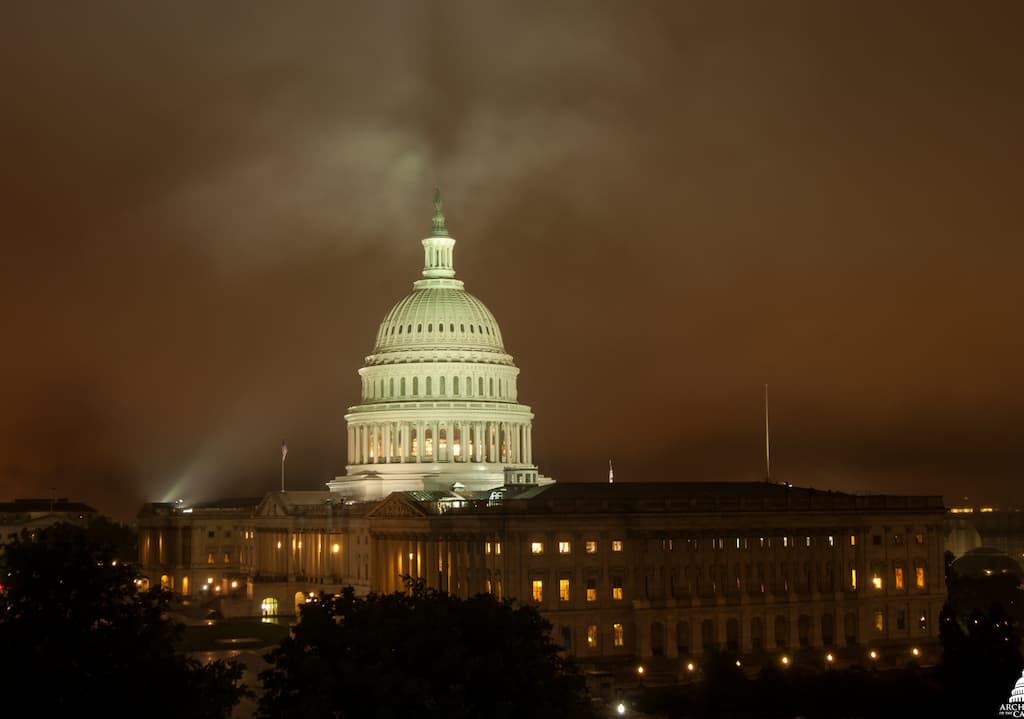

Filed the day senators left to campaign. Voted on days after you voted. Hidden inside a tax bill for abuse survivors. This is how Washington really works.
Corporatocracy (noun) — a system of government in which corporations, financial institutions, or other business entities hold effective political power, either by directly controlling the state or by exerting decisive influence over the officials and institutions that do.
Uniparty (noun, informal) — a term for the Republican and Democratic parties acting as one governing class: fighting loudly over culture-war issues in public, while cooperating quietly to protect donors, corporate interests, and their own power.
Remember in September, when President Trump told reporters, "Right after the election, oil prices are going to be tumbling downward"? Plenty of people asked how he could know the timing.
Here's something else that was timed for right after the election. The White House was at the table for this bill. When the final version was released on November 7, it included changes from negotiations with the House, the Trump administration, electric utilities, and industry groups. The President has championed it. Did he know exactly how it would be moved, and which corporate interests would come out ahead? Nobody has shown that, and I won't claim it. But his administration helped shape a bill built for the same window he was promising you relief: after the votes were counted.
Here's what we know.
Late Thursday night, November 19, the U.S. Senate passed what's been called the most comprehensive permitting reform in decades. The vote was 62 to 33.
You probably didn't hear much about it. That was the point.
The bill is called the Bipartisan American Affordability and Jobs Act of 2026, or BAAJA. It rewrites how Washington approves power lines, gas pipelines, drilling, mines, and the data centers behind artificial intelligence. It never got a single hearing. It never went through a committee. And if you look up the official Senate record of the vote, you won't even see the words "energy" or "permitting."
This isn't a story about whether permitting reform is good or bad. Parts of this bill may do real good. This is a story about how it was done: the timing, the trickery, and the corporate interests on both sides of the aisle that wanted it done before you could weigh in. It's the clearest example I've seen of how the Uniparty actually operates: two parties that fight in public and cooperate in private when their donors want something.
The bait and switch, step by step
Here's exactly how a 494-page energy bill ended up recorded as a tax break for abuse survivors. Follow it one step at a time.
Step 1: Give it a feel-good name. On September 30, four senators filed the bill as S. 5653, the "Bipartisan American Affordability and Jobs Act." Its supporters do claim it will lower costs and create jobs. But the name sells you a promise. It doesn't tell you what the bill does: rewrite the rules for pipelines, drilling, power lines, mines, data centers, and your right to challenge them in court.
Step 2: Borrow someone else's bill. Back in April, the House had passed a short, sympathetic bill by voice vote: H.R. 2347, the Survivor Justice Tax Prevention Act. It keeps survivors of sexual abuse from being taxed on damages they win in court. It passed by voice vote, with no recorded opposition.
Step 3: Gut it and refill it. On November 7, the bill's authors released a new version of their energy bill as a "substitute amendment." In the Senate, it became S.Amdt. 6883. A substitute amendment does exactly what it sounds like: it strikes the original text of a bill and replaces it with something else. S.Amdt. 6883 struck the survivors' tax bill and put the entire energy bill in its place. The survivors' tax fix survives only as a small piece in the back.
Step 4: Adopt the swap. On November 18, the Senate voted 69-27 to adopt the substitute. From that moment, H.R. 2347 was the energy bill in everything but name.
Step 5: Pass it under the old name. On November 19, the Senate passed it 62-33. Here's what the official Senate record says passed:
"H.R. 2347 (A bill to amend the Internal Revenue Code of 1986 to exclude from gross income any damages, other than punitive damages, received on account of any sexual acts or sexual contact.)"
Not one word about energy, pipelines, or data centers.
Why do it this way? Because a bill the House already passed can skip the Senate's committee process. No hearings. No markup. No committee report. Law professor Steve Vladeck called it "a transparent procedural ploy to allow it to skip committee consideration entirely."
First they wrapped it in a feel-good name: the "Affordability and Jobs Act." Then they packed it inside a different bill. Then they sealed it under that bill's title, so the official record shows a tax break for abuse survivors. It's like burying a body: roll it in a carpet, put the carpet in a box, pour concrete over the box. Except this was all perfectly legal. That's what should scare you.
Remember when Nancy Pelosi said, "We have to pass the bill so that you can find out what is in it"? That was March 2010, about the Affordable Care Act. Republicans ran their own version of the play in December 2017, passing a 479-page tax bill just before 2 a.m. after senators got the final text only hours earlier, some of it with changes handwritten in the margins. This time, both parties did it together. A 494-page bill, no hearings, passed late at night under someone else's name. They passed it. Now you get to find out what's in it.
Call it what it is: deception. That's a Uniparty specialty. Hide the real cargo inside something sympathetic, so the official record tells a different story than the one that actually happened.
See the switch for yourself. Don't take my word or anyone else's. Here's the paper trail, all from official government sites:
- The bill's official action log on Congress.gov lists H.R. 2347 under its tax-bill title, then shows the Senate taking up and adopting "S.Amdt.6883," the substitute: https://www.congress.gov/bill/119th-congress/house-bill/2347/all-actions
- The substitute amendment itself, S.Amdt. 6883, is the text that replaced the tax bill with the energy bill: https://www.congress.gov/amendment/119th-congress/senate-amendment/6883/text
- The bill's own authors announced it. The Senate Environment and Public Works Committee's press release, with a link to the full substitute text: https://www.epw.senate.gov/public/index.cfm/2026/11/capito-lee-whitehouse-and-heinrich-release-substitute-amendment-to-bipartisan-american-affordability-and-jobs-act-of-2026
- The full text was printed in the Congressional Record on November 10, 2026, pages S5471 to S5510.
If you open H.R. 2347's main "Text" page, you'll still see the one-page tax bill. That's the version the House passed in April. The energy bill lives in the amendment, which is exactly why most people will never find it.
Why they waited until after you voted
Look at the calendar.
- September 30: The four senators who wrote the bill filed it, the day before Congress left town to campaign for the midterms.
- Early October: The plan was already public. "The current plan is for the Senate to vote on the bill first thing when it reconvenes after the midterm election, during what's known as the lame duck session," wrote a former Senate Democratic leadership aide.
- November 3: You voted. Democrats won both chambers of Congress.
- November 9: Six days later, the Senate voted 73 to 25 to take up the bill.
- November 19: Final passage, late at night, 62 to 33. No hearing, no markup, no committee report.
Nobody in Washington will ever put it in writing. There will never be a memo that says "hold this until the voters are done." But you don't need a memo when the pattern is this plain.
My conclusion: this vote was planned for the one window when voters couldn't hold anyone accountable for it. File it as the campaign starts so nobody has to defend it on the stump. Vote on it after the election, when the members who lost or are retiring have nothing left to lose. Pass it before the new Congress, the one you just elected, gets a say. That's not a conspiracy theory. It's a calendar. And it's the Uniparty's favorite tool: let the voters have their say on Election Day, then go right back to business as usual once the cameras move on.
The Uniparty, in one roll call
This bill wasn't forced through by one party over the other's objections. It was written and moved by both.
Its four authors are two Republicans, Shelley Moore Capito of West Virginia and Mike Lee of Utah, and two Democrats, Martin Heinrich of New Mexico and Sheldon Whitehouse of Rhode Island. Republican Majority Leader John Thune scheduled it. Democratic Leader Chuck Schumer voted for it. Fourteen Democrats plus independent Angus King joined nearly every Republican to pass it, while 28 Democrats voted no.
Here's the part that should bother you most. Heinrich is set to chair the Senate Energy Committee when Democrats take over in January. His party just won both chambers of Congress. Instead of writing a new bill in the open with the Congress you elected, he helped push this one through the outgoing one.
Texas, here's your scorecard:
- Ted Cruz voted yes on final passage, and on the earlier votes to take up the bill and cut off debate on the substitute.
- John Cornyn, who lost his primary to Ken Paxton in May and leaves office in January, voted yes on the votes to begin debate, to cut off debate on the substitute, and on all three votes on November 18 that cleared the final hurdles. On final passage, the record shows him as "Not Voting."
A senator the voters had already fired helped clear the path, then cast no vote on final passage. Draw your own conclusions.
Who wanted this bill?
Follow the money and you'll find corporate interests on every side of the energy business lined up behind it.
- The American Petroleum Institute, Big Oil's top lobbying group, signed a letter with 137 other fossil fuel industry groups urging passage.
- ExxonMobil's CEO said the company supports it.
- The U.S. Chamber of Commerce sent a letter backed by hundreds of local chambers and industry groups.
- The American Clean Power Association, the wind and solar industry's trade group, backs it too.
- Major labor unions support it, and President Trump championed it.
Oil and gas, clean energy, Big Business and Big Labor, Republicans and Democrats, all on the same side. When every corporate interest in a fight agrees, ask who's not at the table. In this case, it's you. That's the Uniparty in a nutshell: the parties argue about culture-war issues on TV and vote together when corporate checks are on the line.
Lobbying tells the same story. In the third quarter of 2026, federal lobbying spending on fuel, gas, and oil issues jumped 50% from a year earlier, according to LegiStorm. That was part of a record quarter for K Street overall, nearly $1.3 billion, as I laid out in Monday's Dispatch.
What's actually in it
The bill's supporters say it will speed up construction of power lines and energy projects and lower power bills over time. One analysis projects household savings of $50 to $78 a year by 2040. Parts of it, especially the transmission reforms, have backing from clean energy advocates.
But here's what it does for the companies, in the bill's own words:
It makes it harder for states to block gas pipelines. Under the bill, a state can't deny a water-quality certification "for any reason other than making a determination by clear and convincing evidence." That's a much higher bar than states face today, and it lands hardest on interstate natural gas pipelines.
It ties the hands of the courts. If a court finds that an agency violated the National Environmental Policy Act, the bill provides that "the only remedy the court may order to redress that violation is to remand, without vacatur or issuance of an injunction." Translation: even if a judge finds the government cut corners, the project keeps going. The permit stays in place, and the agency gets to try again.
It puts a clock on lawsuits. Challenges to a project's approval generally must be filed within 150 days. Miss the window, and you're out of luck.
It cuts some drilling permits. According to an analysis by the conservative group Advancing American Freedom, the federal government "shall not require a permit to drill for an oil and gas lease" when the well sits on non-federal land and the government owns less than half of the oil and gas beneath.
It protects companies that get turned down. A company denied a permit can claim it was the target of a "pattern of disparate treatment," and the bill sets out how to prove it. And projects that are approved get new protections against later revocation. Critics call them "forever permits."
The data center promise, and the Texas question
Here's the part being sold to you as protection. Section 2107 says data centers must pay "the embedded cost and the incremental cost of transmission service." One independent analysis says the bill "explicitly prohibits charging non-data center customers for data center costs." In plain English: big data centers, defined as 20 megawatts or more, would pay for the grid upgrades they cause, instead of you.
That's a good idea. But read the fine print if you live in Texas.
Most of Texas runs on its own grid, ERCOT, and the federal agency that would enforce this rule, the Federal Energy Regulatory Commission, doesn't regulate transmission service there. Other parts of the bill outright exempt ERCOT. On the data center section, Grid Strategies says it "appears to apply to the entire United States including ERCOT," but the firm left Texas out of its cost estimate because FERC doesn't oversee transmission service there.
So will this protect a Texas family's electric bill? Nobody can say for sure. And Texas, which accounts for more than a quarter of the data center capacity planned in the U.S. by 2030, is the state left with a question mark.
Meanwhile, back home, the floodgates just reopened. Requests to plug in big new users to the Texas grid hit 474 gigawatts this year, mostly from data centers. Gov. Abbott said that's about five times the state's peak demand. Gov. Greg Abbott ordered an audit of data center projects in August, and state environmental regulators paused new data center permits. On his way out the door after losing the election, his office let the pause end. State regulators resumed permit reviews on November 16 and immediately approved an air permit for a SpaceX data center. ERCOT's full audit findings haven't been released, and its reports aren't due until December 10.
That sets up a fight in Austin. Governor-elect Gina Hinojosa, a Democrat who beat Abbott on November 3, campaigned on a "moratorium, a ban, on all data center approvals" until the Legislature passes protections for ratepayers, water, and local communities. She has also called for ending the state's data center sales tax break, which cost Texas $1 billion in fiscal 2025. Once she's sworn in on January 19, she can order state agencies to pause permits again. But she can't repeal the tax break on her own. That takes the Legislature, which convenes in January.
Watch that fight closely. Data center money doesn't care which party holds the governor's mansion.
"Right after the election"
This isn't the only thing in Washington that was timed around your vote.
On September 9, President Trump told reporters, "Right after the election, oil prices are going to be tumbling downward." He also said the war with Iran would end "immediately after the election."
Gas prices did fall. The national average dropped to $3.78 a gallon by November 17, its lowest since March. Analysts credit cheaper crude oil as U.S.-Iran diplomacy picked up, plus the usual fall factors like cheaper winter-blend gas and less driving. Prices had peaked in late September and had started to decline before Election Day.
Then the President posted: "Biggest drop in gasoline in 18 years. Notice that they waited until after the 'Election?'"
To be clear, this energy bill did not lower gas prices. It hasn't even become law. But GasBuddy's Patrick De Haan, who gave Trump credit for the drop, said relief could have come earlier. A war the President said would end after the election, a gas price promise, and a 494-page energy bill: all timed for after the votes were counted.
That's the pattern. Decisions that affect your wallet get timed around your ballot, not around your needs.
What happens next
The bill now goes to the House, which is on Thanksgiving recess and will return on Monday, November 30. It has to pass the House before January 3, or it dies. Speaker Mike Johnson has said he has the votes: "We've got the Republicans together to pass anything in the House right now." The chairman of the House Natural Resources Committee has said he doubts there's time to change the bill, which means the House will likely take it or leave it exactly as the Senate wrote it.
You have ten days before they're back.
Questions you should be asking
- Why do we keep trusting people who wait until after we vote to do what they couldn't defend before it?
- If this bill was so good for American families, why did it need a borrowed name, no hearings, and a late-night vote?
- Who does Congress work for? When Big Oil, the clean energy industry, the Chamber of Commerce, and both party leaders all want the same bill, who was speaking for you?
- Why did a senator voters had already fired help push a 494-page bill toward passage on his way out the door?
- Why is it legal to pass an energy bill under the name of a tax bill for abuse survivors? And why do both parties keep using tricks like this?
- If the parties really hate each other as much as they claim on TV, why do they cooperate so smoothly when corporate money is on the line?
- What will it take for you to stop voting for the same two brands and expecting a different result?
If you don't like the answers, here's what you can do about it.
Call to Action
- Call your U.S. representative before November 30 through the Capitol Switchboard at (202) 224-3121. Ask one question: "Will you vote to pass a 494-page bill that never had a hearing, in a lame-duck session, before the new Congress can weigh in?" Ask them to wait for the new Congress and hold public hearings.
- Texans, ask specifically: "Will Section 2107's data center protections cover ERCOT customers, yes or no?" If they can't answer, they shouldn't vote for it.
- Call the offices of Sen. Cruz and Sen. Cornyn and ask why the bill was voted on after the election rather than before. Cornyn's office still answers calls until January 3.
- Watch the House roll call after November 30. Write down how your representative votes, and remember it.
- Share this. The trick only works if nobody notices. Notice.
The Uniparty counts on one thing: that you're not paying attention. Prove them wrong.
Sources
- Native News Online / Yahoo, "Despite Strong Tribal Opposition, U.S. Senate Approves BAAJA in Late-Night Vote" (Nov. 20, 2026). https://www.yahoo.com/news/politics/articles/despite-strong-tribal-opposition-u-102646162.html
- U.S. Senate, Roll Call Vote 270, "On Passage of the Bill (H.R. 2347, as Amended)" (Nov. 19, 2026). https://www.senate.gov/legislative/LIS/roll_call_votes/vote1192/vote_119_2_00270.htm
- CNBC, "Senate passes BAAJA permitting reform bill backed by AI, energy sectors" (Nov. 20, 2026). https://www.cnbc.com/2026/11/20/baaja-bill-senate-passes-permitting-reform.html
- Common Dreams, "15 Senate Democrats Help Republicans Pass 'Giant Giveaway to Big Tech and Polluters'" (Nov. 2026). https://commondreams.org/news/senate-passes-baaja
- More Than Just Parks, "The Senate Permitting Bill (BAAJA): where it stands and how every senator voted." https://morethanjustparks.com/bill-tracker/baaja
- Steve Vladeck, "Congress Should Press Pause on BAAJA" (Nov. 2026). https://www.stevevladeck.com/p/263-congress-should-press-pause-on
- Wikipedia, "Bipartisan American Affordability and Jobs Act of 2026." https://en.wikipedia.org/wiki/Bipartisan_American_Affordability_and_Jobs_Act_of_2026
- Adam Jentleson, "There won't be a better deal" (Oct. 2026). https://www.wordsinsearchlight.org/p/there-wont-be-a-better-deal
- Hill Heat, "First Cloture Vote on BAAJA" (Nov. 9, 2026). https://hillheat.com/events/2026/11/09/first-cloture-vote-on-baaja-s-5653
- Oil Change International, statement on Senate vote (Nov. 18, 2026). https://oilchange.org/news/senate-passage
- Bommarito Consulting, "BAAJA's Senate Votes." https://bommaritollc.com/insights/baaja-senate-vote-november-2026/
- Texas Standard / Houston Public Media, "Ken Paxton cruises to big win against incumbent Sen. John Cornyn" (May 26, 2026). https://texasstandard.org/stories/texas-senate-runoff-results-cornyn-paxton/
- Popular Information, "Fossil fuels get guarantees. Renewables get promises." (Nov. 2026). https://popular.info/p/fossil-fuels-get-guarantees-renewables
- Fishery Friendly Climate Action Campaign, "The Permitting Bill Fishermen Can't Afford to Ignore." https://www.fisheryfriendlyclimateaction.org/blog/the-permitting-bill-fishermen-cant-afford-to-ignore
- LegiStorm, "Lobbying surges on key election issues" (Nov. 2026). https://www.legistorm.com/pro_news/4491/lobbying-surges-on-key-election-issues.html
- Texas Energy and Power, "What the Midterms Mean for Energy" (Rhodium Group estimate). https://www.texasenergyandpower.com/p/what-the-midterms-mean-for-energy
- Bommarito Consulting, "BAAJA, Line by Line" (bill text excerpts, Oct. 2, 2026). https://bommaritollc.com/reports/baaja-line-by-line-2026-10-02.pdf
- Congressional Research Service, "BAAJA of 2026: Summary of All Sections." https://www.congress.gov/crs-product/R49506
- Advancing American Freedom, "Balls and Strikes on BAAJA." https://advancingamericanfreedom.com/memos/balls-and-strikes-on-baaja
- Center for Progressive Reform, legal scholars' letter on BAAJA (Nov. 13, 2026). https://cpr-assets.s3.amazonaws.com/wp/uploads/2026/11/legal-scholars-baaja-senate-ltr-111326.pdf
- Grid Strategies, "Grid Funding from Data Centers in BAAJA." https://gridstrategiesllc.com/wp-content/uploads/Grid-Funding-from-Data-Centers-in-BAAJA.pdf
- House Western Caucus, BAAJA section-by-section. https://westerncaucus.house.gov/uploadedfiles/baaja_section-by-section.pdf
- TechTarget, "Data center operators might pay $55 billion under Senate bill." https://www.techtarget.com/news/data-center-operators-might-pay-55-billion-under-senate-bill/873521/
- Forbes, "Texas Orders Data Center Audit As Grid Requests Reach 474 Gigawatts" (Oct. 13, 2026). https://www.forbes.com/sites/daraabasiita/2026/10/13/texas-orders-data-center-audit-as-grid-requests-reach-474-gigawatts/
- Heatmap News, "What a Bluer Texas Means for Energy and Data Centers." https://heatmap.news/politics/hinojsas-win-data-centers
- DCD, "Texas environmental regulator resumes data center permitting following ERCOT review" (Nov. 18, 2026). https://www.datacenterdynamics.com/en/news/texas-environmental-regulator-resumes-data-center-permitting-following-ercot-review/
- Yahoo / FOX 7 Austin, "Texas data center permits moving forward again following Abbott pause" (Nov. 2026). https://yahoo.com/news/politics/articles/texas-data-center-permits-moving-224338271.html
- CNBC, "Trump says oil and gas prices won't fall until 'right after' midterm election" (Sept. 9, 2026). https://www.cnbc.com/2026/09/09/trump-oil-gas-prices-midterm-elections.html
- Newsweek, "Donald Trump Questions Falling Gas Prices After Election Drubbing" (Nov. 2026). https://newsweek.com/donald-trump-questions-falling-gas-prices-after-midterms-election-drubbing-12731705
- NPR, "Why is gasoline suddenly under $4 a gallon?" (Nov. 11, 2026). https://www.npr.org/2026/11/11/nx-s1-6037588/gasoline-price-below-4-dollars-gallon
- CBS Minnesota, "Gas prices have fallen in the last month. Here's why." (Nov. 2026). https://www.cbsnews.com/minnesota/news/why-are-gas-prices-falling-good-question/
- The Gateway Pundit, "You Got Played, America" (quoting Trump's Truth Social post, Nov. 2026). https://www.thegatewaypundit.com/2026/11/you-got-played-america-gas-prices-drop-quickest/
- Mediaite, on GasBuddy's Patrick De Haan (Nov. 16, 2026). https://www.mediaite.com/media/news/average-gas-prices-continuing-to-drop-sharply-but-trump-couldve-helped-far-earlier-says-gasbuddy-head/
- Astig, "The US Senate voted 62-33 to speed up energy permits" (Nov. 2026). https://astig.ph/us-senate-baaaja-permitting-bill-62-33-2026/
- U.S. Senate, "Contacting U.S. Senators" (Capitol Switchboard). https://www.senate.gov/senators/senators-contact.htm
- Barrio Energy, "Edge Cases" (Nov. 10, 2026), on Hinojosa's moratorium pledge. https://www.barrioenergy.com/news
- Daybreak Wire, "Hinojosa Can Pause Texas Data Center Permits, but Not Repeal the Tax Break" (Nov. 4, 2026). https://daybreakwire.com/politics/hinojosa-data-center-moratorium-governor-powers/
- Gibson Dunn, "Texas Data Center Critical Dates and Procedures Following the 2026 Elections" (Nov. 2026). https://www.gibsondunn.com/texas-data-center-critical-dates-and-procedures-following-the-2026-elections/
- Good Jobs First, "Most States Fail to Disclose which Data Center Companies Get Huge Tax Breaks." https://goodjobsfirst.org/most-states-fail-to-disclose-which-data-center-companies-get-huge-tax-breaks/
- Congress.gov, H.R. 2347 All Actions (S.Amdt. 6883 adopted Nov. 18, 2026). https://www.congress.gov/bill/119th-congress/house-bill/2347/all-actions
- Congress.gov, S.Amdt. 6883 to H.R. 2347, text. https://www.congress.gov/amendment/119th-congress/senate-amendment/6883/text
- Senate Environment and Public Works Committee, "Capito, Lee, Whitehouse, and Heinrich Release Substitute Amendment to Bipartisan American Affordability and Jobs Act of 2026" (Nov. 7, 2026). https://www.epw.senate.gov/public/index.cfm/2026/11/capito-lee-whitehouse-and-heinrich-release-substitute-amendment-to-bipartisan-american-affordability-and-jobs-act-of-2026
- Congressional Record, Nov. 10, 2026, pages S5471–S5510 (full text of S.Amdt. 6883).
- Congress.gov, S.Amdt. 6971 to S.Amdt. 6883 to H.R. 2347 (shows the substitute was proposed to H.R. 2347). https://www.congress.gov/amendment/119th-congress/senate-amendment/6971/text
- Tangle, "The Senate considers permitting reform" (Nov. 18, 2026). https://www.readtangle.com/senate-permitting-reform-baaja/
- King & Spalding, "Navigating New Headwinds: What the 2026 Election Results Mean for Data Center Projects in Texas, Ohio, and Georgia" (Nov. 2026). https://www.kslaw.com/insights/articles/navigating-new-headwinds-what-the-2026-election-results-mean-for-data-center-projects-in-texas
- Office of Speaker Nancy Pelosi, "Pelosi Remarks at the 2010 Legislative Conference for National Association of Counties" (March 9, 2010). https://pelosi.house.gov/news/press-releases/pelosi-remarks-at-the-2010-legislative-conference-for-national-association-of
- PolitiFact, "Texas GOP says Speaker Nancy Pelosi said people will find out what's in health care bill after it passes" (March 15, 2010). https://www.politifact.com/factchecks/2010/mar/15/republican-party-texas/texas-gop-says-speaker-nancy-pelosi-said-people-wi/
- CBS News, "Tax bill: What's in the final version passed by the Senate?" (Dec. 2, 2017). https://www.cbsnews.com/news/tax-bill-whats-in-the-final-version-passed-by-the-senate
- CBS News, "Democrats outraged over Senate GOP's last-minute tax bill reveal" (Dec. 2017). https://www.cbsnews.com/news/democrats-outraged-over-senate-gops-last-minute-tax-bill-reveal
- The Hill, "Senate advances major permitting reform bill to boost energy, infrastructure" (Nov. 18, 2026). https://thehill.com/policy/energy-environment/6227652-baaja-bipartisan-permitting-reform-bill-vote/
- Heatmap News, "What Does the Blue Wave Mean for Permitting Reform?" (Nov. 2026). https://heatmap.news/politics/midterms-permitting-reform
- White & Case, "Senate permitting bill bolsters data center provisions, moves to full vote" (Nov. 2026). https://www.whitecase.com/insight-alert/senate-permitting-bill-bolsters-data-center-provisions-moves-full-vote
- Architect of the Capitol, "Foggy Night at Capitol May 2014," Wikimedia Commons (public domain). https://commons.wikimedia.org/wiki/File:Foggy_Night_at_Capitol_May_2014_(14251050109).jpg