
The first sign showed up in 2018: a red spot on my right cheek that wouldn't go away, and what looked like ordinary dandruff sitting in my left eyebrow. I cleaned my face as anyone would, figured it was just one of those things, and learned to live with it.
That's basically how the next several years went. My scalp was the bigger, more constant problem — flaking that never fully quit. Head & Shoulders was the obvious first move, and it worked, sort of. It knocked the flaking down while I used it, then came back worse the moment I stopped, like the scalp had gotten used to being managed rather than fixed. I cycled through other shampoos. I tried going more "natural"—Brickell, Raw Sugar, the kind of clean-ingredient products that are specifically recommended for sensitive or reactive skin. Raw Sugar in particular felt like it was helping; my face stayed moisturized, the red splotches mostly stayed quiet, and I figured I'd found my answer.
I also noticed something that didn't make obvious sense at the time: if I skipped shaving for two or three days, the redness came back hard. Shave regularly, and it behaves. I didn't have a clear explanation for that pattern — I just knew it was real, so I kept shaving.
Going "Natural" Was the Trap, Not the Fix
Here's the part that took years to catch: the redness wasn't really under control. It was being fed the entire time by exactly the products I'd switched to because they seemed gentler.
The cause, it turns out, is a yeast called Malassezia that lives on everyone's skin and flares into redness, flaking, and irritation when it overgrows — and what it overgrows on is specific fatty acids. Olive oil. Coconut oil. Shea butter. Argan oil. The exact ingredients that "natural" and "sensitive skin" products lean on hardest, because they sound gentle and test well on normal skin. None of that shows up as a warning on a label. A product can be fragrance-free, dye-free, beloved by every sensitive-skin community online, and still be quietly feeding the thing it's supposed to be soothing.
That reframed everything in hindsight. The Raw Sugar that seemed to help was likely just doing a good enough job of moisturizing that the flare-ups looked smaller than they actually were, while still supplying the yeast underneath. Brickell's formulas lean on the same kind of oils. Even a homemade shave oil I'd made myself, picked specifically because I controlled every ingredient, turned out to be built from exactly the fats this yeast wants most.
December and March: Two Real Fixes, One Hidden Catch
By last December, the scalp situation had gotten bad enough that I bought Flakes shampoo. It worked fantastically — better than anything that came before. It's also genuinely expensive to keep buying regularly, so I kept looking.
In March, I picked up RoyceDerm's Green Tea Tree Therapeutic shampoo and conditioner. The shampoo controlled the dandruff well. What I didn't catch until much later was that the conditioner was undoing a chunk of that progress — running down over my face and neck with exactly the kind of oils the shampoo had just helped knock back. I'd swapped one half of the problem for a fix and left the other half quietly making it worse.
The Reset
Once the actual mechanism clicked, I stopped trying to patch the routine and rebuilt it from scratch. Out went the conditioner, the homemade shave oil, the natural body washes on my face — anything with a fatty-acid profile the yeast could use. In its place:
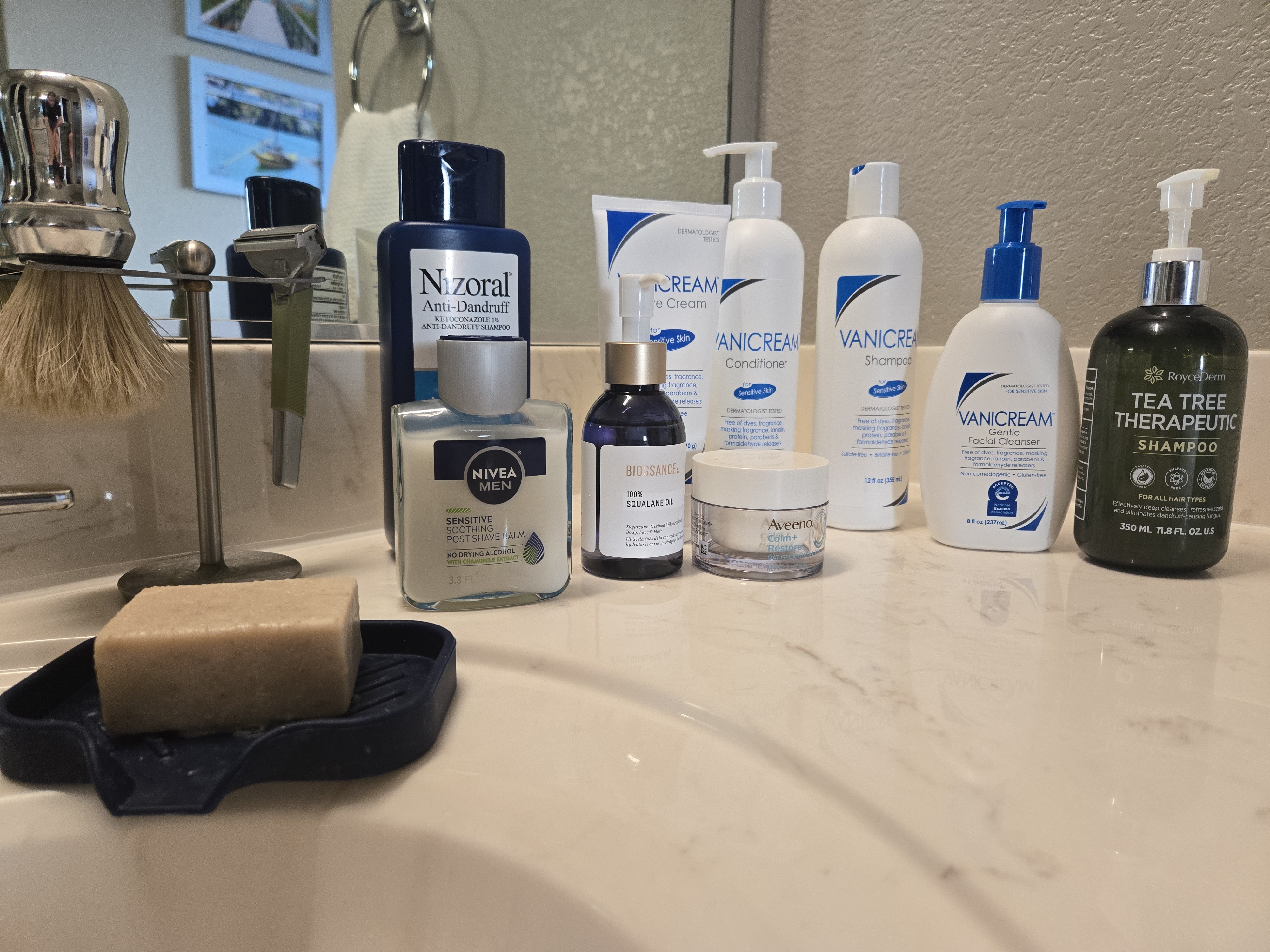
For daily washing, Vanicream's Gentle Facial Cleanser is completely soap-free, oil-free, and about as neutral as a cleanser gets. For active treatment, a 2% pyrithione-zinc bar soap with emu oil on flare days — the zinc does the actual work, and because it's rinsed off in under a minute rather than left on the skin, the oils in the bar don't have time to feed anything before they're gone.
For moisturizing, Aveeno's Calm + Restore Oat Gel — same calming oatmeal I'd trusted before, just on a gel base instead of a heavier cream.
For hair, the rotation ended up three-deep: Nizoral's 1% ketoconazole shampoo — the classic Fresh Scent version, not the peppermint one — went in alongside the RoyceDerm Tea Tree Antifungal Shampoo, with a fragrance-free Vanicream shampoo and conditioner set for the gentler days in between. The old conditioner got dropped entirely. Rotating between a medical-grade active and a botanical one, rather than leaning on just one, turned out to matter — using the exact same anti-fungal every single day is reportedly how the yeast eventually adapts to it. Nizoral also ended up replacing "Flakes," a shampoo that worked great but wasn't sustainable to keep buying at its price point — same ketoconazole, same effect, a fraction of the cost in the 14oz size.
Shaving needed its own fix, on both ends. Vanicream's Shave Cream is genuinely a good, fungal-safe product — I'm just not a fan of it in practice. It's thick enough to clog my razor and force extra passes I don't need. What worked better, almost by accident, was using the Vanicream Facial Cleanser itself as a shave base — thin, slick, zero clog, and it does the same fungal-safe job. In place of my old homemade oil, 100% pure squalane gives the same softening without anything for the yeast to digest.
The aftershave balm I'd used for years — Brickell — had to go too. It leans on coconut oil and shea butter for that classic post-shave feel, which is exactly the wrong feel to chase here. Nivea Men Sensitive Post Shave Balm replaced it, and it turned out to be a genuine upgrade rather than just a safer compromise — it's built around an ingredient called piroctone olamine, which is itself a mild anti-fungal. So instead of just avoiding feeding the yeast, the aftershave is quietly working against it every time I use it.
A Stress Test I Didn't Choose
The timing turned out to be brutal in an unrelated way: right as I was settling into this new routine, I had eyelid and brow-lift surgery, which meant fresh incisions and dissolvable sutures sitting in exactly the area that flares worst. No rubbing, no scrubbing, but the dermatologist still wanted the area washed. That forced a slower, gentler version of the same routine — lather in the hands, pat instead of rub, tilt back to rinse rather than wipe — and it held up. If anything, it proved the routine wasn't depending on aggressive scrubbing to work in the first place. The yeast was never something I needed to scrape off. It just needed to stop being fed.
Where It Stands Now
It's been seven years of treating this as something to manage rather than something with an actual cause. A few weeks into the rebuilt routine, both the dandruff and the dermatitis are fully under control — the redness is gone, and I can wear dark shirts and a sport coat again without looking like I just walked in out of a snowstorm.
If a "gentle, natural" routine has ever quietly stopped working the longer you used it, that's worth a second look at what's actually in the bottle — not just what's missing from it.