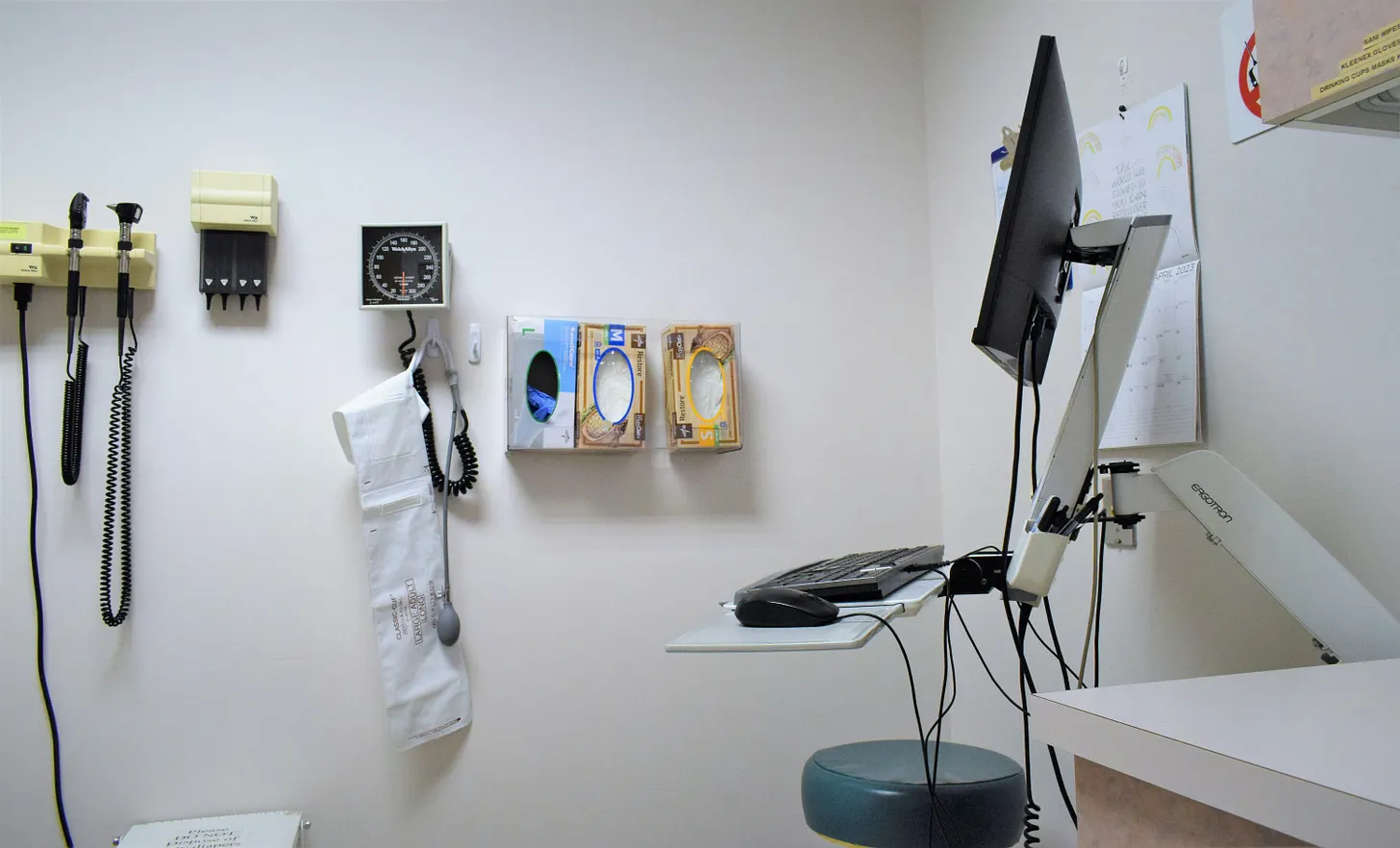

A surgeon, a committee I never met, and a blood pressure spike the day after that made the whole conversation feel a lot less theoretical.
Originally published on Substack. Imported to My Ledger as part of the adrenal journey series.
If you’re just finding this series, Chapter 1 has the full story of how I got here. The long and short of it: fifteen years of “unrelated” diagnoses — high blood pressure, type 2 diabetes, cataracts decades early, a body that ran hot and cold at the wrong times — that turned out to share one cause nobody ever stepped back far enough to look for. That push eventually led to imaging, which found something concrete: masses on both of my adrenal glands. That’s where Chapter One ends.
On August 14th, I sat down with an endocrine surgeon at UT Southwestern in Dallas to talk about those two masses. It wasn’t a long appointment. It was long enough.
The options were roughly what I’d already suspected, once I’d done enough reading to know what to suspect. Do adrenal vein sampling — AVS — to find out if one gland is overproducing cortisol on its own. If it is, deal with that one and see if the other one wakes back up. If it isn’t that clean, there’s medication to blunt the impact of the excess cortisol. And if none of that works, there’s the option nobody wants to say first: take both glands out.
A fair number of my questions got redirected — “that’s really a question for your medical endocrinologist or PCP” — and when I brought up some frustrations with my current endocrinologist, I got politely shut down. I understand why. She wasn’t going to step outside her lane or take a swing at another physician’s judgment, and honestly, I’d rather have a surgeon with that kind of professional discipline than one who doesn’t.
Here’s the part that actually surprised me. She mentioned that later that same afternoon, UTSW was holding an adrenal multidisciplinary conference — endocrinologists, endocrine surgeons, and endocrine radiologists in one room, going through cases together. Mine would be one of them. I left that appointment oddly happy about it. After fifteen years of individual doctors treating individual pieces of me one at a time, the idea of a room full of specialists looking at the whole picture at once, together, in real time, was the first thing in this entire process that felt like the system working the way I’d always wished it would.
That evening, I got a message from the surgeon. The committee had made a decision. Here’s the note, as written:
Endocrine Surgery Staff — Adrenal Multi Disciplinary Conference discussion
Case reviewed today with medical endocrinology, radiology and surgery. Labs reviewed. Agree with diagnosis of hypercortisolism. Imaging reviewed. Agree with bilateral discrete adrenal nodules, however the right side has a lower non contrast HU than the left. This may suggest different potential benign etiologies.
Recommendation from group was to proceed with adrenal vein sampling with dexamethasone suppression. Will place IR referral.
Recommendation was in agreement with med endo assessment here at UTSW, as well as consideration of trial of medical therapy after AVS to clarify the subjective symptoms as caused by cortisol, vs surgery as debulking option.
Translated: do the sampling first, figure out which gland is actually the problem, and possibly try medication before anyone commits to surgery. I was relieved. Bilateral adrenalectomy — taking both glands — was on the table as a possibility, and that’s not a small thing to live with. I did make one thing clear to the team, though: if the medication route comes with known liver toxicity, I’d rather have the surgery than add liver disease on top of everything already stacked up. I’d rather lose the glands than gain a second problem while trying to manage the first one.
I also left with a referral to a medical endocrinologist at UTSW — apparently, the only way to get in the door with one there is through a referral like this, not by calling and asking.
Five days later, on August 19th, I met her. An hour-long appointment — the longest I’ve had with any doctor in this entire process, without a prescription pad coming out in the first five minutes. She took a full history, asked real questions, and by the last fifteen minutes, I could tell she was watching the clock, which is a fair trade for the forty-five minutes that came before it.
Somewhere in that hour, she mentioned she’d been in the room for the August 14th conference — she was one of the specialists who’d already reviewed my case and voted on the recommendation before I ever sat down in front of her. It was a strange feeling, being met by someone who’d already seen me, in a sense, before she’d even met me. I’m still deciding how I feel about that. Mostly, I landed on grateful — it meant the first real conversation with my new endocrinologist wasn’t starting from zero, and that “the committee” from Chapter One’s ending wasn’t some faceless panel. At least one of them was about to become my doctor.
We talked about the liver toxicity question directly — she confirmed there are medication options without that risk, which was good to hear. She also told me something I hadn’t fully let myself sit with yet. These tumors have very likely been there for years, possibly decades, growing the entire time slowly and causing exactly the kind of scattered damage I wrote about in Chapter One. Fifteen years of “unrelated” problems, potentially explained by the same two things sitting quietly on my adrenal glands the whole time. She didn’t want to get into what life after a bilateral adrenalectomy would actually look like, not yet. Her reasoning: do the AVS first, see what it actually shows, and don’t spend energy worrying about a scenario that might not even happen. I appreciated that. It’s the same instinct I try to apply to a lot of things, just harder to follow when it’s your own body on the table.
Here’s the part that ties straight back to everything I wrote in Chapter One. When they took my blood pressure at the start of that appointment, it was 154 over 93 — high, and part of a trend that’s been climbing for a while now, even with medication, alongside breathlessness and a heart rate that doesn’t want to behave. It wasn’t checked again before I left. I forgot to bring it back up in the rush of the appointment ending. One more small thing that fell through a small gap, in a system built out of small gaps.
The next day made that gap feel a lot less abstract. Around 2:30 in the afternoon, my heart rate started climbing for no reason I could point to — not exercise, not stress I was aware of, nothing. At 4:29 p.m. I checked it: blood pressure 152 over 102, heart rate 112 beats per minute. It stayed elevated for just about a full six hours, peaking at 127 beats per minute at one point, before finally settling back to 127 over 86 around 8:30 that night. I sat with that for a while. Six hours is a long time for your own body to be doing something you didn’t ask it to do and can’t explain.
My new endocrinologist messaged me the next morning with real guidance, not a shrug: if most of my readings keep running above 140 systolic, we adjust the blood pressure medication. Below that, keep monitoring. Above 180 systolic, that’s not a monitor-it situation anymore — that’s go and get evaluated now.
I have an appointment with my primary care doctor next week. I haven’t needed to see her in two years, because the cardiologist has been handling blood pressure and cholesterol, and the endocrinologist has been handling — well, everything else, apparently, including things that turned out not to be “everything else” at all. Before that appointment next week, I have sent her every updated lab result, linked her access to my two main providers’ charts so they can actually see each other’s notes without me being the courier between them, and gave her an updated list of every medication and supplement I’m taking, with the schedule. Nobody assigned me that job. I gave it to myself, because I already know what happens when nobody has it.
Chapter Three is when the AVS results come back. Until then, I’m watching numbers on a blood pressure cuff more closely than I ever expected to, and trusting a committee I’ve never sat in a room with to get this right.