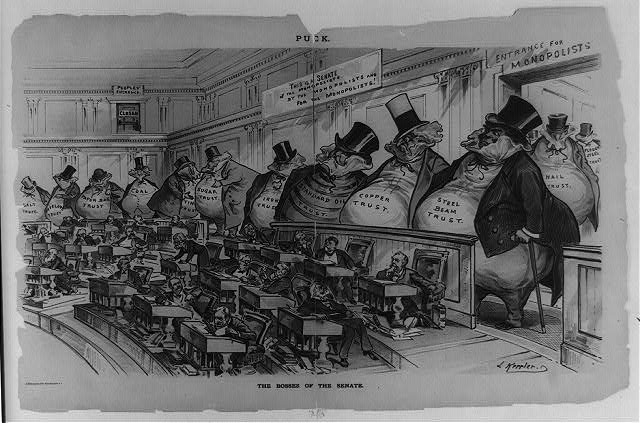

In 1952, a candidate filmed 40 TV ads in a single day. In 2026, Texas hosted the most expensive Senate race in American history. The megaphone keeps getting bigger, and the same two parties keep holding it.
📜 The Faction Files: How Two Parties Took Over America
Part 1: The Parasite and the Host
Part 2: The Founders Warned Us About Parties. Then They Built Them.
Part 7: The Megaphone (you are here)
This is My Ledger, the personal side of v64otd.com. This series is history first: what happened, with sources. Where I give my own opinion, it's marked.
Disclosure: I endorsed independent write-in candidate Jenn Mack for Texas governor and voted Libertarian in most of my other races this fall.
Independent expenditure: money spent to support or attack a candidate by a person or group that isn't supposed to coordinate with that candidate's campaign. Since 2010, there's no limit on how much can be spent this way, or on how much a donor can give to a group that does it.
Half a Billion Dollars for One Seat
If you live in Texas, you already know. You couldn't watch a ballgame, stream a show, check your cell phone, or open your mailbox this fall without someone telling you the other candidate was a danger to everything you love.
Before Election Day, at least $573.2 million had been poured into the U.S. Senate race between Democrat James Talarico and Republican Ken Paxton, according to Al Jazeera. That's the most expensive Senate race in American history. The candidates' own campaigns accounted for only part of it: Talarico raised about $155 million and Paxton about $40 million. The rest came from outside groups.
One man supplied a huge share. According to a New York Times analysis cited by Al Jazeera, Elon Musk put at least $212 million behind Paxton, including $168 million to the Senate Leadership Fund, the super PAC tied to Senate Republican leaders, and the Times said that was likely an undercount because of dark money. President Trump's MAGA Inc. spent at least $10 million for Paxton. On the other side, a pro-Talarico super PAC, Lone Star Rising, spent at least $21 million.
Remember what Musk said in July 2025, when he announced he was forming the America Party: "When it comes to bankrupting our country with waste & graft, we live in a one-party system, not a democracy." He even called the two parties a "uniparty." A month later, the Wall Street Journal reported he'd set the idea aside. A year after that, he was the biggest single funder in the most expensive race in the country, on behalf of one of the two parties.
Here's the part the money men don't want you to notice: the side with the bigger megaphone lost. As of early October, Paxton and his allies had outspent Talarico and his allies on advertising by more than two to one, about $175 million to $71 million, according to AdImpact figures reported by Houston Public Media. On November 3, Talarico won.
Editorial: I'm not celebrating either side here. I'm pointing out that half a billion dollars bought a lot of noise and very little light. One Texas voter told Al Jazeera, "That kind of money is being spent on the wrong stuff." Another said, "It's kind of scary." Almost none of it was spent telling Texans about any choice outside the two parties.
How We Got Here
Political advertising is as old as the republic. The pamphlets and party newspapers of the 1790s (Part 2) and the torchlight parades of the machine era (Part 3) were advertising. But television changed everything, and it changed it fast.
1952: The first TV campaign. Dwight Eisenhower's campaign hired Rosser Reeves, the advertising man behind the M&M's slogan "melts in your mouth, not in your hands." Reeves produced "Eisenhower Answers America," a series of short spots in which ordinary citizens asked questions and Eisenhower gave brief answers. According to the Wisconsin Historical Society, which holds Reeves's papers, the general filmed all 40 of his answers in a single day; the "citizens" were recruited near Radio City Music Hall and filmed separately. His opponent, Adlai Stevenson, refused to make spot ads, reportedly saying he wouldn't speak to an audience he couldn't see. Eisenhower won in a landslide. Candidates had become products, sold the same way as candy.
1964: The fear ad. On September 7, 1964, at 9:50 p.m., during NBC's Monday night movie, Lyndon Johnson's campaign ran an ad of a little girl counting the petals on a daisy, followed by a countdown and a nuclear explosion. It was made by the agency Doyle Dane Bernbach with sound designer Tony Schwartz. It never mentioned Barry Goldwater. It aired as a paid commercial exactly once, then news programs replayed it for free. Johnson won 486 electoral votes to 52. The lesson both parties took from the "Daisy" ad has lasted 60 years: fear works, and the news will rebroadcast it for you.
1971–1976: The rules, and the Court. After Watergate, Congress strengthened the Federal Election Campaign Act of 1971 with amendments in 1974 that limited both contributions and spending. In Buckley v. Valeo, decided January 30, 1976, the Supreme Court split the difference. It upheld limits on contributions and the requirement to disclose donors, but struck down limits on spending, reasoning that "virtually every means of communicating ideas in today's mass society requires the expenditure of money." That idea, that spending money on political speech is a form of speech, is the root of everything that followed.
1988: The outside group. The ad most people remember from the 1988 presidential race wasn't made by George H.W. Bush's campaign. The "Willie Horton" ad, which attacked Democrat Michael Dukakis over a Massachusetts prison furlough program, was produced by an independent group, the National Security Political Action Committee. It was widely condemned as racially charged; Bush denied that it was. The model was set: let an outside group run the ugliest ad, and the candidate keeps his hands clean.
2002: "I approved this message." The McCain-Feingold law, the Bipartisan Campaign Reform Act, signed March 27, 2002, banned unlimited "soft money" donations to the national parties and added the "Stand by Your Ad" rule: candidates have to appear in their own broadcast ads and say they approved them. The idea was that candidates would think twice about running a sleazy ad with their own face on it. The rule covers television and radio, not internet ads.
2004: Both sides find the loophole. If the parties couldn't take unlimited money, other groups could. In 2004, a group called Swift Boat Veterans for Truth spent about $22.6 million, attacking Democrat John Kerry's Vietnam record. On the Democratic side, MoveOn spent about $21.6 million. Both were "527" groups, named for a section of the tax code. The Federal Election Commission later fined both. By then, the election was long over.
2010 and after: The floodgates. As Part 6 explained, Citizens United v. FEC (January 2010) and SpeechNow.org v. FEC (March 2010) created the super PAC: a group that can raise and spend unlimited money as long as it doesn't officially coordinate with a candidate. In 2014, McCutcheon v. FEC struck down the overall cap on how much one donor could give to all candidates and parties combined. Nearly every limit the 1970s reformers built on the spending side is now gone.
Notice the pattern. Every step was taken by, or for, the two parties. Republicans pioneered the TV spot; Democrats perfected the fear ad. Republican-aligned groups ran the Horton and Swift Boat ads; Democratic-aligned groups ran their own. Both parties built super PACs the moment they were legal. The megaphone has always been passed back and forth between the same two hands.
The Rules on Your TV
Most people don't know that broadcast stations have to run some political ads they know are false.
Under Section 315 of the Communications Act of 1934, when a legally qualified candidate buys an ad on a broadcast station, the station can't censor it. Because the station can't change it, it also isn't legally responsible for what it says. As broadcast lawyer David Oxenford explains, "the broadcaster is not liable for the content of the candidate's ad."
Ads from outside groups, such as super PACs, are different. A station is free to accept or reject them based on their content, and because it has that choice, it can be liable if it keeps running a false ad after being told it's false. In practice, a station that receives a lawyer's letter about a super PAC ad faces a decision. The candidate's own ad, true or false, runs.
Candidates also get a discount. In the 45 days before a primary and the 60 days before a general election, federal law entitles candidates to the station's "lowest unit charge," the best rate it gives its most favored commercial advertisers. Super PACs don't get that rate. The rule applies to every legally qualified candidate, including independents and third parties, which sounds fair until you remember that a discount on a $1 million ad buy doesn't help a candidate who can't raise $1 million.
The equal-time rule, and its exceptions. Section 315 also requires a station that gives or sells airtime to one candidate to offer equal opportunities to that candidate's opponents. But in 1959, Congress exempted bona fide newscasts, news interviews, news documentaries, and on-the-spot coverage of news events. In 1975, the Federal Communications Commission ruled that debates count as news events, and in 1984 it dropped the requirement that someone independent of the candidates sponsor them.
That's why a network can put the Democrat and the Republican on the evening news every night, interview them on Sunday morning, and host their debates, without owing the Libertarian or the independent a single second. The equal-time rule protects candidates who can buy ads. The news exemptions protect the networks' freedom to cover whomever they like, and as Part 6 showed, they like covering two.
This year, the rule came back in a strange way, and it involved a Texas candidate. In January 2026, the FCC's Media Bureau issued guidance stating it had found no evidence that any current late-night or daytime talk show interviews qualify for the news exemption. In February, CBS told Stephen Colbert it couldn't broadcast his interview with Talarico, who was then running in the Democratic primary, because airing it could trigger equal-time obligations to his primary opponents. Colbert posted the interview on YouTube instead, where broadcast rules don't apply.
Editorial: Notice which way that cuts. A rule written so stations treat every candidate fairly was used to keep one candidate off one show, and he got more attention for it, not less. Meanwhile, the news exemptions still let every network ignore third-party and independent candidates entirely. Neither party has asked to change that.
The Record: $11.21 Billion
The 2025–26 election cycle set a record for political advertising: $11.21 billion, according to AdImpact, which tracks political ad spending. That's more than the $8.9 billion spent in the 2022 midterms, and slightly more than the $11.20 billion spent in 2024, a presidential year. In the third quarter, broadcast TV took about 51% of the money and streaming TV about 23%.
Think about who receives that money. About half of it goes to the same local TV stations whose newsrooms are supposed to cover the campaigns objectively. Political advertising is one of the biggest paydays in local broadcasting, and the record gets broken again nearly every cycle.
The new frontier: AI. According to the Wesleyan Media Project, which tracks campaign ads, an estimated $137 million or more was spent this cycle airing ads made at least partly with artificial intelligence, in at least 220 ads across 34 states. Republican sponsors accounted for 81% of those ads and 88% of the spending. Only 27% of the ads disclosed that AI was used.
Texas was ahead of this one. In 2019, the Legislature passed Senate Bill 751, which made it a Class A misdemeanor to create a "deep fake video" intended to injure a candidate or influence an election and publish it within 30 days of the election. Texas was the first state to pass such a law. It covers video, though, and only the last 30 days, and AI tools have come a long way since 2019.
What $573 Million Bought
Here's a taste of what Texans got for the most expensive Senate race in history.
In late May, right after Paxton won the Republican runoff, his campaign launched a general-election ad calling Talarico "radical" and "too low-T for Texas." The Club for Growth, a conservative group, ran an ad calling him a "crazy person." In his victory speech, Paxton called his opponent "Tofu Talarico" and "Six-Gender Jimmy." Talarico's campaign answered with "Meet Ken Paxton," a digital ad focused on Paxton's impeachment and felony fraud charges, featuring a mug shot that fills the screen. (For the record: the Texas Senate acquitted Paxton in his 2023 impeachment trial, and his securities fraud case ended in a pretrial agreement in 2024.) A super PAC tied to Senate Republican leaders, called Texas PAC, had spent $131 million by October 1, much of it on ads featuring a clip of Talarico saying "defending trans Texans is something we have to do every day."
You can agree or disagree with any of those attacks. My point is that very little of the half-billion dollars went to explaining what either man would actually do about the cost of living, the war, Social Security, or the debt. A University of Houston communications professor told Houston Public Media he had never seen a Senate race reach the point where it felt like a presidential campaign. The ads were inescapable, and they were mostly fear.
Editorial: That's not an accident. As Part 1 explained, the two parties don't have to make you love them. They only have to make you more afraid of the other one. Fear ads are easy to make, easy to remember, and they work on the voters both parties care about most: the ones who might stay home. The Daisy ad taught that lesson in 1964, and the parties have been running the same play ever since.
Close to Home
The money doesn’t only flow to Senate races. In my October 27 Dispatch, I wrote about a super PAC funded entirely by one Louisiana donor, with close to $1 million in contributions, that mailed voters in Speaker Mike Johnson’s district a postcard claiming he had a “secret plan” to “reduce or eliminate” Social Security. I couldn’t find him saying it. Before 2010, that kind of one-donor campaign was much harder to run.
Texas has its own version, and it’s legal. Texas is one of 11 states with no limit on how much an individual can give to a candidate for state office. Gov. Greg Abbott has made the most of it. By 2019, he had raised more than any governor in American history, according to an Associated Press review, and by 2022 his total had reached $348 million, adjusted for inflation, according to the Texas Tribune. Thirty-nine donors gave him more than $1 million each, together supplying over a quarter of his money.
The money opens doors. About 70% of Abbott’s appointees to the Texas Higher Education Coordinating Board and university boards of regents, or their spouses, were donors, according to the Tribune. His biggest donor, Midland oilman Javaid Anwar, had given $6.3 million by 2022, and Abbott appointed him to the Higher Education Coordinating Board. None of that breaks a law. That’s the problem. And come January, the same no-limits system belongs to Governor-elect Gina Hinojosa. Watch whether she proposes to change it.
You can see the same money in your own mailbox. Mine was full of glossy postcards for state and local races in October, most of them telling me what to fear rather than what anyone would do. If you want to know who paid for one, the “paid for by” line is the place to start. For federal races, you can look the group up on the FEC’s website or OpenSecrets. For Texas state races, campaign finance reports are filed with the Texas Ethics Commission. If the name on the mailer leads to another group with a patriotic-sounding name and no donors you recognize, that’s dark money doing its job.
The Press: Referee or Player?
Advertising is the megaphone campaigns buy. News coverage is the one they get for free. So is the press a fair referee?
Who's in the newsroom? In a 2022 survey of about 1,600 American journalists by Syracuse University's Newhouse School, 36.4% identified as Democrats and just 3.4% as Republicans. Most of the rest, 51.7%, called themselves independents. A newsroom where Democrats outnumber Republicans by more than 10 to 1 doesn't have to conspire to tilt its coverage. It only has to share assumptions about what counts as normal.
How they cover presidents. Researchers at Harvard's Shorenstein Center, led by Thomas Patterson, found that news coverage of President Trump's first 100 days in 2017 was 80% negative. They also found that coverage of Barack Obama's first 100 days was 41% negative, and that coverage of Bill Clinton and George W. Bush in their first 100 days was about 60% negative. Patterson concluded that the press's real bias is "a preference for the negative." Both things are true at once: the press is hard on every president, and it was much harder on one party's president than the other's.
Who trusts them? In 2025, Gallup found that only 28% of Americans trust the mass media "a great deal" or "a fair amount," a record low. That includes just 8% of Republicans, 27% of independents, and 51% of Democrats.
The bigger problem. Here's where I'd push the usual complaint further. The press isn't only tilted toward one party. It's built around both. Coverage is organized as a two-team contest: who's up, who's down, which side won the week. Conservative outlets do this as much as liberal ones; they just root for the other team. As Part 6 showed, in 2016 the network evening newscasts gave Trump and Clinton 2,793 minutes and Libertarian Gary Johnson 11 seconds.
You will find voices for smaller government and more freedom in the press: the Wall Street Journal editorial page, Reason, National Review, and others. But you'll rarely find a major outlet treating independent and third-party candidates as serious contenders, or treating the two-party system itself as a story worth covering. The referee and the players are on the same field, and the referee's station is cashing the players' ad checks.
Editorial: In my experience, the national press celebrates when Democrats win and treats it as a crisis when Republicans do. That's a real problem, and the numbers above back it up. But if you're a conservative who thinks the fix is a press that cheers for your team instead, you're asking for the same disease with a different fever. What we need is a press that holds whoever has power to their promises and tells voters about all their choices, not just two. (In Part 8, I'll compare how the press covered this year's Democratic wave with how it covered the Republican waves of 2010 and 2014.)
The Other Side
To be fair, not everyone who cares about liberty thinks the answer is more rules. The American Civil Liberties Union has argued that the answer to money in politics "must be consistent with our constitutional commitment to freedom of speech and association," and that "it is not the role of the government" to decide which political speech is legitimate. Many libertarians agree: people don't give up their right to speak when they pool their money, and a government that can limit spending on political ads can limit spending on political books and films too. Citizens United itself began as a fight over whether a nonprofit could promote a documentary about Hillary Clinton.
I take that argument seriously. I don't want the government deciding who's allowed to talk about an election, and I especially don't want the two parties writing rules about speech, since we've seen in every part of this series what rules they write. But even the ACLU supports disclosure, and so did the Supreme Court in Citizens United. The free-speech case is about who can speak. It isn't a case for hiding who's speaking.
What Would Actually Help
1. Real-time disclosure. Every ad, mailer, and digital post paid for by an outside group should show its top donors- the real people or companies, not another committee's name- and the group should report them before the election, not after. Pop-up super PACs formed weeks before an election should report as fast as they spend.
2. Stand by Your Ad for every screen. The 2002 rule covers broadcast ads. Extend it to streaming and digital ads, where a growing share of the money now goes.
3. Label AI. If an ad uses AI to create or alter a person's image or voice, say so on-screen every time, for the entire campaign, not just the last 30 days.
4. Open the news exemption. Networks that use the public airwaves and claim the news exemption should have to include every candidate on the ballot in at least some of their coverage, or explain why not. At minimum, lower the debate threshold, as Part 6 argued.
5. Turn down the volume yourself. Every time an ad makes you afraid, ask three questions: who paid for this, what are they not telling me, and what is this candidate for? Then look up every name on your ballot, including the ones nobody bought an ad for.
Discussion Questions for the Comments
• Paxton's side outspent Talarico's on ads by more than two to one, and Paxton lost. Do political ads still work, or have voters tuned them out?
• Should broadcast stations be required to run a candidate's ad even if they know it's false?
• Elon Musk called the two parties a "uniparty," then spent at least $212 million on one of them. What does that tell you?
• Is a newsroom with 10 Democrats for every Republican a problem, even if every reporter tries to be fair?
• If money is speech, is hiding who's paying for it also speech?
What's the most misleading political ad or mailer you saw this year, from either party?
📜 The Faction Files: How Two Parties Took Over America
Part 1: The Parasite and the Host
Part 2: The Founders Warned Us About Parties. Then They Built Them.
Part 7: The Megaphone (you are here)
Sources
- Al Jazeera, “Texans vote in most expensive Senate race in US history,” Nov. 3, 2026: https://www.aljazeera.com/news/2026/11/3/texans-vote-in-most-expensive-senate-race-in-us-history
- ITV News, “Elon Musk to form new political party after fallout with Donald Trump,” July 6, 2025: https://www.itv.com/news/2025-07-06/elon-musk-to-form-new-political-party-after-fallout-with-donald-trump
- Washington Times, “Elon Musk pauses third-party plan: report,” Aug. 20, 2025: https://m.washingtontimes.com/news/2025/aug/20/elon-musk-pauses-third-party-plan-report/
- Houston Public Media via Texas Public Radio, “Texas Senate race shatters state’s campaign spending record,” Oct. 5, 2026: https://www.tpr.org/2026-10-05/texas-senate-race-shatters-states-campaign-spending-record
- Wisconsin Historical Society, “From M&M’s to Presidential Candidates: The Origins of Presidential Campaign TV Commercials”: https://wisconsinhistory.org/Records/Article/CS3475
- Wikipedia, “Daisy (advertisement)”: https://en.wikipedia.org/wiki/Daisy_(advertisement)
- Britannica, “Buckley v. Valeo”: https://www.britannica.com/event/Buckley-v-Valeo
- Wikipedia, “Buckley v. Valeo”: https://en.wikipedia.org/wiki/Buckley_v._Valeo
- EBSCO Research Starters, “Willie Horton Incident”: https://www.ebsco.com/research-starters/history/willie-horton-incident
- Wikipedia, “Stand By Your Ad”: https://en.wikipedia.org/wiki/Stand_By_Your_Ad
- Wikipedia, “527 organization”: https://en.wikipedia.org/wiki/527_organization
- Wikipedia, “Citizens United v. FEC”: https://en.wikipedia.org/wiki/Citizens_United_v._FEC
- Wikipedia, “McCutcheon v. FEC”: https://en.wikipedia.org/wiki/McCutcheon_v._FEC
- David Oxenford, Broadcast Law Blog, “What’s a Broadcaster to Do When a Candidate Complains About the Truth of an Attack Ad?,” Oct. 7, 2014: https://www.broadcastlawblog.com/2014/10/articles/whats-a-broadcaster-to-do-when-a-candidate-complains-about-the-truth-of-an-attack-ad-dealing-with-ads-from-non-candidate-third-party-organizations/
- Free Speech Center at Middle Tennessee State University, “Equal Time Rule”: https://firstamendment.mtsu.edu/article/equal-time-rule/
- FCC Media Bureau, guidance on the equal opportunities requirement for broadcast television (DA 26-68), Jan. 21, 2026: https://docs.fcc.gov/public/attachments/DA-26-68A1.txt
- AlterNet, “Stephen Colbert was right” (CBS and the Talarico interview), 2026: https://www.alternet.org/amp/stephen-colbert-was-right-2675293228
- TheWrap, “Midterm Political Ad Spending Hits Record $11.21 Billion,” Oct. 27, 2026: https://thewrap.com/media-platforms/politics/midterm-elections-political-ad-spending-record-2026/
- Wesleyan Media Project estimate via Magica, “AI-assisted midterm ads draw more than $137 million,” Oct. 2026: https://magica.com/news/wesleyan-ai-midterm-ad-spending-137-million
- TCPAWorld, “Texas Did It First: Texas Was the First to Enact State Legislation on the Use of Deep Fakes in Elections,” May 28, 2024: https://tcpaworld.com/2024/05/28/texas-did-it-first-texas-was-the-first-to-enact-state-legislation-on-the-use-of-deep-fakes-in-elections/
- Texas Tribune, “James Talarico, Ken Paxton launch attack ads in Texas U.S. Senate race,” May 27, 2026: https://www.texastribune.org/2026/05/27/james-talarico-ken-paxton-launch-attack-ads-in-texas-u-s-senate-race/
- Texas Tribune, Gabby Birenbaum, on outside spending in the Texas Senate race, Oct. 1, 2026: https://www.texastribune.org/2026/10/01/texas-senate-gop-outside-spending-ken-paxton-thune-trump-talarico/
- V64OTD, “Neither Party Is Saving Social Security. Both Are Using It to Scare You.,” Oct. 27, 2026: https://v64otd.com/dispatch/social-security-uniparty-fear-2032-cut/
- Washington Times, “Only 3.4% of U.S. journalists are Republicans: survey,” Dec. 30, 2023 (Syracuse University Newhouse School survey): https://m.washingtontimes.com/news/2023/dec/30/only-34-us-journalists-are-republicans-survey/
- NPR, “In A President’s First 100 Days, The News Is Rarely Good,” May 27, 2017: https://www.npr.org/2017/05/27/530337213/in-a-presidents-first-100-days-the-news-is-rarely-good
- Axios, “Media trust hits new low across the political spectrum,” Oct. 2, 2025: https://www.axios.com/2025/10/02/media-trust-new-low
- Washington Examiner, “Rigged: 3rd-party candidates get almost no TV news coverage, study says,” Sept. 6, 2016 (Media Research Center study): https://www.washingtonexaminer.com/?p=170463
- ACLU, “The ACLU and Citizens United,” March 27, 2012: https://www.aclu.org/documents/aclu-and-citizens-united
- Texas Tribune, “In Texas, where money has long dominated politics, Greg Abbott is in a league of his own,” Oct. 18, 2022: https://www.texastribune.org/2022/10/18/greg-abbott-texas-fundraising-governor-donors/
- Texas Standard, “Greg Abbott Has Raised More Campaign Cash Than Any Governor In US History,” Feb. 26, 2019: https://texasstandard.org/stories/greg-abbott-has-raised-more-campaign-cash-than-any-governor-in-us-history/