
Did giving women the vote damage American politics? The numbers say no. Turnout was already falling before 1920, and women now vote at higher rates than men. The real damage came from the people who decided who was allowed to vote at all, and in Texas, a party that claimed the right to decide for itself.
📜 The Faction Files: How Two Parties Took Over America
Part 1: The Parasite and the Host
Part 2: The Founders Warned Us About Parties. Then They Built Them.
Part 5: Suffrage and the Vote (you are here)
Part 6: The Lockdown (coming soon)
Part 7: The Megaphone (coming soon)
Part 8: The Promise and the Mirror (coming soon)
This is My Ledger, the personal side of v64otd.com. This series is history first: what happened, with sources. Where I give my own opinion, it's marked.
Suffrage: the right to vote. "Universal suffrage" means every adult citizen can vote, something the United States didn't fully have until the 1960s.
The Question
When I started this series, one of my questions was whether the women's suffrage movement damaged things. It's a question you hear from time to time, usually tied to the idea that women vote more on emotion than reason, and that once they could vote, the country drifted toward the modern liberal: bigger government, more permissive, softer on everything. And there's a second question that goes with it. Women's groups pushed for Prohibition, which failed so badly it had to be repealed. Does that tell us anything about what could happen if the Libertarians ever got their way?
Those are fair questions, so I went looking at the record. Some of what I found backed up the hunch. Some of it turned it upside down.
What the Turnout Numbers Show
The 19th Amendment was ratified on August 18, 1920, and women across the country voted for president for the first time that November. Turnout that year dropped to 49%, from 62% in 1916, according to the American Presidency Project.
At first glance, that looks like evidence that suffrage hurt participation. But look at the whole trend:
• 1896: 79%
• 1904: 65%
• 1912: 59%
• 1916: 62%
• 1920: 49%
Turnout had already fallen 17 points in the 20 years before women could vote nationally. As we saw in Part 4, the causes were registration laws, weaker party organizations, and Southern disfranchisement, not women.
And the 1920s drop has a simple mechanical explanation. Overnight, millions of newly eligible voters were added to the count. Many of them had never voted, had no habit of voting, and in some states faced pressure not to. Researchers who have studied the 1920s, including political scientists J. Kevin Corder and Christina Wolbrecht, found that women in those first elections generally turned out at lower rates than men, with large differences across states. In Corder's words, women's turnout in presidential elections "lags men's by a considerable margin after suffrage."
Texas got there early. Texas women won the right to vote in party primaries in 1918, which in the one-party Texas of that era was the election that mattered. On June 28, 1919, Texas became the first Southern state to ratify the 19th Amendment. That came just weeks after Texas's male voters, in May 1919, had rejected a state constitutional amendment to give women the vote.
That gap didn't last. According to the Center for American Women and Politics at Rutgers, women have voted at higher rates than men in every presidential election since 1980.
The "Women's Bloc" That Never Was
Politicians in the 1920s were nervous. They didn't know how women would vote, and many feared women would vote as a bloc or stay away from the major parties. That fear helped push Congress to pass the Sheppard-Towner Act in 1921, which funded maternal and infant health programs that women's groups had lobbied for.
Corder and Wolbrecht's research points to the reason the feared bloc never took over: there was no single "woman voter." Wolbrecht has said the stereotype "ignored working-class women, Black women, Native women and immigrant women." Women voted much like the men around them, divided by region, class, and party.
Editorial: So did suffrage damage things? On the evidence, no. Women didn't create the two-party system, didn't cause the turnout collapse, and didn't vote as a single faction. If anything, the fear that they might shows how much the parties have always worried about losing control of a bloc of voters.
Did Women Create the Modern Liberal?
Start with how women actually voted. For the first 40 years after suffrage, women didn't vote more liberal than men. They voted more Republican. Women gave strong support to Herbert Hoover in 1928. In 1952, women were about 5 points more likely than men to vote for Dwight Eisenhower, and in 1956 about 6 points more likely. Women didn't lean more Democratic than men until 1964, and the gap didn't get big until 1980, after the two parties had switched sides on the women's issues of the 1960s and 1970s.
So the modern liberal wasn't born in 1920. Its founders, from Woodrow Wilson and Theodore Roosevelt (Part 4) to Franklin Roosevelt, were elected by electorates that were mostly or entirely male, and the women who voted after 1920 were, if anything, a little more conservative than their husbands.
Today's gap is real, but it's as much about marriage as about sex. In 2024, according to CNN's exit poll, married voters backed Donald Trump by 11 points, and unmarried voters backed Kamala Harris by 14 points. Political scientists mostly explain the gender gap with things like marriage, income, religion, and which issues voters rank first. Men and women both vote on emotion; that's why the fear ads in Part 7 work on everybody.
Where the hunch holds up: the size of government. In 1999, economists John Lott and Lawrence Kenny published a study in the Journal of Political Economy asking whether women's suffrage changed the size and scope of government. They found that suffrage coincided with immediate increases in state government spending and revenue, and with more liberal voting by those states' members of Congress, and that the effects grew over time as more women voted. Lott is a conservative economist, best known for his research on guns, so this isn't a finding from the left. The Sheppard-Towner Act of 1921 is an early example: Congress funded new federal health programs partly out of fear of what women voters might do.
Editorial: So here's my honest answer. Women's votes did help grow government, by about the amount you'd expect when a large group of voters who see government differently is added to the rolls. But they didn't invent the modern liberal; they didn't vote on emotion any more than men do, and for 40 years they were the more Republican half of the electorate. The growth of government had plenty of fathers.
Prohibition: Who Passed It, and Who Repealed It
Women's groups were at the heart of the temperance movement. The Woman's Christian Temperance Union fought saloons for decades. But the group that actually won Prohibition was the Anti-Saloon League, led by Wayne Wheeler, which turned it into a single-issue machine that rewarded and punished politicians of both parties.
And here's the date that matters: the 18th Amendment was ratified on January 16, 1919. The 19th Amendment, giving women the vote nationwide, wasn't ratified until August 1920. In most states, Prohibition was written into the Constitution by men: male voters and male legislators.
Then women led the repeal. In 1929, Pauline Sabin, a wealthy New York Republican, founded the Women's Organization for National Prohibition Reform. Within two years it had nearly 1.5 million members, about three times as many as the WCTU. Her reasons sound like a conservative's today. She saw politicians vote dry and drink wet. She saw bootleggers getting rich and respected. And she worried about the next generation: "children are growing up with a total lack of respect for the Constitution and for the law." The 21st Amendment repealed Prohibition on December 5, 1933.
What Prohibition teaches about Libertarians. Prohibition wasn't permissive. It was the opposite: the federal government banning something millions of people wanted, and creating the black market, the gangsters, and the corruption that came with it. That's why Prohibition is usually the libertarian's favorite example, not the libertarian's warning.
Look at what repeal produced. Not a free-for-all, but legal alcohol that is licensed, taxed, age-limited, and regulated by the states, with local voters deciding whether to allow sales at all. Texas still lets them decide. That's very close to what I've proposed for marijuana: decriminalize it, tax it, sell it in liquor stores, keep DUI laws in force, treat addiction as an illness, and keep busting dealers.
If you want a real warning about going too far, look at Oregon. In 2020, Oregon voters passed Measure 110, which decriminalized possession of small amounts of hard drugs such as heroin, methamphetamine, and cocaine and shifted the focus to treatment. Public drug use and overdoses became a major issue, and in 2024 the Legislature passed House Bill 4002, which made possession a crime again starting September 1, 2024. Supporters of the change said police needed more tools than treatment referrals.
Editorial: That's why full legalization of hard drugs is a non-starter for me, even though I vote Libertarian in most races. Prohibition shows that banning what millions of people want creates crime. Oregon shows that removing the consequences for the hardest drugs creates a different kind of disorder. The lesson of both is the same one this series keeps coming back to: neither total control nor total permission works. Liberty needs laws, and laws need limits.
The Real Damage: Deciding Who Gets to Vote
If you want to see where the vote really was damaged, look at who was kept from casting it.
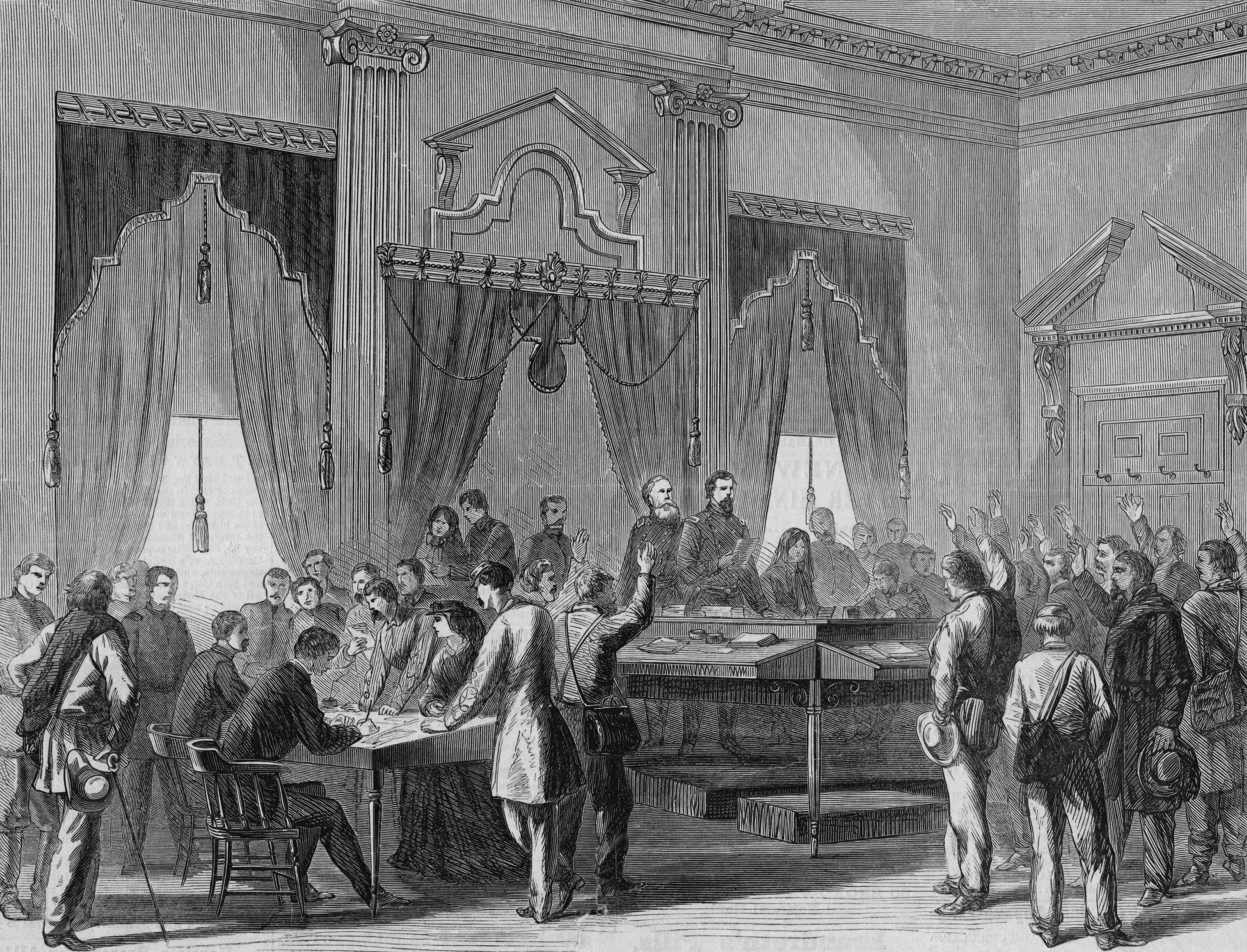
The oath. After the Civil War, on May 29, 1865, President Andrew Johnson offered most former Confederates a pardon and the return of their property, except slaves, if they took an oath to support the Constitution and the Union and to abide by the laws on emancipation. The engraving at the top of this article shows former Confederate soldiers taking that oath in the old Senate chamber in Richmond, sketched for Harper's Weekly in June 1865. Getting back a full place in American political life started with a promise of loyalty to the Constitution.
The promise to Black Americans. The 15th Amendment, ratified in 1870, barred states from denying the vote on the basis of race. For a few decades, Black men voted and held office across the South. In Texas, more Black than white residents voted in the 1868 referendum on calling a constitutional convention, and the Twelfth Legislature that met in 1870 included Black lawmakers such as state Sen. Matthew Gaines and Sen. George T. Ruby, along with a dozen Black representatives.
The takeback. Then Southern states rewrote their constitutions to take that vote away without saying so. They used poll taxes, literacy tests, and "grandfather clauses" that exempted white voters whose ancestors had been able to vote. The numbers are stark. In Louisiana, registered Black voters fell from 130,344 in 1896 to 1,342 in 1904, after the state's 1898 constitution. By 1940, there were 897.
Texas used its own version. Voters approved a poll tax in 1902, and it took effect for the 1903 elections. Paying to vote stayed the law in Texas until 1966, when the U.S. Supreme Court struck down poll taxes in state elections. Texas formally repealed its poll tax the next year.
Fear Was the Weapon
The poll taxes and literacy tests were the paperwork. Fear was the engine.
Wilmington, 1898. The clearest example happened in North Carolina. In 1898, Democrats there ran what they openly called a "white supremacy" campaign against a governing alliance of Republicans and Populists, white and Black. Newspapers such as the Raleigh News and Observer, edited by Josephus Daniels, ran false and inflammatory stories about Black men threatening white women, with racist cartoons to match. A white militia called the Red Shirts rode through Black neighborhoods to keep voters home. Two days after the election, on November 10, an armed mob in Wilmington forced the city's elected officials, white and Black, to resign at gunpoint, burned the Black-owned newspaper, and killed as many as 60 Black residents, according to a state commission's 2006 report. It's often called the only successful coup in American history. North Carolina had 126,000 registered Black voters in 1896. By 1902, it had 6,100.
Both parties walked away. It's tempting to tell this as a story of one party, and Southern Democrats did build Jim Crow. But Republicans abandoned Black voters too. In 1877, the Republican administration of Rutherford B. Hayes withdrew the last federal troops from the South, ending Reconstruction. Then came the "Lily-White" movement inside the Republican Party, a push by white Republicans to drive Black members out of party leadership. It started in Texas. Norris Wright Cuney, a Black dockworkers' leader from Galveston, chaired the Texas Republican Party in the late 1880s and early 1890s, when Black Texans made up about 90% of the party's members, and he coined the term "Lily-White." Within a generation, Republican presidents such as William Howard Taft and Herbert Hoover were courting white Southerners by pushing Black Republicans aside.
The suffragists used fear too. The women's movement wasn't immune. Suffrage leader Anna Howard Shaw complained that the 15th Amendment had made "former slaves the political masters of their former mistresses." At the 1903 national suffrage convention, Mississippi suffragist Belle Kearney argued that giving white women the vote would bring "immediate and durable white supremacy," because educated white women in the South outnumbered all illiterate voters combined. At the great 1913 suffrage parade in Washington, organizers asked Black women to march at the back so they wouldn't offend Southern delegates. Ida B. Wells refused: "Either I go with you or not at all." She waited for the parade to start and stepped into the all-white Chicago delegation. After 1920, most Black women in the South were kept from voting just as Black men were, and the National Woman's Party declined to fight it, calling it a "race issue," not a woman's issue.
When fear finally lost. It took televised violence of the 1960s to break the system. After the Voting Rights Act of 1965, Black voter registration in Mississippi rose from 6.7% in March 1965 to 59.8% in September 1967, according to the U.S. Commission on Civil Rights. In Alabama, it went from 19.3% to 51.6%. In Texas, which had already been forced to open its primaries in 1944, it rose from 53.1% to 61.6%.
Fear today, from both sides. The tools have changed, but fear is still how both parties turn out their voters on this issue. When Georgia passed its 2021 election law, President Biden said it "makes Jim Crow look like Jim Eagle," and critics called it "Jim Crow 2.0." In the 2022 primary, early voting more than doubled from 2018. On the other side, Republicans have warned for years about noncitizens voting. When Georgia's Republican secretary of state, Brad Raffensperger, ran the state's most thorough citizenship audit in 2024, he found 20 noncitizens among 8.2 million registered voters. Problems are worth fixing, but neither party's fear matched the numbers.
Editorial: That is the real story of American suffrage. The right to vote has never been threatened by the people who gained it. It has been threatened by the people who controlled the rules and decided who counted, and their favorite tool has always been fear. In 1898 it was fear of Black men. In 1903 some suffragists sold their own cause with fear of Black voters. Today each party tells its base the other side is stealing elections. As Part 7 shows, the megaphone has changed. The message hasn't.
Texas: When the Party Decided Who Could Vote
Texas provides the clearest example of how a political party used its control over the rules to decide who could vote.
For decades after Reconstruction, the South was a one-party region. The Republican Party was weak, so the Democratic primary was the only election that mattered. Whoever won it won the office.
• 1923: Texas passed a law barring Black voters from the Democratic primary.
• 1927: In Nixon v. Herndon, the U.S. Supreme Court struck that law down as a violation of equal protection.
• The workaround: Texas then let the party's executive committee set its own voter rules. The courts found that was still state action.
• 1935: Texas Democrats tried again, this time through a party convention rule. In Grovey v. Townsend, the Supreme Court held that the party was a private organization and could exclude whom it wished.
• 1944: Lonnie Smith, a Black dentist from Houston, sued after being turned away from the Democratic primary. Thurgood Marshall argued his case. In Smith v. Allwright, the Supreme Court ruled 8–1 that because the primary was part of the state's election process, the party's whites-only rule violated the 15th Amendment.
After that ruling, registered Black voters in the South rose from about 200,000 in 1940 to 800,000 in 1948.
Notice the argument Texas Democrats made for two decades: the party is a private club and can decide who participates. Remember from Part 4 that the Progressive-era primary had turned party nominations into official, taxpayer-run elections. The party wanted the authority of an official election without the obligations that come with one.
Editorial: That's the same tension behind every fight about primaries today. When a party wants to keep people out, it calls itself a private organization. When it wants the state to print its nominee on the ballot, run its primary, and keep independents off the ballot, it acts like part of the government. You can't have it both ways. In 1944, the Supreme Court said so, and it took a Houston dentist to make them.
When Universal Suffrage Finally Came
The country got there eventually, mostly in one decade:
• 1924: The Indian Citizenship Act made Native Americans U.S. citizens, but left voting to the states. Arizona and New Mexico kept barring Native Americans from voting until 1948, and Utah until 1957 on reservations.
• 1964: The 24th Amendment banned poll taxes in federal elections.
• 1965: The Voting Rights Act outlawed literacy tests and put federal oversight on states with a history of discrimination. (Arizona's literacy test, used against Native voters, wasn't fully barred until 1970.)
• 1966: The Supreme Court ended poll taxes in state elections, including Texas's.
• 1971: The 26th Amendment lowered the voting age to 18.
By the early 1970s, nearly every adult citizen could legally vote for the first time in American history.
What This Means for the Faction Files
Expanding the vote didn't break American politics. Every group that won the vote, from men without property to Black Americans, women, and 18-year-olds, made the electorate bigger and harder for any one faction to control.
What damaged things was factional control over the rules: parties and the legislatures they ran were deciding who could vote, how strict registration should be, and whether a primary was public or private. That same control over the rules is what Part 6 is about. The two parties no longer decide who can vote. But they still decide whom you get to vote for.
A Note on Images From This Era
If you go looking through the archives, you'll find plenty of campaign art from this period built on fear. One 1864 Democratic campaign cartoon, "How Free Ballot Is Protected!", used a racist caricature of a Black Union soldier to scare white voters away from Lincoln's party. Fear-based campaign material isn't new. The Wilmington cartoons of 1898 were its descendants, and the Texas and Louisiana mailers from this fall are too. Part 7 follows that line all the way to the $573 million Texas Senate race.
Discussion Questions for the Comments
• Women voted more Republican than men for 40 years after suffrage. Does that change how you think about the gender gap today?
• Prohibition was written into the Constitution before women could vote nationally, and a Republican woman led the repeal. Who deserves the blame and the credit?
• Is there a line between legalizing marijuana and decriminalizing hard drugs? Where would you draw it?
• Both parties used fear to keep people from voting, or to scare them into voting. What's the fear you hear most today?
• Is a political party a private club or part of the government? Can it be both?
• Who decides who gets on your ballot today, and do you trust them to be fair?
📜 The Faction Files: How Two Parties Took Over America
Part 1: The Parasite and the Host
Part 2: The Founders Warned Us About Parties. Then They Built Them.
Part 5: Suffrage and the Vote (you are here)
Part 6: The Lockdown (coming soon)
Part 7: The Megaphone (coming soon)
Part 8: The Promise and the Mirror (coming soon)
Sources
1. The American Presidency Project, UC Santa Barbara, "Voter Turnout in Presidential Elections": https://www.presidency.ucsb.edu/data/turnout.php
2. Washington University in St. Louis, "What came next" (on Wolbrecht and Corder's research), Aug. 17, 2020: https://source.washu.edu/2020/08/what-came-next/
3. Center for American Women and Politics, Rutgers, "Explore Data on Voters": https://cawp.rutgers.edu/data-voters
4. EBSCO Research Starters, "Sheppard-Towner Act": https://www.ebsco.com/research-starters/law/sheppard-towner-act/
5. Miller Center, Andrew Johnson, "Proclamation Pardoning Persons who Participated in the Rebellion," May 29, 1865: https://millercenter.org/the-presidency/presidential-speeches/may-29-1865-proclamation-pardoning-persons-who-participated
6. 64 Parishes, "Louisiana v. the Franchise": https://64parishes.org/louisiana-v-the-franchise
7. Wikipedia, "Smith v. Allwright": https://en.wikipedia.org/wiki/Smith_v._Allwright
8. Miller Center, University of Virginia, "Theodore Roosevelt: The American Franchise": https://millercenter.org/node/265
9. V64OTD, "The Faction Files, Part 4: The Progressives": https://v64otd.com/lifestyle/faction-files-part-4-the-progressives/
10. National Park Service, "Texas and the 19th Amendment": https://www.nps.gov/articles/texas-women-s-history.htm
11. Texapedia, "Poll tax history": https://texapedia.info/poll-tax-history/
12. KUNC/AP, "100 years ago, US citizenship for Native Americans came without voting rights in swing states," June 2024: https://www.kunc.org/news/2024-06-05/100-years-ago-us-citizenship-for-native-americans-came-without-voting-rights-in-swing-states
13. J. Kevin Corder, figures on women's turnout after suffrage: https://jkcorder.github.io/papers/aba_figures.pdf
14. Jo Freeman, "The Gender Gap" (women's voting, 1920s to 1980): https://jofreeman.com/polhistory/gendergap.htm
15. Daily Citizen (Focus on the Family), "2024 Election Recap: Marrieds Vastly Helped Trump Win," citing CNN exit polls: https://dailycitizen.focusonthefamily.com/2024-election-recap-marrieds-vastly-swayed-the-election/
16. John R. Lott Jr. and Lawrence W. Kenny, "Did Women's Suffrage Change the Size and Scope of Government?," Journal of Political Economy 107(6), Dec. 1999: https://ideas.repec.org/a/ucp/jpolec/v107y1999i6p1163-1198.html
17. National Constitution Center, "Happy birthday (kind of) to the 18th Amendment": https://constitutioncenter.org/blog/happy-birthday-kind-of-to-the-18th-amendment
18. Wikipedia, "Pauline Sabin": https://en.wikipedia.org/wiki/Pauline_Sabin
19. KDRV, "Oregon to recriminalize hard drug possession starting September 1," Aug. 2024: https://www.kdrv.com/news/oregon-to-recriminalize-hard-drug-possession-starting-september-1/article_7a3775cc-6344-11ef-9888-773da79fef8b.html
20. Exploros (Texas history), "African Americans and Politics": https://www.exploros.com/summary/African-Americans-and-Politics
21. Smithsonian Magazine, "When White Supremacists Staged the Only Successful Coup in U.S. History": https://www.smithsonianmag.com/history/when-white-supremacists-staged-the-only-successful-coup-in-us-history-180985400/
22. Wikipedia, "Lily-white movement": https://en.wikipedia.org/wiki/Lily-white_movement
23. Wikipedia, "Norris Wright Cuney": https://en.wikipedia.org/wiki/Norris_Wright_Cuney
24. History Matters (George Mason University), Belle Kearney, "The South and Woman Suffrage," 1903: https://historymatters.gmu.edu/d/5317
25. NBC News, "'For the future benefit of my whole race': Black women fought fiercely for the vote": https://www.nbcnewyork.com/news/national-international/for-the-future-benefit-of-my-whole-race-black-women-fought-fiercely-for-the-vote/4115398/
26. Economic Policy Institute chart, citing the U.S. Commission on Civil Rights, "Black voter registration in selected Southern states before and after the Voting Rights Act of 1965": https://www.epi.org/chart/freedom-to-vote-figure-a-black-voter-registration-in-selected-southern-states-before-and-after-the-voting-rights-act-of-1965/
27. Reason, "If Georgia's Election Law Was Supposed To Suppress the Vote, It Sure Did a Bad Job," May 25, 2022: https://reason.com/2022/05/25/if-georgias-election-law-was-supposed-to-suppress-the-vote-it-sure-did-a-bad-job/
Georgia Recorder via Alabama Reflector, "Georgia GOP secretary of state: Audit found 20 noncitizens registered to vote out of 8.2M," Oct. 24, 2024: https://alabamareflector.com/2024/10/24/georgia-gop-secretary-of-state-audit-found-20-noncitizens-registered-to-vote-out-of-8-2m/