
The Progressives set out to break the party bosses. They gave us the secret ballot, primaries and the direct election of senators. Along the way, they handed the two parties something the machines never had: the government's own power to decide who gets on the ballot.
📜 The Faction Files: How Two Parties Took Over America
Part 1: The Parasite and the Host
Part 2: The Founders Warned Us About Parties. Then They Built Them.
Part 4: The Progressives (you are here)
Part 6: The Lockdown (coming soon)
Part 7: The Megaphone (coming soon)
Part 8: The Promise and the Mirror (coming soon)
This is My Ledger, the personal side of v64otd.com. This series is history first: what happened, with sources. Where I give my own opinion, it's marked.
Progressive Era: roughly 1890 to 1920, when reformers in both parties set out to clean up corruption, rein in big business, and use expert government to solve social problems. Not to be confused with today's use of "progressive" as a label for the left.
The Reformers' Promise
At the end of Part 3, the machines were running American politics on bought votes, public ballots, and patronage jobs. The Progressives decided to break them.
They weren't one party. They were a movement that worked inside both. Republican Theodore Roosevelt and Republican Gov. Robert La Follette of Wisconsin were Progressives. So was Democrat Woodrow Wilson. Their reforms passed with support from both sides, which is part of why they lasted.
And many of those reforms were real improvements. But almost every one of them had a second effect the reformers either didn't see or didn't mind: each one moved power away from voters and parties as voluntary groups, and into state law, where the two big parties wrote the rules.
Reform 1: The Secret Ballot, and Who Gets on It
In Part 3, we saw how the secret ballot spread from 1888 to 1892, replacing the party-printed tickets that let bosses watch you vote. That was a genuine win for liberty.
But think about what changed. When parties printed their own ballots, anyone could print one. When the state printed a single official ballot, the state had to decide which parties and candidates were allowed on it. For the first time, getting on the ballot became a legal privilege granted by the government, which was run by the two major parties.
Historian Peter Argersinger documented how quickly they used it. In the 1890s, the Populists' best strategy was "fusion": a Populist and a Democrat, or a Populist and a Republican, would back the same candidate, listed on two party tickets. Republican-controlled legislatures in several states responded with "anti-fusion" laws written into the new official ballots, banning a candidate's name from appearing more than once. Argersinger concluded that the goal and the result were to destroy independent third parties. It worked. The Populists collapsed, as we saw in Part 3, and fusion has been illegal in most states ever since.
Editorial: This is the moment the two parties stopped needing to beat third parties at the polls. From here on, they could beat them in the statehouse, by writing the rules for who gets on the ballot in the first place.
Reform 2: The Primary
Robert La Follette's fight was with the party conventions, where bosses picked nominees behind closed doors. His answer was the direct primary: let voters pick the party's nominee instead. Wisconsin adopted the first statewide direct primary law on May 23, 1903, in what one history calls "a direct assault on the power of the party bosses." By the end of World War I, all but four states used primaries for some or all statewide nominations.
That broke the bosses' grip on nominations, and it was a real gain. But it also turned the parties' private nominating business into an official, taxpayer-run election, with state laws determining who could vote in it and who could run. The two parties became, in effect, part of the government's election machinery.
It also set up a trap we still live in. Once a party's nominee was chosen in a state-run primary, states began passing "sore loser" laws barring the loser from running in November as an independent. Mississippi passed the first one in 1906. Today, 48 states have one. Most states followed much later, between 1970 and 1995, and Iowa added one as recently as 2021. The Progressives built the primary; the two parties spent the next century locking out its losers.
Reform 3: Electing Senators Directly
Before 1913, state legislatures chose U.S. senators. That produced long deadlocks. Delaware's legislature took 217 ballots over 114 days in 1895, leaving the state without a full Senate delegation for two years. It also produced the public perception, fed by a 1906 magazine series titled "The Treason of the Senate," that senators answered to big business rather than voters.
By 1912, as many as 29 states were already allowing voters to choose their senators through party primaries or general elections, under what was called the "Oregon Plan." The 17th Amendment made it national. Connecticut's approval on April 8, 1913, completed ratification.
It was a popular reform that made senators answer directly to voters. It also ran their nominations through the state-run party primaries, where the two parties wrote the rules. And it removed the states from any direct voice in Washington, one of the Founders' checks on federal power.
1913: The Year Washington Changed
The 17th Amendment wasn't the only big change that year. In 1913, the Progressive Era also gave the country the 16th Amendment, which made the modern federal income tax possible, and on December 23, President Wilson signed the Federal Reserve Act, creating a central banking system with a board of presidential appointees. In a single year, Washington gained a permanent new source of revenue, a central bank, and senators who no longer answered to the states. Most of the federal growth in "The Progressives Today" below is driven by those three changes.
What Happened to Turnout
Here's the part that surprises people. The reforms that were supposed to clean up politics coincided with a historic collapse in voting.
• 1896: 79% of eligible voters turned out.
• 1904: 65%.
• 1916: 62%.
Those are from the American Presidency Project and count only people legally eligible at the time. Turnout never returned to its 1800s levels.
There are several reasons, and the Progressives' own reforms are among them. According to the University of Virginia's Miller Center, between 1890 and 1920 nearly every state passed personal registration laws, requiring voters to appear in person at government offices, often with identification certificates and residency requirements, which discouraged working people and recent immigrants. And by weakening the party organizations that had mobilized voters, reforms like primaries and the direct election of senators "seriously reduced overall voter participation in elections," the Miller Center says. In the South, literacy tests and poll taxes stripped Black Americans of the vote almost entirely. That's Part 5.
Editorial: So the honest answer to "how much has voter apathy contributed?" is this: some of what looks like apathy was engineered. When you make voting harder and take away the organizations that got people to the polls, fewer people vote. Then the people who still vote are the most partisan ones, and the parties write the rules for them.
The Progressive View of the Constitution
The Progressives didn't just change election rules. Many of them changed how Americans thought about government itself.
Woodrow Wilson laid it out in 1908, before he became president, in a book called Constitutional Government in the United States. Government, he wrote, is "not a machine, but a living thing," and it is "accountable to Darwin, not to Newton." He praised the Constitution for being "sufficiently broad and elastic to allow for the play of life and circumstance."
Compare that with Madison in Part 2. Madison designed a system to restrain power, because "the latent causes of faction are thus sown in the nature of man." Wilson wanted a system that could grow and adapt, run by experts and strong leaders. The Founders feared what concentrated power would do. Many Progressives trusted that the right people with more power would do good.
The record shows both sides of that bet. The era gave us real protections, including the Pure Food and Drug Act of 1906 and the first federal child labor reforms. It also gave us national Prohibition, and as president, Wilson allowed the segregation of federal departments, including the Treasury and the Post Office, with separate offices, lunchrooms and bathrooms, and the removal of Black supervisors. Power concentrated for good intentions doesn't stay with good intentions.
The Third Party That Almost Won
The Progressive Era also produced the strongest third-party campaign in American history.
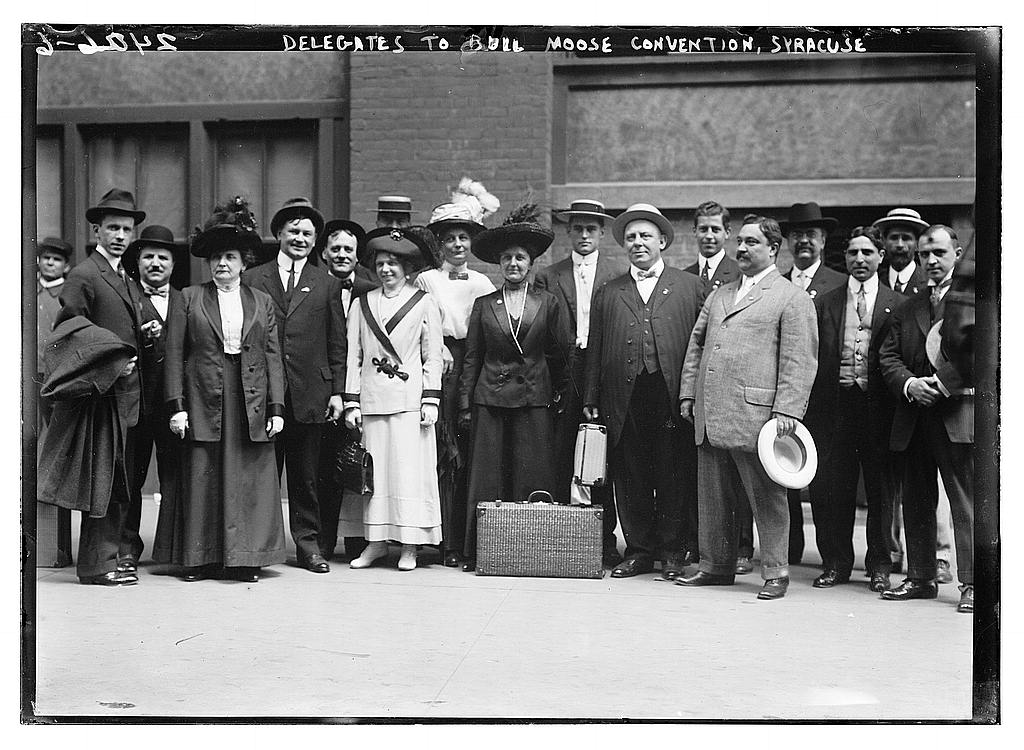
In 1912, former President Theodore Roosevelt challenged President William Howard Taft for the Republican nomination. Roosevelt won 9 of the last 10 presidential primaries. But only 12 states held primaries, and Taft controlled the delegates chosen by state conventions, so the party establishment renominated Taft on the first ballot. Roosevelt accused Taft's side of stealing more than 200 delegates, walked out, and ran as the nominee of the new Progressive Party, nicknamed the "Bull Moose" Party.
He finished second. Roosevelt won 27.4% of the vote and 88 electoral votes, the most electoral votes for any third-party candidate in American history, and beat the sitting Republican president, who won only 23.2% and two states. Democrat Woodrow Wilson won with 41.8%.
Then the pattern from Part 3 played out again. The Progressive Party faded quickly, Roosevelt himself returned to the Republican fold, and both major parties absorbed the Progressive agenda. The movement didn't need its own party anymore. It had moved into both.
How the Progressives Took Over Both Parties
One question that started this series was how the Progressive movement managed to get inside both parties. The answer is that it never had to break in. It worked from inside both from the start, and when its own third party failed, its ideas simply stayed in both.
That's the most important lesson of the era. Movements don't need to win as a third party to change the country. But when they move into the two parties, the parties get stronger, not weaker. The Progressives took power away from the bosses and handed much of it to the state, which was run by the two parties. The machine got cleaner, more legal, and more permanent.
The Progressives Today: Both Parties
If the Progressive movement had faded with Roosevelt's Bull Moose Party, this would just be history. It didn't. Its central idea, that the country's problems are best solved by more federal power run by experts, is alive in both parties. The parties mostly argue about who gets to run it.
Democrats say it out loud. At a CNN/YouTube debate on July 23, 2007, Hillary Clinton was asked whether she was a liberal. "I prefer the word 'progressive,'" she said, "which has a real American meaning, going back to the progressive era at the beginning of the 20th century." In the House, the Congressional Progressive Caucus, founded in 1991 by Bernie Sanders and five other members, had 97 members as of April 2026.
Even Democrats who ran as moderates kept the core premise. In his 1996 State of the Union, Bill Clinton famously declared, "The era of big government is over." His next sentence: "But we cannot go back to the time when our citizens were left to fend for themselves."
Republicans do it in practice. George W. Bush never called himself a Progressive. He ran as a "compassionate conservative." But look at the record:
• The biggest Medicare expansion since the program began. In 2003, Bush and a Republican Congress created the Medicare prescription drug benefit, Part D. In the House, 204 of 229 Republicans voted for it; in the Senate, 42 of 51. An analyst at the Center on Budget and Policy Priorities called it "the biggest expansion of the program since the beginning." The Congressional Budget Office put its cost at $203 billion through 2010 alone.
• Washington in the classroom. His No Child Left Behind Act of 2002 gave the federal government its largest role in local public schools to that point.
• A new security bureaucracy. After 9/11, his administration created the Department of Homeland Security and expanded federal surveillance powers under the Patriot Act.
• The bailout. When the financial system cracked in 2008, Bush backed a $700 billion rescue. He explained it to CNN on December 16, 2008: "I've abandoned free-market principles to save the free-market system."
You can defend some of those decisions. Many Americans did. But every one of them is the Progressive premise in action: a crisis or a need, solved by more federal power.
The scoreboard. In 1930, federal spending was 3.6% of the economy. By 1960, it was 17%. In 2025, it was 22.7%, according to Federal Reserve data from the government's budget tables. Both parties held the White House and Congress for long stretches of that climb. Neither reversed it.
Editorial: The words have changed. Today "progressive" usually means the left wing of the Democratic Party, and Bush's agenda looked nothing like Bernie Sanders's. But the shared premise is the same one Wilson wrote down in 1908: government is "a living thing" that should grow to meet whatever problem is in front of it. One party grows it for social programs, the other for security and bailouts, and both grow it when they're in charge. That's the Uniparty's deepest agreement, and it's a Progressive one.
How We Reverse It, and Why We Have To
Why it matters. Every expansion of federal power is permanent; the people holding it are not. As Part 8 will show, the November 2026 election handed Washington to the other team, just as 2006, 2010, 2016, and 2018 did. Each time, all the power the last majority built up passes to people the losing side fears. The only protection is the one the Founders designed: power that's limited no matter who holds it. Madison's answer in Federalist No. 10 wasn't to trust the right faction. It was to make sure no faction could get too much.
How we do it. The good news is that the Progressives left us some of the tools.
1. Use the Progressives' own weapon: the citizen initiative. The Populists and Progressives believed state legislatures were controlled by special interests, so they gave voters the power to write laws directly. South Dakota adopted it first, in 1898, and Oregon followed in 1902. Where legislatures run by the two parties won't fix ballot access, open primaries, or sore loser laws, voters in initiative states can do it themselves. The 2024 losses in seven states (Part 6) show it takes a better case, not a different tool. One big exception: Texas has no statewide citizen initiative at all, as Part 6 explains.
2. Bring back fusion. The anti-fusion laws of the 1890s still stand. Today, fusion is legal and common only in New York and Connecticut. In 1997, the Supreme Court ruled in Timmons v. Twin Cities Area New Party that states may ban it, but nothing requires them to do so. Legislatures can repeal those bans, and lawsuits in New Jersey and Wisconsin have challenged them.
3. Repeal sore loser laws and equalize ballot access, as Part 6 lays out.
4. Make Congress write the laws again. In 2024, in Loper Bright Enterprises v. Raimondo, the Supreme Court voted 6–3 to overrule the 40-year-old Chevron doctrine, which had instructed courts to defer to federal agencies' interpretations of ambiguous laws. Now judges decide those questions themselves. That's a start. The rest is up to Congress: write clear laws, put expiration dates on major regulations so they come back for a vote, and stop handing law-making to agencies voters can't fire.
5. Push power back down. The Progressives moved decisions from towns and states to Washington. Every decision that can be made closer to home should be, where voters can see who made it and replace them.
Editorial: None of this means undoing everything the Progressive Era did. Clean food and secret ballots are worth keeping. It means reversing the habit it started: every problem goes to Washington, every reform goes into a party-written law, and every new power stays forever. Undoing that is how we get back to the Founders' design, where liberty didn't depend on which faction won the last election.
Editorial: I don't think most Progressives set out to build the two-party lock. Many of them were sincere reformers fighting real corruption. But good intentions written into law last longer than the people who had them. A century later, the ballot-access rules, the primaries, the sore-loser laws and the registration hurdles they left behind are exactly the tools the Uniparty uses to keep everyone else out. Part 6 shows how.
Before that, Part 5 takes on the other great change of the era, one that's often blamed for things it didn't do: women getting the vote.
Discussion Questions for the Comments
• The secret ballot ended vote-buying but let the government decide who gets on the ballot. Was that a fair trade?
• Should a candidate who loses a primary be allowed to run in November as an independent?
• Wilson called the Constitution "elastic." Madison designed it to restrain power. Whose view has won, and should it have?
• George W. Bush said he "abandoned free-market principles to save the free-market system." Was he a conservative, or a Progressive in practice?
• Which reform would you start with: fusion, open primaries, ending sore loser laws, or making Congress write the laws again?
📜 The Faction Files: How Two Parties Took Over America
Part 1: The Parasite and the Host
Part 2: The Founders Warned Us About Parties. Then They Built Them.
Part 4: The Progressives (you are here)
Part 6: The Lockdown (coming soon)
Part 7: The Megaphone (coming soon)
Part 8: The Promise and the Mirror (coming soon)
Sources
1. Adam Brown, notes on Peter Argersinger, "A Place on the Ballot: Fusion Politics and Antifusion Laws," American Historical Review 85 (1980): 287–306: https://adambrown.info/p/notes/argersinger_a_place_on_the_ballot
2. Encyclopedia.com, "Ballot Access": https://encyclopedia.com/politics/encyclopedias-almanacs-transcripts-and-maps/ballot-access
3. EBSCO Research Starters, "Wisconsin Adopts the First Primary Election Law": https://www.ebsco.com/research-starters/law/wisconsin-adopts-first-primary-election-law
4. Ballotpedia, "Sore loser laws by state" (July 2026): https://ballotpedia.org/Sore_loser_laws_by_state
5. U.S. Senate, "The Seventeenth Amendment": https://www.senate.gov/about/origins-foundations/senate-and-constitution/seventeenth-amendment.htm
6. The American Presidency Project, UC Santa Barbara, "Voter Turnout in Presidential Elections": https://www.presidency.ucsb.edu/data/turnout.php
7. Miller Center, University of Virginia, "Theodore Roosevelt: The American Franchise": https://millercenter.org/node/265
8. Woodrow Wilson, Constitutional Government in the United States, 1908, Chapter III (Teaching American History): https://teachingamericanhistory.org/library/document/constitutional-government-in-the-united-states/
9. History.com, "Woodrow Wilson and racial segregation": https://www.history.com/articles/woodrow-wilson-racial-segregation-jim-crow-ku-klux-klan
10. Federal Reserve History, "Federal Reserve Act Signed into Law": https://www.federalreservehistory.org/essays/federal-reserve-act-signed
11. Wikipedia, "1912 United States presidential election": https://en.wikipedia.org/wiki/1912_United_States_presidential_election
12. V64OTD, "The Faction Files, Part 3: The Machine": https://v64otd.com/lifestyle/faction-files-part-3-the-machine/
13. Daily Kos, "Hillary in '07: I consider myself a proud modern American progressive" (quoting the July 23, 2007 CNN/YouTube debate): https://www.dailykos.com/story/2015/1/16/1358195/-Hillary-in-07-I-consider-myself-a-proud-modern-American-progressive
14. Wikipedia, "Congressional Progressive Caucus": https://en.wikipedia.org/wiki/Congressional_Progressive_Caucus
15. Government Executive, "That Time Bill Clinton Declared 'The Era of Big Government Is Over,'" May 2022: https://govexec.com/management/2022/05/that-time-bill-clinton-declared-era-big-government-over/366425
16. PolitiFact, "Ron Paul says when Republicans were in power they expanded government health care," July 25, 2011: https://www.politifact.com/factchecks/2011/jul/25/ron-paul/ron-paul-says-when-republicans-were-power-they-exp/
17. Business Standard/Reuters, "Bush says sacrificed free market principles to save economy," Dec. 17, 2008: https://business-standard.com/article/economy-policy/bush-says-sacrificed-free-market-principles-to-save-economy-108121700008_1.html
18. Federal Reserve Bank of St. Louis (FRED), "Federal Net Outlays as Percent of Gross Domestic Product": https://fred.stlouisfed.org/data/FYONGDA188S
19. Ballotpedia, "History of initiative and referendum in the U.S.": https://ballotpedia.org/History_of_initiative_and_referendum_in_the_U.S.
20. Wikipedia, "Electoral fusion in the United States": https://en.wikipedia.org/wiki/Electoral_fusion_in_the_United_States
GFOA, "U.S. Supreme Court Ends Chevron Deference" (Loper Bright Enterprises v. Raimondo, 2024): https://www.gfoa.org/u.s.-supreme-court-ends-chevron-deference