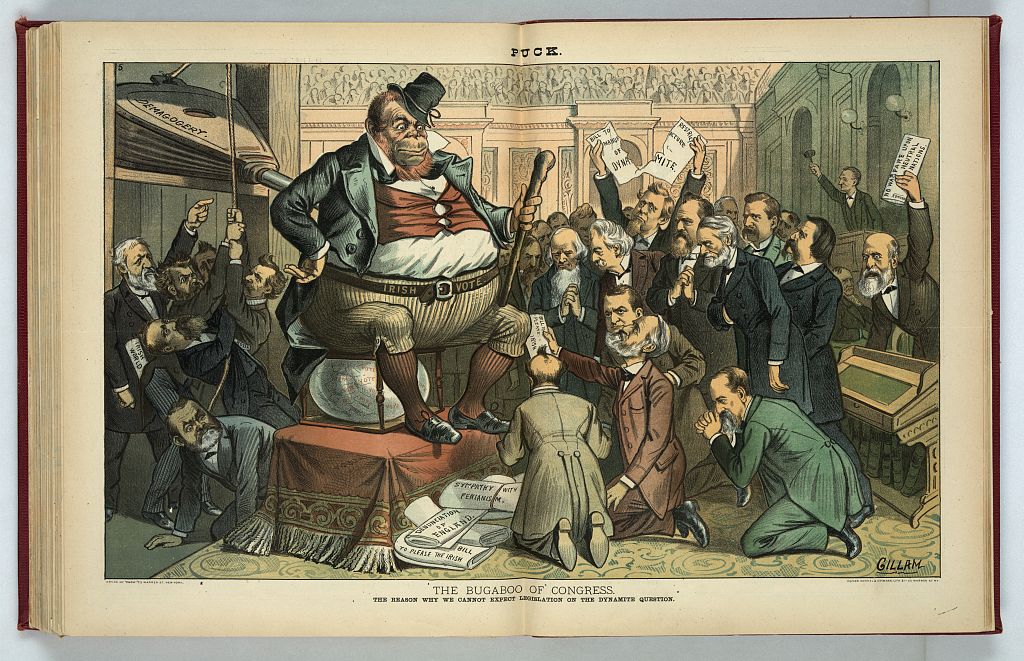

The highest voter turnout in American history came in 1876, when the parties printed the ballots, bought the votes and handed out the jobs. The Founders' reluctant parties had become machines.
📜 The Faction Files: How Two Parties Took Over America
Part 1: The Parasite and the Host
Part 2: The Founders Warned Us About Parties. Then They Built Them.
Part 3: The Machine (you are here)
Part 6: The Lockdown (coming soon)
Part 7: The Megaphone (coming soon)
Part 8: The Promise and the Mirror (coming soon)
This is My Ledger, the personal side of v64otd.com. This series is history first: what happened, with sources. Where I give my own opinion, it's marked.
Political machine: a party organization that wins elections by trading favors for votes: jobs, contracts, cash and help for people who stay loyal, and punishment for those who don't. It runs on loyalty, not ideas.
The Man Who Built It on Purpose
In Part 2, we saw the Founders split into parties almost by accident, each side convinced the other was the real danger. The next generation didn't stumble into parties. They built them deliberately.
The architect was Martin Van Buren of New York, who later became the eighth president. In January 1827, he wrote to Virginia newspaper editor Thomas Ritchie with a plan. "Party attachment in former times furnished a complete antidote for sectional prejudices by producing counteracting feelings," he wrote. His solution was "the revival of old party distinctions," built on an alliance "between the planters of the South and the plain Republicans of the north."
Read that again. Van Buren didn't see parties as a necessary evil. He saw them as a tool for holding a divided country together by giving people team loyalty strong enough to override their regional conflicts. That alliance became the Democratic Party, and it carried Andrew Jackson to the White House in 1828.
Editorial: Van Buren wasn't wrong that loyalty can paper over division. But notice what that means. A party built to bury hard questions under team loyalty has a reason to keep you loyal and the hard questions buried. That's still the business model.
The Convention: A Third Party's Idea
Here's a piece of history most Americans don't know: the national party convention, the four-day spectacle both parties still put on every summer, was invented by a third party.
In 1831, the Anti-Masonic Party, a movement opposed to the secret influence of the Freemasons, held the first national nominating convention in Baltimore. It nominated a candidate and adopted a written platform, both firsts. The next year, on May 21, 1832, Jackson's supporters held their own convention in the same city, officially named themselves the Democratic Party, and picked Van Buren as Jackson's running mate.
The Anti-Masons faded within a few years. Their invention became the centerpiece of the two-party system. Keep that pattern in mind. It comes back.
To the Victor Belong the Spoils
Once Jackson took office, he made party loyalty pay. He called it "rotation in office": removing officeholders who had no inherent right to their jobs and opening government service to ordinary people. In practice, it meant firing opponents and hiring supporters, from bureau chiefs in Washington down to village postmasters.
In 1832, Sen. William Marcy of New York, a Jackson ally, defended the practice on the Senate floor. He said he saw "nothing wrong in the rule, that to the victor belong the spoils of the enemy." The spoils system had its name.
Both parties ran on it for the next half-century. Every new administration faced thousands of job seekers, and the jobs went to the people who had worked for the winning side. Government jobs became the fuel that kept the party machines running.
It took a murder to slow it down. In 1881, a disappointed office seeker who believed he was owed a government job shot President James Garfield. Garfield died weeks later. In 1883, Congress passed the Pendleton Civil Service Act, which required merit exams for some federal jobs and banned forcing officeholders to give money to the party. At first, it covered about 14,000 of roughly 100,000 federal positions.
The Ballot Everyone Could See
To understand how the machines held power, you have to understand how people voted. It wasn't secret.
Through most of the 1800s, there was no official government ballot. Each party printed its own, often in its own colors, typefaces, and designs, so anyone watching could tell at a glance which ticket a voter dropped in the box. Party workers handed them out at the polls. Some ballot boxes had glass sides.
That made buying votes easy, because the buyer could watch the seller deliver. The machines had a vocabulary for it. "Floaters" sold their votes to the highest bidder. "Repeaters" voted more than once. "Colonizers" were voters moved into close districts. In 1888, a Republican Party circular in Indiana told party workers to "divide the floaters into blocks of five," each block watched by a trusted man with money.
The fix came from Australia. In 1888, Louisville, Kentucky, and Massachusetts adopted the secret ballot, printed by the government and marked in private. By the 1892 election, 38 states used it. Hold onto that, too. In Part 4, we'll see how that same reform later handed the two parties a new way to lock out everyone else.
Boss Tweed
The most famous machine of all was Tammany Hall, the Democratic organization that ran New York City, and its most famous boss was William "Boss" Tweed.
Through padded contracts and kickbacks, Tweed's ring looted the city. A committee of New York aldermen estimated in 1877 that the ring stole $25 million to $45 million, an enormous sum at the time. Later estimates ran as high as $200 million.
What helped bring Tweed down was a cartoonist. Thomas Nast drew him in Harper's Weekly as a bloated thief with a diamond stickpin. Tweed reportedly told his men to "stop them damned pictures" because his voters couldn't read but could see the cartoons. Tweed was convicted in 1873 and died in a New York jail in 1878.
Editorial: Tammany was Democratic, but the machines weren't a one-party problem. Republican machines ran Philadelphia and much of Pennsylvania for decades, and both parties bought votes wherever they could. The Indiana floaters circular came from Republicans. The machine was the system, not the side.
The Turnout Trap
One question kept coming up while I wrote this series: how much has voter apathy contributed to this mess? The numbers from the machine era turn that question on its head.
• 1828: about 58% of eligible voters turned out.
• 1840: turnout jumped to 80%, in a campaign famous for parades, slogans, songs, and hard cider.
• 1876: turnout hit 81.8%, the highest in American history.
• 1920: turnout had collapsed to 49%.
Those figures, from the American Presidency Project at UC Santa Barbara, are adjusted for the number of people eligible to vote at the time. Before 1920, that mostly meant men.
So the highest turnout in American history came when the parties printed the ballots, voting was public, votes were for sale, and government jobs went to loyal party workers. High turnout didn't mean voters were free. In many places, it meant the machines were very good at getting their people to the polls.
Editorial: That's the trap. We're told that voter apathy is the problem and turnout is the cure. Turnout matters. But a voter who shows up out of fear, loyalty, or payment isn't exercising liberty. He's feeding the machine. The question isn't just whether people vote. It's whether they're voting for something, or just for their team.
Why turnout collapsed after 1900 is one of the biggest stories in this series, and it's not the one most people expect. That's Part 4.
The Last Time a New Party Broke Through
The machine era is also the last time Americans replaced one of the two major parties.
In 1854, Congress passed the Kansas-Nebraska Act, letting new territories decide for themselves whether to allow slavery. The Whig Party, one of the two major parties, split apart over it. That year, former Whigs and other opponents of slavery's expansion met in Ripon, Wisconsin, and organized the Republican Party. Six years later, in 1860, Republican Abraham Lincoln was elected president.
A third party became a major party in six years. It has never happened since.
The closest anyone came was the People's Party, better known as the Populists. In 1892, angry farmers and workers backed James Weaver for president. He won about 8.5% of the popular vote and 22 electoral votes, the first third-party candidate to win electoral votes since the Civil War. The Populists' Omaha Platform called for a graduated income tax and the direct election of U.S. senators, among other things.
Then came 1896. The Democrats nominated William Jennings Bryan, who borrowed much of the Populist message. The Populists endorsed him too, and he lost. Within a few years, the party had collapsed, absorbed into the Democrats in much of the country, and it disbanded after 1908.
But its ideas won. The 16th Amendment made the modern federal income tax possible in 1913, and the 17th Amendment gave voters the direct election of senators the same year.
Editorial: That's the pattern from the Anti-Masons forward. A third party comes up with an idea the voters want. One of the big parties takes the idea, takes the voters, and the third party disappears. The two parties don't have to beat outsiders. They just have to absorb them. It's worth remembering every time a major party suddenly discovers an issue a third party has been talking about for years.
The Machine Today
The machine era ended more than a century ago. The machine didn't.
Yesterday, voters handed Democrats control of the U.S. House and Senate. In Texas, they elected Democrats as governor and lieutenant governor and to a U.S. Senate seat. Listen to what voters said on the way out of the booth:
• They were hurting. About three-quarters rated the economy "not so good" or "poor," and about 8 in 10 said inflation had caused their household severe or moderate financial hardship, according to the AP Voter Poll.
• They were angry about the war. 62% said President Trump made the wrong decision in starting the war with Iran, and 40% called the war a major factor in their vote, according to the NBC News Exit Poll.
• They weren't in love with the winners. Just under half of voters view the Democratic Party favorably, according to the AP poll. That's not much better than the roughly 4 in 10 who view Republicans favorably.
That's not an endorsement. It's an eviction. Voters fired one team the only way the system lets them: by hiring the other team.
Sound familiar? It's 1896 again. Voters angry at the party in power ran to the other major party, and the alternatives on the ballot got crumbs. In Texas, the Libertarian candidates for governor and U.S. Senate drew about 1.3% and 1.5% in early returns.
Disclosure: I voted Libertarian in most of my races yesterday and endorsed independent write-in candidate Jenn Mack for governor.
Now watch the winners. Senate Democratic leader Chuck Schumer said on election night, "We listened to the American people... We listened. They didn't." House Democratic leader Hakeem Jeffries said "the American people are crying out for transformational change." Every wave gets read by the winners as a mandate for their platform, not as a rejection of the losers' record. We'll come back to that in Part 7.
Editorial: The two-party machine is a trap on three levels. Morally, it trains us to choose the lesser evil and call it a virtue. Philosophically, it teaches us to vote against something rather than for it. Politically, its rules on ballot access, debate stages, and committee seats make sure the only place an angry voter can go is the other half of the same machine. Yesterday, millions of Americans voted against inflation, the cost of living, and a war. What they'll get is a new majority that believes they voted for its agenda. The 1888 floaters sold their votes for a few dollars. We give ours away for free, every two years, to whichever team we're angriest at.
What the Machine Era Teaches Us
The Founders feared factions. Van Buren's generation turned factions into an industry, with jobs, ballots, and loyalty as the raw materials. Reformers eventually took away some of the machine's tools: the secret ballot, civil service exams, and in time, the decline of the big-city bosses.
But the machine didn't die. It evolved. In Part 4, we'll meet the Progressives, the reformers who set out to clean up politics, and see how some of their best reforms ended up giving the two parties a legal lock on the ballot that they never had before.
Discussion Questions for the Comments
• Would you rather have high turnout with machines, or lower turnout with secret ballots? Is there a way to have both?
• What issue today do you think a third party raised first, before one of the big parties took it over?
• Is a government job, contract, or grant handed out for party loyalty today any different from the spoils system?
• Was your vote yesterday for something, or against something?
📜 The Faction Files: How Two Parties Took Over America
Part 1: The Parasite and the Host
Part 2: The Founders Warned Us About Parties. Then They Built Them.
Part 3: The Machine (you are here)
Part 6: The Lockdown (coming soon)
Part 7: The Megaphone (coming soon)
Part 8: The Promise and the Mirror (coming soon)
Sources
1. Martin Van Buren to Thomas Ritchie, Jan. 13, 1827 (Teaching American History): https://teachingamericanhistory.org/document/letter-to-thomas-ritchie/
2. National Constitution Center, "On this day, the first Democratic Party convention": https://constitutioncenter.org/blog/on-this-day-the-first-democratic-party-convention
3. Encyclopedia.com, "Spoils System" (Dictionary of American History): https://www.encyclopedia.com/history/united-states-and-canada/us-history/spoils-system
4. Smithsonian Magazine, "The Vote That Failed": https://www.smithsonianmag.com/history/the-vote-that-failed-159427766/
5. Wikipedia, "William M. Tweed": https://en.wikipedia.org/wiki/William_M._Tweed
6. The American Presidency Project, UC Santa Barbara, "Voter Turnout in Presidential Elections": https://www.presidency.ucsb.edu/data/turnout.php
7. History.com, "Republican Party founded": https://www.history.com/this-day-in-history/republican-party-founded
8. Wikipedia, "Populist Party (United States)": https://en.wikipedia.org/wiki/Populist_Party_(United_States))
9. V64OTD, "The Faction Files, Part 2: The Founders Warned Us About Parties. Then They Built Them.": https://v64otd.com/lifestyle/faction-files-part-2-founders-warned-about-parties/
10. WHYY/AP, "Democrats win the U.S. House, taking full control of Congress as voters express frustration with Trump," Nov. 4, 2026 (AP Voter Poll): https://whyy.org/articles/election-2026-democrats-win-us-house-senate-trump/
11. Daily Caller, "Exit Poll Reveals GOP's Biggest Vulnerability With Midterm Voters," Nov. 3, 2026 (citing the NBC News Exit Poll): https://dailycaller.com/2026/11/03/exit-polls-trump-economy-voters-gas-prices-iran-war-referendum-midterms-2026/
12. ABC7, "Schumer takes victory lap," Nov. 4, 2026: https://abc7.com/live-updates/midterm-elections-2026-live-updates-election-results-key-races-us/20001292/entry/20014254/
13. KUT, "Texas election results 2026" (early returns): https://www.kut.org/texas/2026-11-03/texas-nov-midterm-statewide-election-results