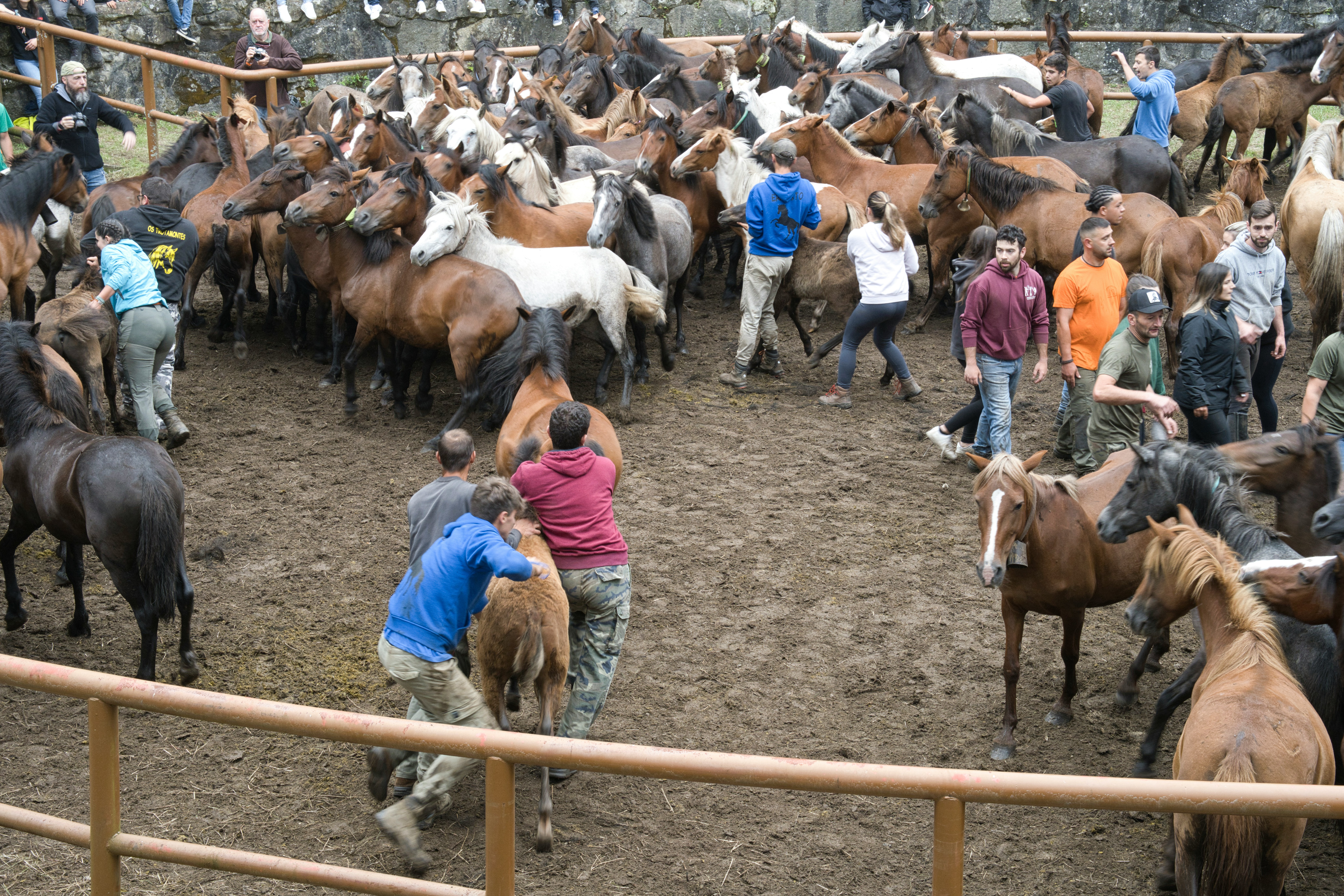

Federal law protects wild horses right up until the moment the government sells one. A 2004 loophole, a $25-to-$750 markup, an employee once paid by the horse, and a budget fight the administration keeps losing explain the rest — along with a few questions nobody's answered.
Federal law has protected America's wild horses since 1971. That protection ends the moment the government sells one.
The New York Times reported on August 20 that several hundred wild horses sold through a Bureau of Land Management program have ended up in slaughterhouses overseas, in what amounts to a betrayal of a decades-old congressional promise. This isn't a story about anyone breaking the law. It's a story about a law with a hole in it, a government agency that kept selling through that hole anyway, and an administration that has twice tried to widen it.
The Loophole
The Wild Free-Roaming Horses and Burros Act of 1971 was enacted to protect wild horses and burros on public land from capture, harassment, and slaughter. In 2004, Congress amended it. Horses older than 10, or ones that had been offered for adoption at least three times without a taker, became eligible for BLM to sell "without limitation" — legal language that means exactly what it sounds like. The moment one of those horses is sold rather than adopted, the protections that kept it safe for its entire life stop applying.
BLM's own policy page says it's the agency's position "not to sell or send any wild horses or burros to slaughter," and buyers sign a bill of sale promising not to slaughter the animal or resell it for slaughter. That promise has no teeth once the horse changes hands again. A buyer can legally resell a horse at auction, where the next buyer owes nothing to BLM at all.
What the Numbers Look Like
In 2025, BLM sold about 3,700 wild horses and burros — more than double the number sold the year before, and roughly fourteen times the 268 sold back in 2015. The Times investigation centered on Brandon Jones, an Ohio livestock trader who acquired roughly 500 of those horses from BLM. According to the paper's reporting, BLM approved his applications despite warning signs, and many of the horses he acquired were later moved toward slaughter through informal networks of dealers and auctions rather than any direct, traceable sale.
Who Actually Profits
BLM sold those horses to Jones for $25 a head. Taxpayers covered the shipping. A horse can fetch up to $750 at a slaughter plant — a markup north of 2,900 percent between what the government charged and what the end of that chain can pay. BLM reportedly awarded Jones a bulk sales contract just two months after he had been cited for violating the federal Packers and Stockyards Act, the law that governs fair dealing in livestock markets. When the Times asked him to identify the buyers he'd resold horses to, he reportedly declined to name many of them.
That $25 price tag deserves scrutiny in its own right, separate from where the horses ended up. It isn't a market price — it's a number that doesn't come close to covering what the government itself spends getting a horse off the range, through processing, and to a buyer's trailer, before shipping is even factored in. BLM eats that gap and then pays for the delivery on top of it, which means every sale under this program starts as a net cost to taxpayers before a single dollar changes hands on the resale end. A price structure like that isn't a rounding error; it's a design choice, and it's one with an obvious fix. BLM could set the sale price at a level that actually recovers its own handling and transport costs, or require buyers to arrange and pay for their own shipping, or add a Government surcharge to cover it either way. Any of the three would, at minimum, stop the program from subsidizing the exact resale-for-profit dynamic that this section documents. None of them require new legislation or touch on the appropriations rider fight at all — they're paperwork and policy changes BLM could make on its own, and the fact that it hasn't is worth sitting with.
This isn't the first time this exact pattern has played out. A 2015 Interior Department Inspector General investigation — this newsletter reviewed the primary report directly — found that between 2008 and 2012, BLM sold 1,794 wild horses to a Colorado rancher and livestock hauler named Tom Davis, at $10 a head, delivered by the truckload (about 35 horses per load). No one else had ever bought more than 1,000 horses from the program; the next-largest buyer purchased 325. Davis told investigators he resold each 35-horse load for $3,500 to $4,000, netting an estimated $2,500 to $3,000 profit per load, which, across the roughly 51 loads he purchased, works out to a total estimated profit in the neighborhood of $130,000 to $155,000, this newsletter's own calculation based on his figures. He told the inspector general "probably close to all" of the horses ended up in Mexico, and that he knew where they were going because there was "one place to go... to the kill plant." The report also found BLM spent more than $140,000 transporting horses to Davis — taxpayers covering shipping, the same arrangement reported in the Jones case a decade later.
The report found BLM "did not follow current law" in managing the program and kept selling to Davis even after the agency had information that he was sending horses to slaughter. It also found that the BLM employee who processed those sales received performance-based monetary awards tied to the number of horses she sold or adopted out — a direct financial incentive, built into her compensation, to move horses off the government's books with little scrutiny of where they went next. Separately, the same report investigated — and could not substantiate — an allegation that Davis had a financial relationship with then-Interior Secretary Ken Salazar, whose family Davis claimed to have done farming and trucking work for; Salazar denied any relationship with Davis, BLM employees said they weren't aware of one, and investigators closed that thread for lack of evidence rather than clearing it outright. Despite the other findings, both the U.S. Attorney's Office for the District of Colorado and Colorado's Conejos County District Attorney's Office declined to bring civil or criminal charges against anyone. In direct response to the Davis case, BLM adopted a policy in December 2012 requiring an Assistant Director's sign-off before selling any individual buyer more than four horses within a six-month period — a safeguard specifically designed to prevent one buyer from ever again acquiring hundreds of horses unchecked. Brandon Jones acquired roughly 500 in a single year in 2025. Whether that 2012 safeguard was applied, waived, or quietly abandoned in his case is not addressed in any of the reporting so far.
Eleven years and one presidential term apart, the shape of the two cases is nearly identical: a single high-volume private buyer, a federal agency that kept selling despite red flags, and no one held accountable afterward — except this time, the safeguard the agency itself built to stop a repeat was apparently either not used or not enough.
Where the Meat Actually Goes
This part is harder to trace all the way through, and it's worth being upfront about where the trail gets thin. Because domestic slaughter has been dead since 2007, any wild horse that ends up slaughtered leaves the country first. Animals' Angels, an investigative animal-welfare group that tracks the export pipeline shipment-by-shipment, put the full 2024 total at 17,208 horses shipped to Mexico and 2,912 to Canada — just over 20,000 American horses of all kinds, not specifically wild-horse-origin. Then, in 2025, that pipeline did something it hadn't done in over a decade: it grew. Roughly 5,000 more horses were exported for slaughter in 2025 than in 2024, the first year-over-year increase in the trade in more than ten years — the same year BLM's wild horse sales also more than doubled. Nothing currently published directly ties those two increases together, and Animals' Angels' own analysis attributes most of the growth on the Mexico side to shifts in the Mexican cattle and beef market rather than to BLM's sales specifically. But the two curves bending upward in the same year, in a program that had been shrinking for a decade, is a coincidence worth naming rather than ignoring.
Japan is the dominant destination for horsemeat moving through this specific US-Canada-Mexico pipeline — it's the only significant buyer of horsemeat exported from Mexico, and the largest buyer of horsemeat exported from Canada, where 2025 sales to Japan were valued at roughly 8.6 million Canadian dollars. (Whether Japan is the single largest importer of horsemeat worldwide, as opposed to the largest buyer specifically sourced from this North American pipeline, is a separate and less settled question — European trade data point to Italy as a larger overall global importer.) The European leg of this specific pipeline, by contrast, has essentially closed: Canada's horsemeat exports to Europe "completely stopped" in 2025 except for a single shipment to Germany that went for animal consumption, not human, according to Animals' Angels — a collapse the group attributes to stricter EU import requirements and a consumer-awareness campaign that got a major French retailer to cut ties with Canada's largest horse-slaughter operator. One more twist: some of this meat doesn't leave North America at all. Canada's sole confirmed U.S. buyer, Central Nebraska Packing, imported roughly $2.35 million worth of Canadian horsemeat in 2025 to supply zoos across the United States — meaning some fraction of these animals may end up feeding captive wildlife in American zoos rather than being exported overseas.
What none of the available reporting — including the Times investigation itself — has done is trace specific wild horses from a BLM sale, through a reseller like Jones, across a specific border crossing, into a specific slaughter plant, and out to a specific destination, whether that's a dinner plate in Tokyo or a zoo enclosure in Nebraska. That chain exists in pieces, sourced from different data sets, but nobody has published the complete, linked version for this particular wave of sales. Tellingly, even Animals' Angels — the group with the most granular data on this pipeline — flags its own version of this gap: Mexican horsemeat export revenue barely moved in 2025, even as shipment volume rose, horsemeat isn't a large part of Mexican domestic consumption, and the group's own 2026 report asks, without being able to answer, "where is the meat going?" If the organization tracking this most closely can't fully close that loop, it's not a gap this newsletter is inventing — it's one built into the industry's own paperwork.
How They Actually Cross the Border
The paperwork requirements are specific: a negative Coggins test for equine infectious anemia, valid within 6 months; a health certificate, valid for 30 days; and a USDA "owner-shipper" form listing each horse's green slaughter tag number, which, by regulation, must be signed by a veterinarian. In practice, according to investigators who have documented the process at the border, that signature often doesn't reflect an actual inspection — the paperwork is commonly faxed to a veterinarian's office, signed, and returned without the vet seeing the horses. Inspection on the ground varies by crossing: at the Sweetgrass, Montana, crossing into Canada, horses are reportedly unloaded and inspected before reloading; at the Champlain, New York, crossing, they're checked without being unloaded at all, from inside the trailer. Mexican inspectors reportedly check paperwork against the horses and turn away animals with severe injuries or stallions, but this is a paperwork-matching process, not a full health screening. Canada separately bars any horse that was in Texas within the previous 21 days, a disease-control measure — the same basic logic behind the screwworm-related cattle border restrictions this outlet has covered on the beef side of the ledger.
The paperwork itself has a documented identity problem. Animals' Angels' 2026 shipment-by-shipment tracking of the Mexico export corridor found that one of the most frequent names on export paperwork, "Ramos Livestock," isn't an actual shipper at all — it's a placeholder that multiple different kill buyers use when they don't want their real names on official government documents. The group has separately flagged a Texas-incorporated company, Coyuma Cattle Company, whose shipments to a Juarez slaughter plant grew from 1 to 45 per year between 2024 and 2025, generating over $1 million in revenue, while its public-facing business presence advertises only cattle sales, with no mention of horses anywhere. Neither example involves BLM horses specifically, and neither is illegal on its face. But they establish, in the government's own export records, that buyer-identity obfuscation isn't a hypothetical risk in this pipeline — it's an observed, ongoing practice, which makes Brandon Jones's refusal to name his own resale buyers look less like an isolated evasion and more like standard industry behavior that the paperwork system already accommodates.
For scale: this entire live-export-to-slaughter pipeline had shrunk dramatically over the previous decade — from more than 148,000 horses in 2014 down to roughly 20,000 in 2024, an 86 percent decline, according to Animals' Angels' tracking. Then 2025 broke that decade-long trend, adding back around 5,000 more horses than the year before. The pipeline is still much smaller than it used to be. What's new, on top of the first uptick in over ten years, is that it now appears to include legally protected horses.
What We Still Don't Know
Some real questions here don't have public answers, and rather than fill that gap with speculation, it's worth naming exactly what's missing. The broader kill-buyer network moving horses across the border is, to a meaningful extent, already documented — investigators have named specific shippers, dollar volumes, and even a placeholder alias multiple buyers share to keep their names off paperwork. What's missing is the specific link: nobody has published the identities of the buyers Brandon Jones resold horses to — he reportedly wouldn't name them — or confirmed whether any of his roughly 500 horses moved through any of the already-documented kill-buyer channels. Nobody has published a figure for what share of the roughly 20,000 to 25,000 horses exported for slaughter each year are BLM wild horses specifically, as opposed to other unwanted domestic horses moving through the same network. Nobody has established whether any current BLM employee has a compensation structure resembling the volume-based incentive identified in the 2015 IG report — that report covered 2008–2012, and no comparable audit of current-day incentive structures has been published. And while the 2015 case shows BLM's own inspector general took a political-relationship allegation seriously enough to investigate it — and came up short on evidence, not proof of nothing — nobody has published anything resembling that scrutiny applied to the current wave of sales.
None of that is proof of collusion between government and private industry. But a federal agency approving a bulk contract for a buyer two months after a livestock-law citation, an employee compensation structure that rewarded volume over destination in the last confirmed instance of this exact pattern, a reseller who won't name his buyers, and zero prosecutions across two documented cases, eleven years apart, is not a record that earns the benefit of the doubt. When the same agency keeps producing the same unanswered questions across two administrations, the silence itself is the finding.
Where Trump Actually Fits Into This
Nothing in the Times reporting suggests the administration ordered BLM to sell horses to slaughter, or that BLM's written policy changed. What changed is the budget request sitting underneath that policy.
The real legal backstop against wild horse slaughter has never really been the 1971 Act itself — it's an appropriations rider that Congress has renewed every year for decades, barring BLM from killing healthy wild horses or burros outright and from selling them without conditions against slaughter. The Trump administration has now proposed eliminating that rider twice in a row, in back-to-back budget requests: the FY26 request, released in May 2025, proposed cutting the Wild Horse and Burro Program's funding by more than 25 percent, from $143 million to $100 million, while dropping the slaughter-ban language entirely. The FY27 request, released in April 2026, did the same thing again — proposing to cut the program from roughly $142 million down to about $106.8 million, again without the anti-slaughter rider. Advocacy groups that track this closely, including the American Wild Horse Conservation and Humane World for Animals, have both said plainly that removing the rider would open the door to the government directly killing some of the roughly 62,000 to 64,000 wild horses and burros currently held in government holding facilities, not just tolerating the sale-loophole pipeline that already exists.
So far, Congress has said no both times. The House passed its FY26 Interior Appropriations bill in January 2026 with the slaughter protections intact and added $11 million specifically for fertility-control management as a humane alternative to roundups. The Senate's FY26 bill, from its Appropriations Committee, also kept the ban and additionally rejected a separate proposal that would have expanded BLM's authority to transfer horses to foreign governments — another route critics warned could function as a backdoor around the same protections. Both chambers acted on a bipartisan basis; this has not broken down along party lines the way most fights over this administration's policies have.
The Part That's Still Open
The FY26 fight over language played out through most of the past year, and Congress has held the line each time so far: the House passed its version with the slaughter protections intact in January 2026, and the Senate Appropriations Committee's version kept them too. But neither chamber's FY26 Interior bill has actually been signed into law as a stand-alone, final appropriations act. The government has instead been running on a series of continuing resolutions — most recently one the Senate passed on August 8, 2026, funding operations at current levels through December 11, with the House having passed its own version before leaving for August recess. That means the wild horse slaughter protections are, as of this writing, still riding on a stopgap rather than a finalized law, due to be renegotiated again this winter — at the same time the FY27 request, which proposes eliminating the rider all over again, works its way through the same process. Nothing about the outcome is guaranteed; it depends on the annual fight repeating itself indefinitely, for as long as anyone wants the protection to remain in effect.
In the meantime, the sale-authority loophole that put roughly 500 horses in Brandon Jones's hands doesn't require Congress to change anything at all. It's already legal. BLM already has the authority to sell those horses "without limitation." The only thing standing between the current pipeline and something larger is the same rider the administration has twice asked Congress to remove.
The Really Disturbing Part of This
Everything above treats horses and cattle as two separate stories moving on two separate tracks — one federally protected, one just livestock. Follow the actual plants, and that line gets a lot blurrier.
Start with Bouvry Exports, the company that dominates what's left of Canada's horse-slaughter industry and whose Quebec plant, Viande Richelieu, is the confirmed destination for the US-origin horsemeat that ends up as zoo feed at Central Nebraska Packing. Bouvry's main Alberta facility, in Fort Macleod, isn't a horse-only operation. When Canadian food safety regulators suspended its license in 2022 over sanitation and E. coli control failures, Food Safety News described the plant plainly: "Bouvry Exports produces and exports bison, elk, equine, and beef meats." Multiple independent Canadian outlets covering that same suspension confirm it. Horses and cattle, processed by the same company, out of the same regulatory filings, likely through the same building. This isn't speculation — it's how the company itself is described in coverage of its own federal licensing troubles.
Then there's what's already been found in the beef supply on the other side of the border. A study out of the National Autonomous University of Mexico's School of Veterinary Medicine tested 433 raw and cooked meat samples from 339 vendors across Mexican cities — mostly ground beef and steak strips, the ordinary stuff sold in markets and at food stalls. Forty-three of those samples, just under 10 percent, tested positive for horse DNA. Ground beef had the worst rate. Almost none of the vendors selling it knew. And in some of the horse-DNA-positive samples, researchers also found high levels of clenbuterol — a drug banned in food animals in both Mexico and the United States because it's dangerous to people who eat contaminated meat. That's not a labeling technicality. That's an undisclosed drug residue riding along with an undisclosed species, sold to people who thought they were buying beef.
Nobody has connected those two facts directly — no study has tested beef actually crossing into the US specifically for horse DNA or clenbuterol, and this newsletter isn't claiming that link is proven. What's confirmed is narrower and still unsettling: a major horse-slaughter operator processes horse and beef under one corporate roof: a documented, government-referenced instance of exactly the kind of species-crossing this piece has been asking about, and a peer-reviewed study has already found undisclosed horsemeat, paired with a banned drug, in ordinary beef sold in Mexico — the same country that supplied a rapidly growing share of US beef imports through 2025 and into 2026, and the same country this newsletter's earlier Dispatch on the beef industry's four-company chokehold already flagged for strained inspection capacity, when the U.S. Cattlemen's Association pointed to a prior recall tied to an import surge as a warning sign. One more relevant, unresolved thread from that same piece: Trump's administration wouldn't say which countries would supply the new tariff-free beef quota announced this month — "I don't want to say which countries, but there are a few countries," he told reporters. Whether Mexico is one of them hasn't been disclosed either.
Put the two pieces next to each other, and the pattern that runs through this entire piece shows up again: a system that tracks volume and price with real precision, and tracks species and safety with almost none. Nobody is required to prove Americans are not eating horsemeat. The point is that nobody has looked hard enough, on either side of this specific border, to prove they aren't — and a business record and a peer-reviewed study, read side by side, are exactly the kind of thing that should have prompted someone to check by now.
Call to Action
Everything documented in this piece — the sale-authority loophole, the $25 pricing, the appropriations rider fight, the species-testing gap on imported meat — sits under federal jurisdiction. BLM is a federal agency, the rider is a federal appropriations law, and meat-species testing is a federal food-safety function. There isn't a meaningful state-level lever here, and it would be misleading to pretend otherwise. This is a Congress-and-federal-agencies problem, which means it only moves if enough people actually contact the offices that control it. Here's specifically what to do:
- Call or write your U.S. Senators and ask them to vote to keep the anti-slaughter appropriations rider in the FY26/FY27 Interior funding bill. That rider is due for another fight before the December 11 funding deadline. The Capitol switchboard connects to any Senate office: (202) 224-3121. If you're in Texas, that's Sen. Ted Cruz and Sen. John Cornyn's offices.
- Call or write your U.S. Representative and ask them to support the House in holding the line on the same rider, as it did in January 2026. The same switchboard number reaches any House office. Texans in the Dallas–Fort Worth area (TX-24) should contact Rep. Beth Van Duyne's office directly.
- Contact the Department of the Interior and ask Secretary Doug Burgum to fix BLM's sale program administratively — specifically, to raise the $25 per-horse sale price to cover the government's own handling and shipping costs (or shift that cost to buyers), and to confirm whether the buyer-vetting safeguard adopted in 2012, after the Tom Davis case, is actually being enforced. This doesn't require Congress; it's within the agency's own authority. Contact through doi.gov.
- Contact HHS and the FDA and ask directly whether species-DNA testing is being applied to beef imports from Mexico, given the documented horsemeat and clenbuterol findings in this piece. Ask for a yes-or-no answer, not a general statement about food safety. Contact through hhs.gov and fda.gov.
- If you're registered to vote in Texas, contact both campaigns in the open U.S. Senate race — Ken Paxton's and James Talarico's — and ask each one, on the record, whether they'll support the appropriations rider and tougher BLM sale rules if elected. Neither candidate holds federal office yet, so neither has a vote today, but this is exactly the kind of position that should be locked in before Election Day, not discovered after.
corporatocracy (noun) — a system where the law that's supposed to protect something applies only up until the moment the government profits from selling it, and where closing that gap depends on a private trader's paperwork being caught by reporters rather than by the agency that approved it.
curated control (noun) — protection that exists on a website's policy page and in a bill of sale, but not in any mechanism that follows the animal past the first sale — leaving the actual outcome to whichever buyer down the chain decides what "without limitation" is going to mean.
Sources
Trump's Wild Horses Legal Loophole Slaughter — The New York Times, Aug. 20, 2026 (original investigation)
Hundreds of America's wild horses reportedly sent to slaughter under Trump — Humane World for Animals, Aug. 21, 2026 (Brandon Jones detail, sale figures, FY26/FY27 budget context)
Is Trump admin allowing sale of protected wild horses to slaughterhouses? What we know — Snopes
Fact Check: Is Trump's admin allowing sale of protected wild horses to slaughterhouses? — MEAWW
Wild and Free-Roaming Horses and Burros Act of 1971 — background and 2004 sale-authority amendment
President's Budget Could Open Door to Massacre of 64,000 Wild Horses & Burros — American Wild Horse Conservation
House Passes FY26 Appropriations with Wild Horse Funding and Protections — American Wild Horse Conservation
Senate Appropriators Maintain Wild Horse Slaughter Ban in FY26 Interior Dept. Funding Bill — American Wild Horse Conservation
Congress passes short-term funding bill — slaughter ban continues, but roundups may resume — American Wild Horse Conservation via Lassen News, Nov. 13, 2025
U.S. GAO - Horse Welfare: Action Needed to Address Unintended Consequences from Cessation of Domestic Slaughter — GAO-11-228 (2007 domestic slaughter closure background)
Wild Horses Sold for Slaughter: BLM's Controversial Sales — American Wild Horse Conservation (Tom Davis case background, pricing detail)
Bureau of Land Management failures lead to betrayal and slaughter of wild horses, New York Times investigation shows — Humane World for Animals press release, Aug. 20, 2026 (Jones bulk contract timing relative to Packers and Stockyards Act citation, 2015 IG parallel)
State of the Horse Slaughter Industry — 2026 Update — Animals' Angels North America, March 2026 (2025 export data, Japan/Canada/Mexico destination breakdown, Central Nebraska Packing zoo-meat detail, Coyuma Cattle Company, the 2025 slaughter-export increase)
State of the Horse Slaughter Industry - Annual Update 2025 — Animals' Angels North America, March 2025 (2024 export data by country, named kill buyers, the "Ramos Livestock" shared-alias finding, Bouvry Exports plea deal)
Investigative Report of Bureau of Land Management Wild Horse Buyer — U.S. Department of the Interior, Office of Inspector General, 2015 (primary source, read directly: Tom Davis case pricing, profit structure, employee compensation findings, the Salazar allegation and its disposition, the 2012 BLM policy reform, declined prosecution)
What does the President's FY26 Budget Mean for Wild Horses & Burros? — American Wild Horse Conservation, June 3, 2025 (FY26 budget request figures: $143M to $100M)
President Trump's proposed budget abandons wild horses to slaughter — Humane World for Animals, April 16, 2026 (FY27 budget request figures)
Senate Passes Continuing Resolution to Fund Government Through Mid-December — Sen. Kevin Cramer press release, Aug. 8, 2026 (current government-funding status)
Meat processing plant at Fort Macleod, Alberta suspended for past ten days — Food Safety News, Feb. 27, 2022 ("Bouvry Exports produces and exports bison, elk, equine, and beef meats")
Horse slaughter conditions in Mexico explored by AAEP group — American Veterinary Medical Association / JAVMA News, Feb. 15, 2009 (primary account of the two major Zacatecas plants, both equine-only)
Mislabelled horsemeat discovered in Mexican outlets — FoodNavigator-USA, Nov. 7, 2017 (UNAM School of Veterinary Medicine study: 433 samples, 339 vendors, 43 positive for horse DNA, clenbuterol findings)
From 561 Companies to Four: The Beef Monopoly Trump's "Deal" Won't Touch — V64OTD, Aug. 24, 2026 (this newsletter's companion Dispatch on beef-processor concentration and the tariff-free import announcement)