

[DISPATCH_LOG]
The Pivot Point: While America Stumbles, Xi Just Chose His World
Affiliate Disclosure: This post contains a referral link. V64OTD may earn a commission if you purchase through our link, at no cost to you.
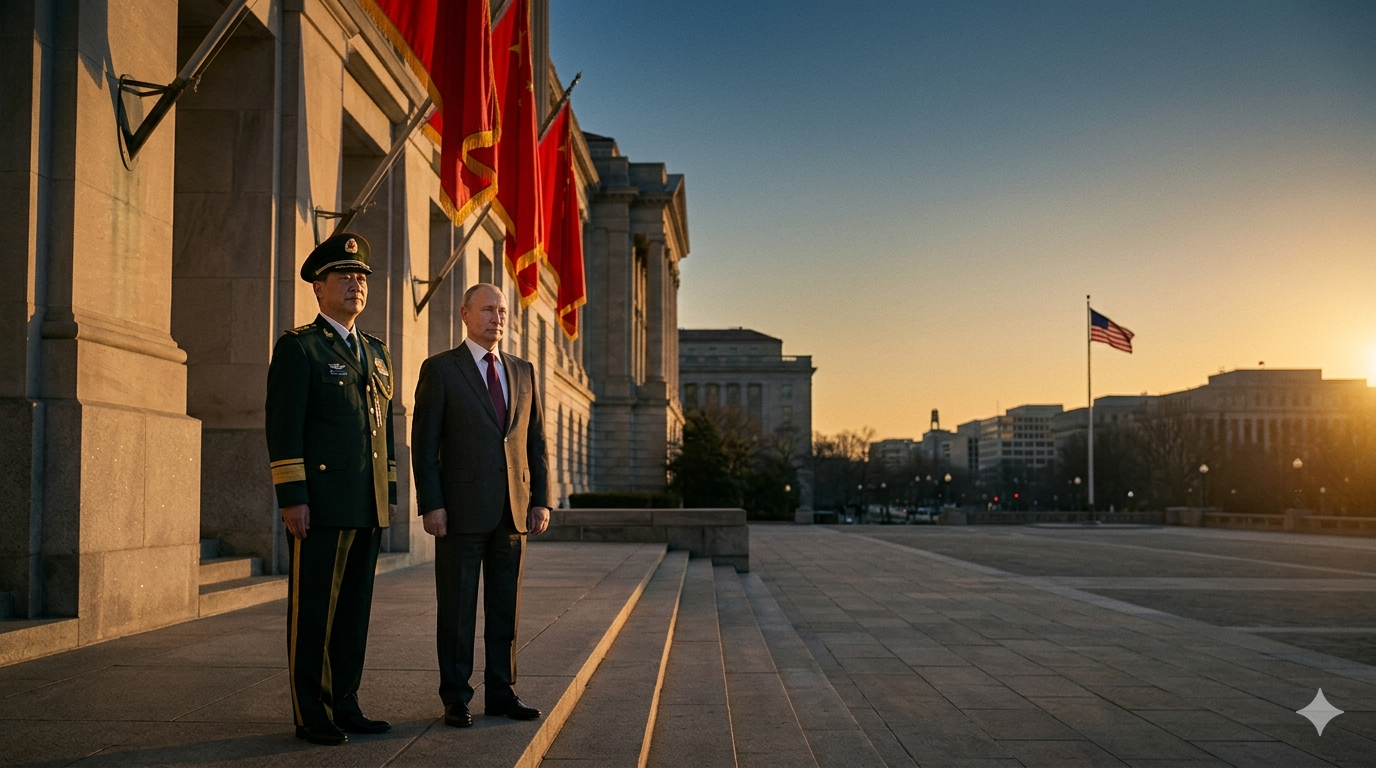
Five days ago, Donald Trump left Beijing, having called his summit with Xi Jinping "very good" and "very productive." The two sides produced some concrete trade outcomes — a framework for new boards of trade and investment, a Chinese commitment to purchase $17 billion annually in US agricultural products, and an initial order of 200 Boeing aircraft. What they did not produce was any breakthrough on the issues that actually matter to the global order: no agreement on Taiwan, no commitment from China to pressure Iran on the Strait of Hormuz, no reduction in Chinese purchases of the Iranian oil, keeping Tehran financially viable while American servicemen patrol a blockaded waterway. Trump got trade wins. He got no geopolitical ones. Today, Vladimir Putin landed in Beijing to a full red carpet, a military honor guard, a gun salute, and Xi Jinping waiting on the steps of the Great Hall of the People. They signed 20 bilateral agreements. Xi called the Russia-China relationship "a force of calm amid chaos." Putin quoted a Chinese proverb about longing for a friend. In the span of five days, China hosted the leaders of both the United States and Russia — and the contrast in what each of them left with could not be more pointed. Trump left with trade commitments and open geopolitical questions. Putin left with signed agreements and a partner who just told the world exactly where it stands.
The Back-to-Back That Rewrote the Room
The sequencing of this week's diplomacy was not accidental. Putin's visit to Beijing — his 25th trip to China, announced one day after Trump's departure — was structured to arrive immediately in the wake of the US-China summit, and the message it delivered was architectural. China has positioned itself not as an ally of Russia or a partner of America, but as the indispensable neutral superpower — the one capital both Washington and Moscow must court, neither of which can afford to lose. That positioning is not neutrality. It is leverage, and Xi is exercising it with precision.
The joint statement issued today took direct aim at Trump's proposed $175 billion "Golden Dome" missile defense system, warning against what both governments called a return to the "law of the jungle" in international affairs — Beijing's standard diplomatic language for American unilateralism. They criticized the expiry of the last US-Russia arms control treaty, which collapsed in February when Trump failed to respond to Moscow's proposal for a one-year extension. And they signed 20 agreements spanning energy, technology, agriculture, transport, media cooperation, scientific research, and the establishment of a Joint Innovation Institute — a breadth of institutional entanglement that dwarfs anything Trump produced from his own Beijing meeting five days earlier.
Behind the ceremony, analysts note a significant shift in the Russia-China power dynamic. Putin arrives in Beijing weaker than at any point since the Ukraine war began. Days before his departure, Ukraine launched what Russian media described as its largest drone attack on Moscow in over a year — more than 500 drones targeting the capital. Russia has been losing ground in Ukraine, recording its first net territorial loss since August 2024 in April. The Russian economy is now structurally dependent on China as its primary energy customer, primary trade partner, and primary source of goods that Western sanctions have cut off. Putin needed this meeting. Xi received him as a peer — and that asymmetry is itself a geopolitical signal.
What China Gets — and What America Just Conceded
The Strait of Hormuz angle is where this summit connects directly to every American paying over $4.50 at the pump, up approximately 50% since the February 28 start of the Iran war. Prior to the war, China was the largest buyer of Iranian oil, purchasing approximately 1.4 million barrels per day at heavily discounted prices that kept Tehran financially viable despite US sanctions. Since February 28, those flows have been severely disrupted by the conflict and intensified sanctions pressure — giving Beijing a direct and urgent economic incentive to see the strait reopened and Iranian supply restored. China needs Hormuz to be open. China also needs Iran to survive as a functioning state. It has leverage on both tracks, and it is the only major power to do so.
Trump went to Beijing last week and left without a Chinese commitment to pressure Iran on the Strait or on nuclear negotiations. Xi said nothing publicly during the Trump summit that constituted a concrete offer on Iran. Today — with Putin in the room — the two leaders discussed what their readout called "coordination on international issues," which is the diplomatic shorthand for Iran, Ukraine, and the future architecture of a world order that neither Russia nor China wants Washington to design unilaterally. China did not give Trump what he wanted. It then hosted the one leader whose interests most conflict with Trump's. That sequence is not a coincidence. It is a strategy.
Call to Action: The World Is Being Reorganized. Watch Where the Lines Are Being Drawn.
The United States is simultaneously managing a frozen war in the Middle East, a stalled Taiwan policy, a NATO alliance under strain, a $4 trillion debt ceiling fight at home, and a Federal Reserve whose independence is now a political variable. While Washington manages those fires, Beijing just hosted both Washington and Moscow in the same week — and walked away with signed agreements from both and binding commitments to neither. That is what strategic patience looks like at a civilizational scale.
- Track the Hormuz-China-Iran triangle: The one actor with the clearest leverage to reopen the Strait of Hormuz is China — it needs Iranian oil, it has Xi's relationship with Putin, who has his own Iranian connections, and it still holds Trump's trade architecture as a card. Watch whether any back-channel movement on Hormuz emerges from Beijing in the next two weeks. That signal will come through energy market pricing before it comes through press releases.
- Watch the Golden Dome vote in Congress: The $175 billion missile defense system that both Xi and Putin explicitly criticized today requires congressional authorization and appropriation. That debate is coming to the Senate floor. The joint Russia-China statement opposing it is not a reason to kill it — it may be a reason to accelerate it. Know your senator's position before the vote.
- Protect your financial exposure to a fragmenting dollar system: Russia and China are settling bilateral trade in yuan and rubles, not dollars. The 20 agreements signed today deepen that infrastructure. The long-term erosion of dollar dominance is not an imminent crisis — but it is a slow-moving structural shift that rewards people who prepare early. Hard assets, commodity exposure, and non-dollar-denominated positions are worth understanding now, not after the headlines force the conversation.
If you're researching this and not using a VPN to keep your financial browsing private from ISPs and data brokers, start now — Surfshark is what we use at V64OTD.
V64OTD // THE WORLD IS BEING REORGANIZED. THE QUESTION IS WHETHER YOU'RE WATCHING.
[ SHARE_THIS_DISPATCH ]