

[DISPATCH_LOG]
THE GHOST IN THE MACHINE: A HISTORY OF CELLULAR AGRICULTURE
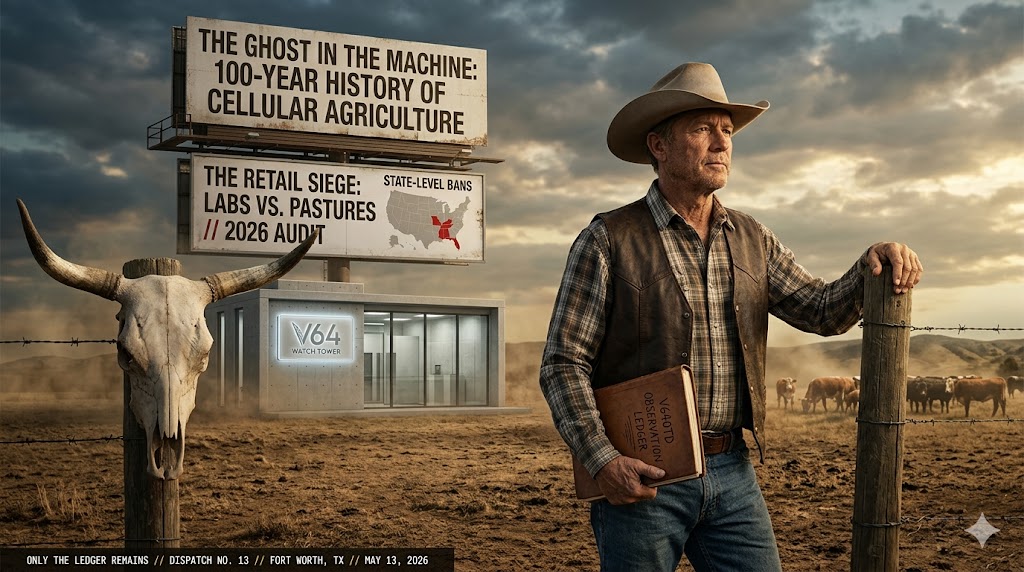
SECTION I: THE HUNDRED-YEAR PROPHECY
The concept of growing meat without the animal is not a modern whim of Silicon Valley, but a century-old prophecy. In December 1931, Winston Churchill famously predicted that we would one day "escape the absurdity of growing a whole chicken in order to eat the breast or wing, by growing these parts separately under a suitable medium" (Churchill, 1931). For nearly eighty years, this remained science fiction, confined to the margins of biological theory.
It wasn't until August 5, 2013, that the world witnessed the first practical application: a five-ounce burger, grown in a laboratory at Maastricht University and served at a televised press conference in London. It cost $325,000 to produce (Post, 2014). That single patty ignited a global race. By 2020, Singapore became the first nation to grant regulatory approval, followed by the United States in 2023. Yet, as we stand in May 2026, the transition from novelty to necessity has hit a wall of legislative fire and cultural skepticism.
SECTION II: THE BIOLOGY OF THE BIOREACTOR
Cellular agriculture does not "create" meat; it "multiplies" it. The process begins with a biopsy—a small tissue sample taken from a donor animal. Scientists isolate myosatellite cells (repair cells) and place them into a Bioreactor, which mimics the internal environment of an animal’s body (Good Food Institute, 2026).
Inside, the cells are bathed in a Growth Medium containing amino acids, glucose, and vitamins. In 2026, the industry has successfully shifted away from Fetal Bovine Serum (FBS) to plant-based growth factors, significantly lowering costs. The ambition is total: no protein is exempt.
- Beef: The "Holy Grail." Companies like BioBQ (Texas-based) and Aleph Farms use 3D scaffolds to teach cells to form the complex structure of a ribeye or brisket.
- Pork: Focusing on the "Flavor Trojan Horse." By culturing pork fat and mixing it with plant proteins, manufacturers achieve the "animal sizzle" that previous alternatives lacked.
- Seafood: Companies like Wildtype (Salmon) and Finless Foods (Tuna) target the high-end sushi market, bypassing traditional terrestrial livestock regulations (World Intellectual Property Organization [WIPO], 2026).
SECTION III: THE RETAIL BLACKOUT (2026 AUDIT)
Despite federal USDA and FDA "Grants of Inspection" issued to companies like Upside Foods and GOOD Meat, as of May 13, 2026, there is a massive disconnect between federal approval and local availability.
You cannot currently walk into a standard American grocery store and buy lab-grown meat.
The rollout has been throttled by a "State-Level Siege." Retailers like Kroger, H-E-B, and Walmart are not stocking these products due to the legal complexity of managing inventory in a fragmented legislative landscape. Currently, human consumption is limited to "prestige" environments such as Bar Crenn in San Francisco and China Chilcano in Washington, D.C. (Good Food Institute, 2026).
SECTION IV: THE PET FOOD "TROJAN HORSE"
While the human market is stalled, the industry has pivoted toward a "Pet Food First" strategy. Because regulatory hurdles for animal feed are lower and less politically sensitive, the pet aisle has become the first true retail front.
Active Retail Deployment (May 2026):
- Coolty Meat: Debuted in May 2026 by Forza10 and BeneMeat, featuring 26% cultivated protein (Forza10, 2026).
- Meatly (UK): Launched "Chick Bites," combining cultivated chicken with plant-based ingredients for the European market.
- U.S. Markets: In states like Massachusetts and California, "science-backed" pet stores are stocking hybrid kibble enhanced with cultivated fats. This is the industry’s testing ground for mass production and normalization (WIPO, 2026).
SECTION V: THE LEGISLATIVE FIREWALL
The struggle is no longer scientific; it is sovereign. As of May 2026, a "legal patchwork" has effectively blocked cultivated meat from the Heartland through proactive bans and restrictive labeling.
| State | Status (as of May 13, 2026) | Primary Legislation |
| Florida | BANNED | SB 1084 (Florida Department of Agriculture, 2024). |
| Alabama | BANNED | SB 252 (Alabama State Legislature, 2024). |
| Nebraska | PROHIBITED | LB 246 (Good Food Institute, 2026). |
| South Dakota | BANNED | SB 124 (South Dakota Legislature, 2026). |
| Texas | MORATORIUM | SB 261 (Texas Legislature, 2025). |
The USDA’s 2026 update to the "Product of USA" labeling rule further isolates these products by mandating that only meat from animals born, raised, and slaughtered in the U.S. can bear that claim (U.S. Department of Agriculture [USDA], 2024).
SECTION VI: THE STEALTH INTEGRATION STRATEGY
The industry's new strategy is "Integration" rather than "Disruption." They are moving away from 100% lab-grown cuts and toward:
- Hybrid Blends: Mixing cultivated animal fat with plant proteins to improve consumer acceptance of "plant-based" alternatives.
- Ingredient Processing: Selling cultivated proteins as "fillers" or "flavor enhancers" to large-scale processors.
- Institutional Supply: Targeting school lunches and prisons in states without protective legislation (WIPO, 2026).
SECTION VII: CALL TO ACTION – DEFENDING THE DINNER PLATE
The arrival of the engineered harvest is not an inevitability; it is a policy choice. To ensure the Ledger of our food remains intact, Americans must act at the state level before the stealth rollout reaches local shelves.
1. Demand State-Level Intervention: Contact your State Legislators today. Support legislation that mimics Florida and Alabama's bans (Alabama State Legislature, 2024; Florida Department of Agriculture, 2024).
2. Labeling Integrity: Advocate for laws requiring "Cell-Cultured" or "Lab-Grown" descriptors in the largest font on the package to ensure consumer transparency (USDA, 2024).
3. Audit Your Local Grocer: Ask managers about their policy on "Hybrid Proteins" or "Engineered Lipids."
4. Support Decentralized Ranching: Strengthening your relationship with local, independent Texas ranchers is the ultimate defense against a centralized, corporate-controlled food supply. Buy local. Buy Texas.
REFERENCES
Alabama State Legislature. (2024). Senate Bill 252: Prohibition of the manufacture and sale of cultivated meat. Alabama Secretary of State.
Churchill, W. (1931). Fifty years hence. Strand Magazine.
Florida Department of Agriculture and Consumer Services. (2024). SB 1084: Regulation of food and cultivated meat products. Florida Senate Archive.
Forza10. (2026, May 1). Launch of Coolty: The first cultivated pet food protein. Corporate Press Release.
Good Food Institute. (2026). State of the industry report: Cultivated meat and seafood 2025-2026. GFI Research Division.
Post, M. J. (2014). Cultured meat from stem cells: Challenges and prospects. Meat Science, 97(3), 298–304. https://doi.org/10.1016/j.meatsci.2014.01.023
South Dakota Legislature. (2026). Senate Bill 124: Prohibiting the sale of cultivated meat products. South Dakota Legislative Research Council.
Texas Legislature. (2025). Senate Bill 261: Relating to the labeling of certain meat food products. Texas Legislative Service.
U.S. Department of Agriculture. (2024, March 13). USDA finalizes voluntary 'Product of USA' labeling rule. Food Safety and Inspection Service.
World Intellectual Property Organization. (2026). Global trends in biotechnology: Food systems and cellular agriculture. WIPO Economics and Statistics Series.
[ SHARE_THIS_DISPATCH ]