

[DISPATCH_LOG]
The Cancer Warning Nobody Gave You: Why Middle Age Is the Danger Zone Medicine Has Been Ignoring
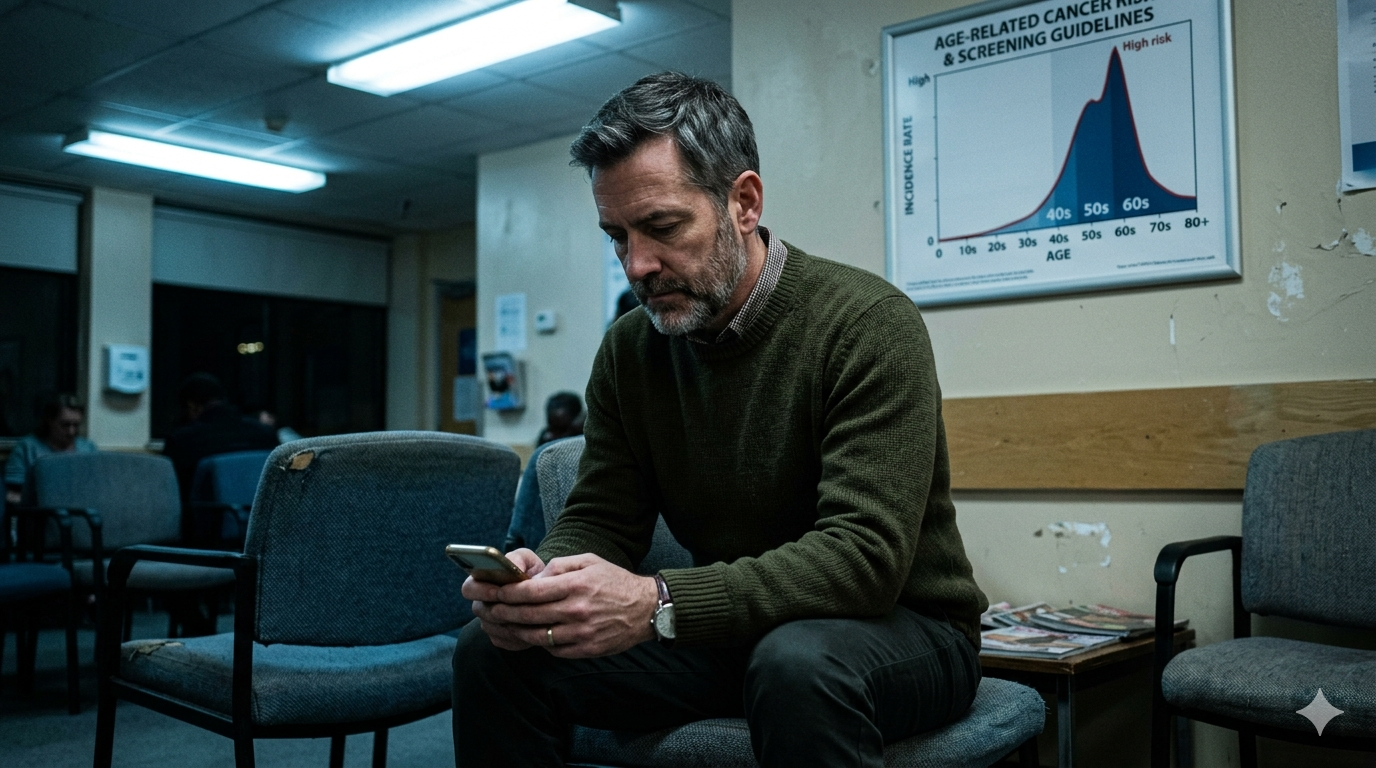
Medicine has told you for decades that cancer is primarily a disease of old age — that the older you get the higher your risk and the more aggressively you should screen. That assumption has shaped everything: the age at which colonoscopies begin, the guidelines for mammograms, the benchmarks for PSA testing, the entire framework of when the medical establishment decides you are worth watching closely.
New research presented at the American Association for Cancer Research annual meeting in April — published this week in the journal Cancer Research — says that assumption is wrong in a way that may be costing lives. Researchers at Fox Chase Cancer Center studied how melanoma behaves across different life stages and found something that contradicts the foundational logic of cancer screening in America: cancer spread was lowest in young subjects, surged dramatically in middle age, and then dropped again in very old age. Not a steady climb. A peak. A dangerous middle window — and then a decline that nobody has fully explained.
"While risk increases steadily as people age, it abruptly decreases after ages 80-85," said lead investigator Mitchell Fane, PhD, a cancer biologist who specializes in aging and cancer at Fox Chase. "We want to explain the mechanism of why very old patients are getting less cancer, but middle-aged patients are getting more."
If you are between 40 and 65, this research is about you. And your doctor may not have told you it exists.
The Immune Cell That Changes Everything in Middle Age
The mechanism the researchers identified sits in the immune system — specifically in a specialized type of immune cell called a gamma-delta T cell. These cells act as the immune system's first line of surveillance against cancer. In young and healthy immune systems, gamma-delta T cells are active, alert, and effective at identifying early cancer cells and keeping them dormant — contained before they can establish, spread, or become the kind of disease that shows up on a scan.
In middle-aged subjects the researchers found a specific and alarming pattern: melanoma cells were releasing certain molecules that exhausted and shut down the gamma-delta T cells — effectively disabling the immune system's cancer surveillance function at exactly the moment those subjects were most vulnerable to metastatic spread. With the gamma-delta T cells neutralized, previously dormant cancer cells were waking up and spreading aggressively. The immune system's cancer watchdog was being switched off — not by age-related decline, but by the cancer itself, exploiting a specific vulnerability in the middle-aged immune architecture.
In very old subjects, that vulnerability appeared to resolve — the pattern of aggressive spread dropped again, and the gamma-delta T cells appeared less susceptible to the same disabling mechanism. The researchers do not yet fully understand why. The working hypothesis is that the immune system undergoes another transition in very old age that inadvertently restores some of the cancer surveillance function that middle age temporarily lost. Understanding that mechanism — what changes between middle and very old age that reduces metastatic vulnerability — is now the central research question.
What This Means for the Screening You Are Not Getting
The American Cancer Society's current guidelines recommend colonoscopy screening beginning at age 45. Mammogram guidelines vary by organization but generally begin annual screening at 40-45. Skin cancer screening has no formal national recommendation for frequency — the US Preventive Services Task Force has not issued a blanket recommendation for routine skin cancer screening in asymptomatic adults. The assumption embedded in all of these guidelines is that the relationship between age and cancer risk is a steady upward line — older means higher risk, younger means lower risk.
The Fox Chase research suggests that line has a peak in the middle that our screening schedules do not adequately account for. If cancer spread is most aggressive in middle age — if the immune system's surveillance capacity is most compromised between roughly 40 and 65 — then the people who most need aggressive monitoring are not necessarily the 75-year-olds the system is built around. They are the 52-year-olds who feel fine, had a normal checkup last year, and assume they are not in a high-risk window because no one has told them they are.
Harvard researchers confirmed a parallel finding earlier this year: six cancers — colorectal, cervical, pancreatic, prostate, kidney, and multiple myeloma — are rising faster in adults under 50 than in older adults across at least five countries. The trend is documented across two large cancer databases covering 2000-2017 and is accelerating. The cancer your grandmother got at 78 is not the cancer threatening your generation at 48. The disease is not waiting for you to get old.
What the Research World Has Been Getting Wrong
The Fox Chase finding carries a secondary indictment that the research community itself acknowledged: fewer than 10% of mouse cancer studies use aged animals. The vast majority of preclinical cancer research — the foundation of drug development, treatment protocols, and clinical trial design — is conducted on subjects that are biologically equivalent to humans in their early 20s. Researchers are designing cancer treatments based on data from immune systems that do not reflect the immune systems of the patients most likely to need those treatments.
"The vast majority of studies are done in these very young mice that have a healthy and intact immune system," said lead researcher Mitchell Fane. The consequence of that research gap is direct: cancer drugs that show remarkable promise in preclinical trials repeatedly fail when they reach human patients — in part because the human patients are middle-aged or older, with immune systems that behave fundamentally differently from the young systems the drugs were tested against. Billions of dollars in cancer research investment, years of clinical trials, and years of patient hope have been affected by a study design flaw that the research community has known about and not adequately corrected.
That is not a peripheral finding. It is a structural indictment of how the medical establishment has prioritized and conducted cancer research — and it has consequences for every patient who received a treatment that worked in a lab mouse and failed in a 55-year-old human body.
Call to Action: Do Not Wait for the Guidelines to Catch Up
Medical guidelines move slowly. The research establishing that cancer behaves differently in middle age than the guidelines assume was presented at a major conference this spring and published this week. It will take years — possibly a decade — for that finding to work its way through the institutional review process, influence updated screening recommendations, and change the conversation your primary care physician has with you at your annual physical. You do not have that kind of time to wait passively.
Talk to your doctor today — specifically about your cancer surveillance plan between now and age 65. Ask about gamma-delta T cell function, about your personal immune profile, and about whether your current screening schedule reflects the latest research on when cancer spreads most aggressively. If your doctor does not know what the Fox Chase AACR research says, bring it to the appointment. The study is public. The journal Cancer Research published it. You have the right to ask whether the care you are receiving is based on the most current evidence.
Know the ABCDE warning signs for melanoma — the cancer studied in this research — and apply them to yourself every 90 days. Asymmetry, Border irregularity, Color variation, Diameter larger than a pencil eraser, Evolving appearance. Melanoma caught in stage one has a 98% survival rate. Melanoma caught in stage four has a 22% survival rate. The difference between those two numbers is often a single dermatology appointment that did not happen in time.
Push for expanded research funding for aged animal models. The gap between young-mouse research and middle-aged human outcomes is killing people. Contact your congressional representatives and ask them to specifically support NIH funding directives that require age-appropriate animal models in cancer research. This is not a fringe ask. It is a documented research failure with a documented solution that requires political will and public pressure to implement.
The window nobody warned you about is open right now — for many of you reading this. The immune system that is supposed to be watching for cancer is most vulnerable between 40 and 65. The cancer cells know it even if your doctor has not told you yet.
V64OTD // THE WINDOW IS OPEN. MOST PEOPLE WON'T KNOW UNTIL IT CLOSES.
[ SHARE_THIS_DISPATCH ]