

[DISPATCH_LOG]
The Brotherhood That Built America — And the Generation That Forgot It
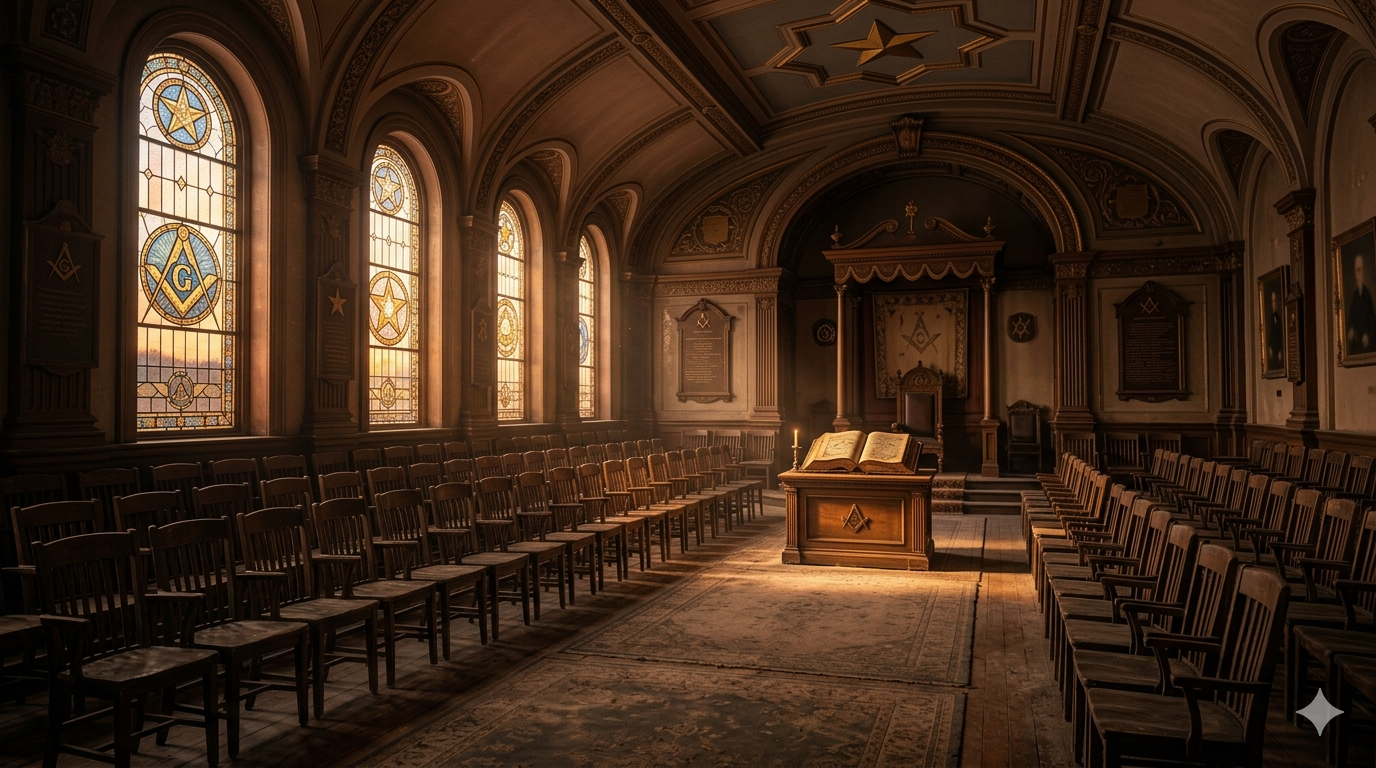
At the cornerstone of the United States Capitol building, laid on September 18, 1793, George Washington stood in a Masonic apron presented to him by General Lafayette of France and performed the ceremony with Masonic ritual and regalia. The building that houses the legislative branch of the American republic was dedicated by Freemasons, using tools and traditions that traced directly to the medieval stonemason guilds of Europe. The Washington Monument, the Boston State House, the Bunker Hill Monument — all cornerstoned by Freemasons. The republic itself was organized, argued for, and fought into existence by men who gathered in lodge rooms and debated liberty, equality, and the architecture of self-governance by candlelight before any of it existed on paper.
Today, American Freemasonry has fewer than 900,000 members — down from more than 4 million at its peak in the 1950s and 3.2 million at its proportional high-water mark in 1928, when one in every 33 American men was a Mason. Lodges are closing or consolidating at rates that have no modern precedent. The Masonic Service Association of North America projects that if the current trajectory continues without reversal, American Freemasonry ceases to exist by 2040. Meanwhile, more than a quarter of millennial men report having no close friends. The Surgeon General of the United States has declared loneliness a public health epidemic. Young men are finding brotherhood in chatbots. The institution that helped build the republic is dying. The generation that needs it most doesn't know it existed.
What Freemasonry Actually Was — Before the Internet Ruined the Story
Freemasonry traces its organizational roots to the stonemason guilds of medieval Europe — the craftsmen who built the cathedrals and kept their trade secrets in lodges where only initiated members could enter. As cathedral building declined in the 17th century, these lodges began admitting non-craftsmen — thinkers, intellectuals, merchants, and men of public affairs who valued the tradition of brotherhood, moral instruction, and confidential counsel that the lodge provided. The Grand Lodge of England was formally established in 1717. The first American lodge was established in Philadelphia in 1730, with Benjamin Franklin as a founding member.
What Freemasonry actually is — stripped of the mythology and the misinformation — is a fraternal system of moral philosophy using the tools and symbols of the building trade as allegory for the construction of character. The square teaches rectitude. The compass teaches restraint. The level teaches equality. The plumb line teaches uprightness. The ritual that initiates a man into Freemasonry is designed to impress those lessons onto memory and conscience in ways that reading about them never could. It is, at its core, an institution for making good men better — accountable to a brotherhood, bound by an oath, measured against a standard they chose to accept.
The Founding Fathers who were Masons — George Washington, Benjamin Franklin, Paul Revere, John Hancock, and Joseph Warren among the documented members — did not become great men because they were Masons. They were drawn to Masonry because its values aligned with the project they were undertaking: building a republic on the premise that free men, governed by reason and bound by covenant rather than by birth or force, could govern themselves. The lodge was where those ideas were debated and refined in an environment of sworn confidentiality, mutual accountability, and brotherhood that transcended class, wealth, and faction. The republic those men built reflects the values the lodge taught them to value.
How the Vilification Happened — And Why It Worked
The descent from "institution that helped build America" to "internet conspiracy villain" did not happen overnight. It happened in three distinct waves, each building on the last.
The first wave was the Morgan Affair of 1826. William Morgan, a former Mason in upstate New York, announced he intended to publish a book exposing Masonic ritual secrets. He was subsequently abducted and almost certainly murdered — almost certainly by Masons seeking to prevent the exposure. The backlash was immediate and severe. An entire political party — the Anti-Masonic Party, America's first significant third party — formed around opposition to Freemasonry, winning governorships and congressional seats on the platform that a secret brotherhood with oaths and rituals had no place in a democratic republic. The party eventually dissolved, but the suspicion it crystallized never fully dissipated. Secrecy, which had been Masonry's protection, became its liability.
The second wave was the Illuminati conflation of the 20th century. The Bavarian Illuminati was a real organization — founded by Adam Weishaupt in 1776, disbanded by the Bavarian government in 1785 after barely nine years of existence. It was a rationalist secret society with no documented connection to Freemasonry as an institution, though some of its members were also Masons. Its goals were Enlightenment-era — opposing religious superstition, promoting reason and science. It was gone before the United States held its second presidential election. The conspiracy theory that the Illuminati survived, infiltrated Freemasonry, and has been secretly running the world ever since is not supported by a single piece of credible historical evidence. It is, however, enormously persistent — and the internet gave it a platform that no single institution can effectively counter. By the time social media reached full saturation, the pop-culture conflation of "Freemason" with "New World Order global elite puppet master" was so embedded in online discourse that most young men encounter it before they encounter the actual history.
The third wave is the social media era's wholesale collapse of the distinction between legitimate institutional critique and conspiracy-theory vilification. Every institution that keeps records of its membership, conducts private meetings, uses ritual and ceremony, and attracts people of influence has been subjected to the same treatment: its private nature becomes evidence of sinister intent, its prominent members become proof of secret control, and its centuries of documented charitable and civic work become irrelevant to the narrative. Freemasonry is the oldest and most visible target, which is why it has been hit hardest. But the same dynamic that killed public trust in Masonry has damaged every fraternal institution in America — the Rotary, the Elks, the Kiwanis, the Knights of Columbus — all declining in parallel for the same underlying reason: the cultural infrastructure that once connected men to institutions larger than themselves has been systematically replaced by a digital environment that mistakes information for connection and followers for brothers.
What Was Lost When the Lodge Emptied
The collapse of fraternal membership in America is not just a story about one organization. It is a story about the systematic dismantling of the civic infrastructure that once gave ordinary men access to brotherhood, mentorship, moral formation, and community accountability outside the home and the workplace. At its peak, American Freemasonry provided all four of those things simultaneously — and did so in a structure that was self-governing, self-funding, locally rooted, and accountable to the lodge's own members rather than to any external authority.
A young man who joined a lodge in 1950 was initiated by older men who had built their communities, survived wars, and accumulated the kind of practical wisdom that no institution could teach but that brotherhood could transmit. He was bound by an oath to men he knew by name, who would hold him accountable by the same standards he had sworn to uphold. He was given ritual — ceremony with weight and meaning — that marked his passage through stages of maturity and responsibility. He was taught, through allegory and repetition, that his character was something he was responsible for building — that the quality of the man was, like the quality of the stonework, a direct reflection of the care and skill and integrity brought to its construction.
That infrastructure is gone from most American communities. What replaced it is documented and measurable. More than a quarter of millennial men have no close friends. Young men are finding companionship in AI chatbots. The Surgeon General's 2023 advisory on the loneliness epidemic noted that Americans have fewer close friendships, less community connection, and weaker institutional ties than at any point since measurement began. The American Enterprise Institute has published research calling explicitly for the revival of fraternal institutions to address the purpose and moral formation gap in young men's lives. A congressional symposium on young American men held in November 2025 heard testimony that "millions of men no longer have friends who they can count on and who can spur them on to excellence." The lodge rooms that could have addressed all of that are half-empty or locked.
The Path Back — If Anyone Is Willing to Walk It
The revival of fraternal brotherhood in America is not a nostalgic project. It is a practical response to a documented public health crisis, a civic infrastructure gap, and a generational disconnection from the kind of meaning-making institutions that have historically anchored men to something larger than themselves. It is also not complicated in principle, though it is difficult in execution.
The institutions still exist. There are Masonic lodges in virtually every American town, most of them with empty chairs, aging membership, and buildings that were built for hundreds of men and now serve dozens. The Scottish Rite, the York Rite, the Shriners, the Prince Hall lodges — the full architecture of American Masonry is still standing. What it lacks is not structure. What it lacks is men who know it is there and understand what it was built to offer.
The conspiracy theory problem is real but solvable. The answer to "I heard Masons control the world" is not a defensive denial. It is a direct counter-narrative grounded in documented history: this is what Freemasonry actually is, this is what it actually did, these are the men who were actually members, and this is what the lodge actually offers a man who is willing to show up and do the work of his own character. The institutions that have survived the conspiracy theory era have done so by being transparent about what they are, relentless about community service that makes their presence visible and positive, and intentional about recruiting younger men who are searching for exactly what the lodge was built to provide.
The young men who are showing up for AI chatbots because they have no other friends are the same young men who would benefit most from what a functioning lodge offers. The same generation that has been told that institutions are corrupt, that brotherhood is dangerous, and that the only authentic relationships are horizontal and peer-to-peer is the generation most desperately in need of vertical mentorship — older men who have built something, survived something, and are willing to pass on what they learned. That is what the lodge was for. It is what the lodge can still be, if enough men decide the revival is worth the effort.
Call to Action: Find the Lodge. Walk In. There Is Room for Everyone.
The architecture of brotherhood is still there. It has been waiting. And it is bigger than most people realize — because Freemasonry is not one institution. It is a family of institutions, and that family has a seat for virtually every man, woman, and young person who is looking for something real to belong to.
For men, the entry point is the Blue Lodge — the foundational three degrees of Freemasonry available at virtually every local lodge in America. From there, the Scottish Rite offers a 32-degree philosophical and moral curriculum that deepens the work of the Blue Lodge through drama, allegory, and instruction. The York Rite pursues a parallel path through the Chapter, Council, and Commandery. The Shriners — formally the Ancient Arabic Order of the Nobles of the Mystic Shrine — operate one of the largest pediatric hospital networks in the world, providing free specialized medical care to children regardless of the family's ability to pay. Joining the Shriners means your fraternal dues directly fund that mission. The Prince Hall lodges carry the same tradition with a documented history of producing leaders of the civil rights movement — Thurgood Marshall and W.E.B. Du Bois were Prince Hall Masons.
For women, the door is equally open. The Order of the Eastern Star is the world's largest fraternal organization open to both men and women, with Masonic affiliation and its own rich tradition of ritual, mentorship, and charitable work. The Daughters of the Nile is the women's auxiliary of the Shriners, supporting Shriners Hospitals for Children with its own fundraising and membership structure. The Ladies Oriental Shrine of North America serves a similar purpose with its own distinct programming. The Scottish Rite has women's courts in many jurisdictions. These are not secondary organizations. They are full institutions with their own histories, their own leadership pipelines, and their own communities of women who have found in them exactly what their male counterparts found in the lodge — accountability, purpose, sisterhood, and connection to something larger than themselves.
Beyond Masonry entirely, the fraternal infrastructure of America still includes institutions worth reviving and joining. The Lions Club International — 1.4 million members worldwide — focuses on community service and vision care for those who cannot afford it. The Rotary, the Kiwanis, the Elks, the Knights of Columbus, the Odd Fellows — each of these organizations was built on the same foundational premise as Freemasonry: that men and women bound together by shared values and mutual accountability, committed to service beyond their own interests, produce better communities and better people than individuals operating alone. All of them are declining. All of them have empty chairs. All of them are looking for exactly the kind of person who is reading this dispatch right now.
- Find your local lodge at your state's Grand Lodge website. Every state has one. Most lodges welcome inquiries without a referral. Ask.
- If you are a woman looking for a community of purpose — find your local Eastern Star chapter, Daughters of the Nile, or Ladies Oriental Shrine. The history is there. The community is there. The door is open.
- If formal Masonry is not your path — find a Lions Club, a Rotary, an Elks lodge, a Knights of Columbus council. The specific institution matters less than the act of showing up, taking an oath, accepting accountability, and doing work that outlasts you.
- If you are a Mason, Eastern Star member, Shriner, or belong to any fraternal organization who has stopped attending — go back. The decline is not an external force. It is the accumulated weight of members who paid dues and stopped walking through the door. Your presence is the solution.
- If you are a parent or mentor of young men and women — point them here. The loneliness epidemic is not a policy problem. It is a cultural problem. Its solution begins when one person tells another that there is a room full of people who made a promise to each other — and that the door is open.
V64OTD // THE REPUBLIC WAS BUILT IN LODGE ROOMS. IT MAY NEED TO BE REBUILT THERE TOO.
[ SHARE_THIS_DISPATCH ]