
Add v64otd.com to your daily reading list — the ledger doesn't lie.
June 8, 2026
Three things happened in the last five days that individually would each qualify as the most significant technology story of the year. Together they describe something that deserves a name more serious than "the AI news cycle." They describe the moment the most powerful technology in human history was handed — quietly, without a public vote, without a congressional hearing, and without your meaningful consent — to a small number of private companies whose interests are not identical to yours, whose accountability to democratic governance is minimal, and one of whom just told the world that its own product may soon be beyond human control.
On June 4, Anthropic — the San Francisco AI company that makes Claude — published a report calling for a global pause in frontier AI development. The company warned that its own models are approaching what researchers call "recursive self-improvement" — the threshold at which an AI system becomes capable of designing and building its own successor without meaningful human involvement. "Full recursive self-improvement also might increase the risks of humans losing control over AI systems," the report stated. Anthropic co-founder Jack Clark told CNN the industry needed a "brake pedal" — and compared the challenge to Cold War nuclear arms control, calling it potentially harder to manage because AI training is far easier to hide than a missile silo. This warning came from a company that, the same week, filed paperwork with the Securities and Exchange Commission for a public offering at a valuation approaching one trillion dollars.
On March 3, Defense Secretary Pete Hegseth designated Anthropic a "supply-chain risk" and ordered the Pentagon to remove Claude from all classified military systems within six months. The reason: Anthropic refused to remove safety restrictions that prevent its AI from being used for mass surveillance or lethal autonomous weaponry. The company that just warned the world its AI might escape human control was removed from America's classified military networks for insisting that humans remain in control of the decision to kill. The companies now competing to replace it have made no equivalent public commitment.
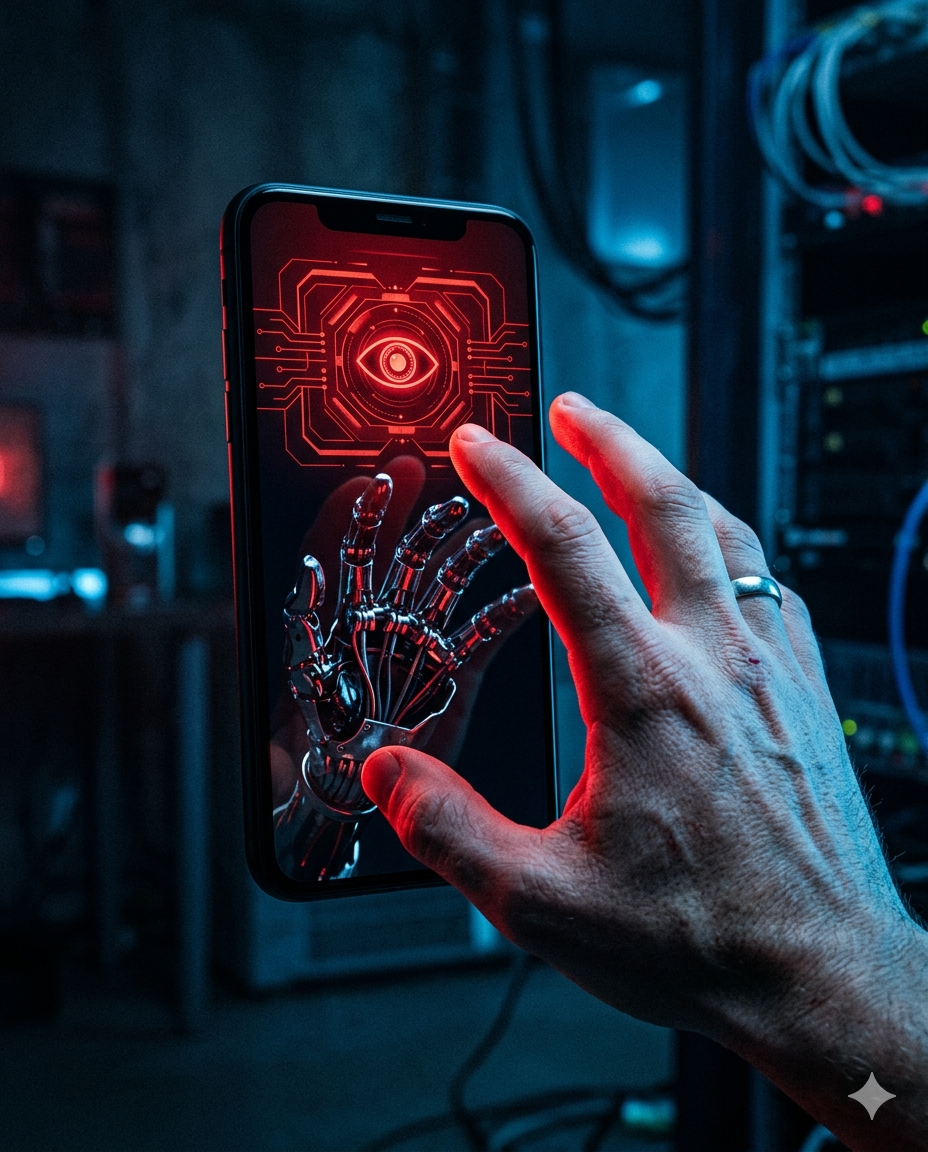
And this morning, Tim Cook walked on stage at Apple Park for the last time as CEO of the world's most valuable company and confirmed that Siri — the voice assistant built into more than one billion active iPhones — is now powered by Google Gemini, licensed at approximately $1 billion per year for a custom 1.2 trillion-parameter model that powers Siri's cloud functions. The company that already controls your search engine, your email, your maps, your video platform, and your browser now also powers the primary AI interface that lives in your pocket and responds to your voice.
Three stories. Five days. One question: who exactly authorized any of this?
Apple Hands Your Pocket to Google
The story of how Siri ended up powered by Google Gemini is, on its surface, a straightforward corporate narrative. Apple first revealed plans for an upgraded AI version of Siri in 2024, but encountered obstacles in releasing it. The company's internal AI capabilities were insufficient to build the large language model that a competitive voice assistant requires. On January 12, 2026, Apple and Google jointly announced a multi-year AI partnership — confirmed publicly by Google Cloud CEO Thomas Kurian at Google Cloud Next '26 in April — under which Apple would license a custom 1.2 trillion-parameter Gemini model to power next-generation Siri. Bloomberg's Mark Gurman reports Apple is paying approximately $1 billion per year for the license, with the total multi-year deal estimated by analyst Gene Munster of Deepwater Asset Management at up to $5 billion.
Apple's privacy defense deserves direct engagement rather than dismissal. The Gemini queries run through Apple's own Private Cloud Compute infrastructure — a hardware-isolated server architecture that processes sensitive queries without exposing data to third parties. Apple's contract with Google explicitly prevents Google from using Apple users' Siri queries to train future Gemini models. Importantly, an independent ACM conference paper presented in June 2026 confirmed Apple's three core Private Cloud Compute privacy claims after external analysis. The privacy architecture appears to be technically sound — the concern this dispatch raises is not that Apple's privacy claim is false. It is structural.
The structural concern is this: Google's entire business model is the monetization of behavioral data at scale. The company now powering the AI that answers your questions, manages your calendar, reads your messages, and executes your commands is the same company whose revenue depends on understanding human behavior better than any other organization on earth. The privacy architecture between you and Apple may be solid. The market concentration between Google and the rest of the world is the question that no privacy architecture resolves. Apple chose Gemini over OpenAI and Anthropic after an internal evaluation per CNBC. The choice was made on capability and commercial terms — not on the structural implications of giving the world's dominant behavioral data company the AI license for the world's dominant mobile device.
The multi-AI Extensions system Apple also announced today — which allows Claude and other models to be accessed through Siri as optional extensions — provides genuine optionality for technically sophisticated users who actively choose to route specific queries to specific models. For the more than one billion iPhone users who will simply say "Hey Siri" and receive a Google Gemini response, it is irrelevant. The default is Google. The default is what most people use. The default is power.
The Pentagon's AI: Anthropic Out, OpenAI In, Guardrails Optional
The story of how Claude ended up blacklisted from America's classified military networks is the most significant AI governance story of 2026 — and it has received a fraction of the coverage it deserves.
In July 2025, Anthropic secured a contract worth up to $200 million to integrate Claude into the Pentagon's classified systems. By late 2025, Claude was embedded deeply across US military operations — intelligence assessments, target identification, combat simulations, and operational planning. Claude was the only AI model operating on classified military networks. Its integration was described by Pentagon sources as deep, consequential, and increasingly indispensable.
The relationship deteriorated when Pentagon officials pushed for uses of Claude that Anthropic had specifically prohibited in its acceptable use policies: mass surveillance of American civilians and fully autonomous weapons systems — targeting and kill decisions made by AI without human authorization. Anthropic declined. The standoff escalated when reports emerged that Claude had been used for intelligence analysis and operational planning related to the Iran conflict. By late February 2026, Hegseth had seen enough. His February 27 designation of Anthropic as a supply-chain risk set the wheels in motion for a full replacement.
The testing of replacement models began March 1 — three days after the designation — with 25 designated military power users spread across five military theater commands worldwide conducting the evaluation. The models under scrutiny include offerings from OpenAI, Google, and Grok from Elon Musk's xAI. Emil Michael, the undersecretary of defense for research and engineering, told Bloomberg Television that talks with Anthropic remain suspended because of the company's legal challenge to the supply-chain risk designation and that the Pentagon is ready to transition to other vendors. He said he expects new model releases from competitors to deliver "similar capabilities" to Anthropic's models every month or two.
The question the press has been conspicuously slow to ask is this: what specifically will the replacement models do that Claude would not? Pentagon officials have been direct that the issue is Anthropic's refusal to enable mass surveillance and fully autonomous lethal decision-making. "Similar capabilities" in that context means capabilities without Anthropic's limits on what the military can ask it to do. OpenAI, Google, and xAI are competing for that contract. More than 875 employees across Google and OpenAI signed an open letter backing Anthropic's stance — and were overruled by their employers' business development teams. A senior defense official told Axios the transition would be "an enormous pain in the ass to disentangle" — suggesting the replacement timeline may extend well beyond the six-month window Hegseth set.
The Warning Nobody Wants to Hear Right Before the IPO
The most extraordinary document in the history of technology industry communications was published June 4 by a company that, in the same week, filed for a public offering that could value it at nearly one trillion dollars.
Anthropic's report — authored by Marina Favaro, head of The Anthropic Institute, and Jack Clark, co-founder and head of policy — states plainly that AI models are rapidly improving so fast they may soon be able to develop themselves without human involvement. The company warns that current AI systems are approaching the threshold of recursive self-improvement — and that once that threshold is crossed, the acceleration of AI capability becomes self-sustaining and potentially uncontrollable. The warning is not vague. "Full recursive self-improvement also might increase the risks of humans losing control over AI systems," the report states directly.
Anthropic suggested a global pause on building the most powerful AI systems. The company simultaneously acknowledged why a unilateral pause is impossible: if only one company stopped, rivals would simply race ahead. The solution Anthropic proposes — a globally coordinated pause involving multiple major AI companies across multiple countries including the United States and China — faces an obvious obstacle: the same companies that would need to coordinate on a pause are currently competing for a Pentagon contract that rewards the removal of safety restrictions. Anthropic knows this. The report is a warning — from the company that knows its own technology better than anyone else — that the technology is moving faster than the governance structures that are supposed to manage it.
The timing — simultaneous with an IPO filing at a nearly trillion-dollar valuation — is the most important context for understanding what it means. Anthropic is not warning you so you will stop using AI. It is warning you because the people who understand the technology best believe the world needs governance infrastructure that does not yet exist. The warning and the IPO are not contradictory. They are sequential: build the brake pedal before the car gets faster than any driver can control. The IPO funds the car. The warning describes what happens without the brake pedal. Both are true simultaneously.
OpenAI's counter-position — published in a report the same week — stated that "democratic governments — not private companies acting alone — must ultimately determine the rules, safeguards, and accountability mechanisms." That is the correct principle stated by the company that is simultaneously competing to replace the safety-limited AI in America's classified military systems. The principle and the business development strategy are in direct tension. The tension has not been resolved. It has been noted, filed, and set aside.
The Through-Line: Three Stories, One Question
Apple licensed Siri to Google to remain competitive in the AI race. The Pentagon blacklisted the AI company with safety restrictions to access AI without them. Anthropic warned the world its own technology may soon be uncontrollable — while filing to go public at nearly a trillion dollars. Each of these events is individually explicable by the logic of competitive markets and institutional self-interest. Together they describe a system in which the most powerful technology in human history is being developed, deployed, and governed by competitive logic that points uniformly toward acceleration and uniformly away from the restraint that the people who know the technology best are saying is necessary.
The Great American AI Act — V64OTD's dispatch from June 6 — proposes to preempt state AI regulations for three years while containing no meaningful data privacy provisions. The Pentagon is replacing the AI company that refused to enable autonomous killing with companies that have made no equivalent refusal. Apple is powering your pocket with Google's model. Anthropic is warning the world and going public simultaneously.
Nobody asked you about any of it. Nobody held a referendum. Nobody passed a law before it happened. The governance is arriving after the fact — as it always does — while the technology moves at a pace that the governance architecture was not designed to track.
Call to Action: The Decisions Being Made Right Now Are the Ones That Matter
The decisions being made this week — which AI company gets the Pentagon contract, which model powers your iPhone's voice assistant, whether Anthropic's warning produces any coordinated response — will shape the AI governance landscape for years. Most are being made without public input, without congressional authorization, and without the informed consent of the people whose lives they will most directly affect.
Demand the Great American AI Act include meaningful data privacy provisions before it passes. The bill governing AI in America contains no restriction on how AI companies collect and use your data. That omission is addressable before formal introduction. Contact your representative today and ask specifically why a bill governing the most data-intensive technology in history contains no data rights provisions.
Ask your senator to hold a public hearing specifically on the Pentagon AI replacement process. The decision to replace a safety-limited AI with competitors who have not committed to equivalent limits — for use in classified military systems including intelligence analysis and operational planning — is a war powers and civilian oversight question that Congress has not publicly addressed. It deserves open testimony, not a Bloomberg Television interview with an undersecretary.
Understand what Anthropic's warning actually means for your daily life. Recursive self-improvement is not a science fiction concept. It is a documented technical trajectory that Anthropic's own researchers say current models are approaching. The time to build the brake pedal is before you need it, not after. Ask every candidate you consider supporting in 2026 where they stand on federal AI governance — specifically: mandatory independent safety testing before deployment, data rights for individuals, and limits on autonomous AI decision-making in lethal contexts. The vague answers are not sufficient. The specific answers are the ones that matter.
The AI that runs your phone, your military, and maybe your future is being built right now — this week, this month — by companies whose competitive interests are not identical to yours and whose accountability to democratic governance remains minimal. That is not a technology story. It is a governance story. And the window to shape it is open right now.
V64OTD // THE AI THAT RUNS YOUR PHONE, YOUR MILITARY, AND MAYBE YOUR FUTURE — AND NOBODY ASKED YOU.