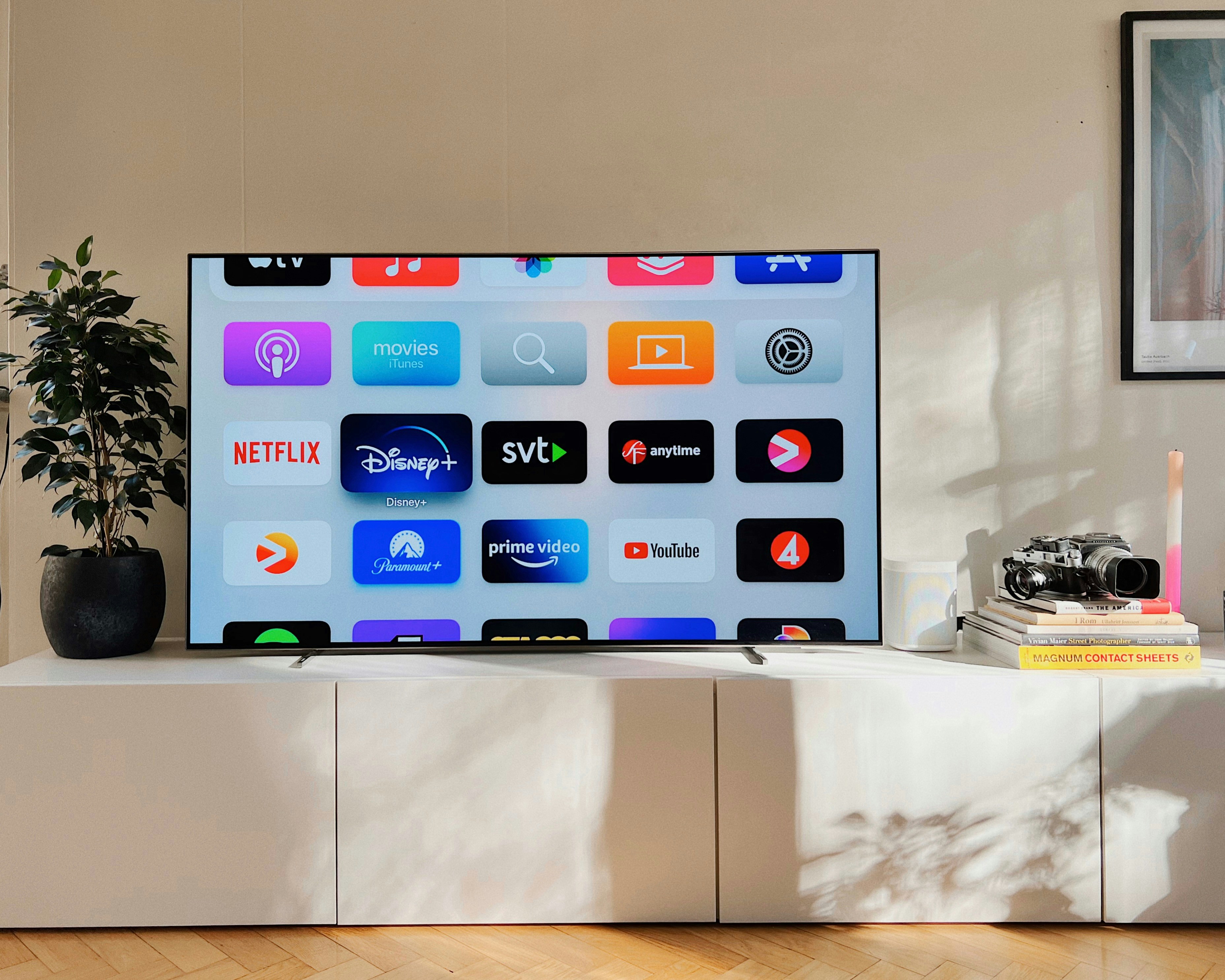

In 2015, the pitch was simple: drop cable, pick up Netflix and maybe Hulu, keep a few dollars in your pocket every month, and watch what you want when you want it. Ten years and roughly a dozen mergers later, the average American household is spending more on streaming than it used to spend on cable, watching it get carved into smaller pieces owned by fewer companies, and canceling services faster than at any point since streaming became a habit. This is the pattern the FCC-Paramount ethics story fits inside — not an isolated scandal, but the latest turn of a wheel that's been turning for a decade.
corporatocracy (noun) — a system where the companies that used to compete for your subscription now compete to buy each other instead, and the choice you're left with shrinks every time they do.
curated control (noun) — a system in which your choice, your access, or your outcome feels like the product of open competition, when the entity presenting it controlled the boundaries before you ever arrived; it doesn't decide for you, it decides what you're allowed to decide from, and calls the difference freedom.
Phase One: The Promise (2015–2018)
Cord-cutting's original case was financial. Netflix and Hulu already existed, but this was the stretch where "just get Netflix" became genuine advice, not a niche habit. HBO launched HBO NOW in 2015, letting people pay for prestige TV without a cable bundle for the first time. Amazon expanded Prime Video and took it worldwide by 2016. Netflix was mid-transformation from a DVD-mailing service into a content producer, with House of Cards and Stranger Things proving original streaming shows could match anything on a traditional network. For most households, "streaming" meant one, maybe two subscriptions, and the total bill was a fraction of cable. The pitch was working.
Phase Two: The Land Grab (2019–2021)
Then every media company that had spent the 2010s licensing its shows to Netflix looked at Netflix's stock price and decided to stop. Apple TV+ launched November 1, 2019. Disney+ launched eleven days later, on November 12, at $6.99 a month — cheap on purpose, to buy market share fast. Peacock (NBCUniversal) and HBO Max (WarnerMedia) both launched in 2020. Discovery+ followed in 2021. Each new service pulled its flagship titles off the platforms that used to carry them — Friends went exclusive to HBO Max, The Office went exclusive to Peacock, Seinfeld went to Netflix — so a viewer who wanted access to all of it needed all of it. Industry press at the time called this exactly what it was: in 2020, if you wanted to watch everything you used to get on cable, it was simply going to cost you more money, spread across more monthly charges, than cable had. The fragmentation wasn't an accident of competition; it was the direct, predictable result of six media conglomerates deciding the licensing-revenue model was worth less than the subscription-revenue model, all at once.
Phase Three: The Consolidation Turn (2022–2023)
Fragmentation was never going to be the endpoint — running a standalone streaming service is expensive, and not every media company that launched one in the 2019–2021 land grab could afford to keep losing money on it. The unwind started with AT&T spinning off WarnerMedia and merging it with Discovery in April 2022 to form Warner Bros. Discovery, over direct objections from Senator Elizabeth Warren and Rep. Alexandria Ocasio-Cortez that the deal "raises significant antitrust concerns." Neither the FTC nor the DOJ challenged it. Once merged, WBD's new leadership went looking for savings inside the library it had just acquired, and viewers got a preview of what "consolidation" actually looks like day to day: completed, ready-to-release projects — including the $90 million film Batgirl, fully shot and in post-production — were shelved and written off for tax purposes rather than released, and older HBO and HBO Max titles including Westworld and The Nevers were pulled from the platform entirely. WBD ultimately took $2.8 to $3.5 billion in content write-offs. None of that content came back; the company's own CFO said by January 2023 that the tax-write-off era was over, which was less a promise than an admission of what the prior year had been.
2023 added a second lever beyond content cuts: monetizing the audience harder. Netflix's password-sharing crackdown, which rolled out in the U.S. at the end of May 2023, is the clearest data point in the entire decade for how consolidation-era streaming actually makes its money. It worked, by the numbers that matter to the company: Netflix added 5.89 million subscribers in Q2 2023 as the crackdown took hold, 8.76 million more in Q3, and 13.1 million in Q4 — 29.5 million net new subscribers for the year, more than the company itself had guided investors to expect, closing 2023 at 260 million total subscribers and $34 billion in annual revenue. Growth kept accelerating from there; Netflix added another 9.33 million subscribers in the first quarter of 2024 alone. Every other major service took the signal. Password-sharing restrictions and ad-supported tiers, which barely existed at the start of the decade, are now standard across Netflix, Disney+, Max, Peacock, and Paramount+ — meaning the "cheap" plan many households now pay for comes with commercials that didn't exist when they signed up, on top of a subscription fee that didn't shrink to reflect it.
Phase Four: The Mergers Get Bigger (2024–2026)
By 2024, four years of standalone-streaming losses had made the direction of travel obvious, and the deals started getting larger. Paramount's board fielded and rejected a merger approach from Skydance Media through most of 2024 before agreeing to it in 2025, with the FCC approving the combined company in July 2025 on a 2-1 vote. Warner Bros. Discovery, less than three years removed from its own founding merger, put itself up for sale in October 2025 — first weighing a split of its cable networks from its studio and streaming assets, then fielding competing bids from Paramount, Comcast, and Netflix. Netflix's offer, at $82.7 billion, covered only the streaming and studio assets. Paramount's hostile, all-cash bid for the entire company — cable networks included — won at $111 billion after eight rounds of price increases, making it the largest entertainment deal ever announced. That merger is currently paused pending a 12-state antitrust lawsuit, and it's the deal at the center of the ethics questions raised in V64OTD's companion piece on the FCC chairman's gifts from Paramount.
Zoom out, and the shape of the decade is a bell curve: a handful of services in 2015, a dozen-plus at the 2020–2021 peak, and a smaller number of much larger companies absorbing each other on the way back down by 2026. The number of choices a household had to juggle went up, then the number of companies behind those choices went down — and the second part happened without ever giving back the first part's price increases.
What It Actually Costs Now
The financial promise cord-cutting made in 2015 has functionally inverted. Reviews.org found U.S. consumers spent an average of $3,350 a year in 2025 — about $278.50 a month — to stay connected across their streaming and internet services, up again year over year. A streaming stack that actually matches what cable used to offer — Netflix, Max, Disney+, Hulu, Peacock, and a live-TV service — now runs $150 to $165 a month at current list prices, which is comparable to or higher than a bundled cable bill in many markets. Individual services tell the same story, even accounting for the fact that none of them jumped all at once: Netflix's standard ad-free plan cost $12.99 a month in early 2020 and $19.99 as of the March 2026 increase, up 54%. Disney+ launched at $6.99 in November 2019 specifically to buy market share fast; its ad-free Premium plan is $18.99 now, nearly triple. HBO Max launched in May 2020 with a single ad-free plan at $14.99; that tier, now called Standard, is $18.49 following an October 2025 increase — a smaller jump in percentage terms, but one that arrived alongside something that didn't exist in 2020 at all: a cheaper ad-supported tier, now $10.99, that didn't exist until mid-2021 and exists specifically so the company can sell a "budget" option that still shows commercials. None of this happened as a single dramatic jump — it happened the way these things always happen, a dollar or two at a time, on a schedule set by companies that got bigger every time two of them merged.
Consumers have started responding the way people respond to a bad deal: by leaving. The average American household cut its subscriptions from 4.1 services in 2024 to 2.8 in 2025 — a 32% drop in a single year — and monthly churn across the streaming industry has climbed from roughly 2% in 2019 to over 6% in 2026. Cost is the single most-cited reason people cancel. That's not a footnote to the consolidation story; it's the market's verdict on it, delivered household by household, faster than any regulator has moved on any of the mergers that caused it.
The Amazon-MGM Precedent, Again
V64OTD's companion piece on the FCC-Paramount ethics story lays out the Amazon-MGM case in detail: a 2021 acquisition sold to the public on a promise of "greater access" to MGM's film library, which instead resulted in the James Bond catalog being pulled behind a second, separate paywall (MGM+) two years later, alongside a nearly two-thirds cut to original-content spending and mass cancellations once the deal's owners needed to show a profit. That pattern — access promised at announcement, restriction delivered after close — isn't unique to Amazon. It's the standard playbook for what happens after any of the mergers on this timeline, and it's the honest baseline for what to expect once Paramount and Warner Bros. Discovery are one company instead of two.
Where This Leaves the Viewer
None of the individual decisions in this timeline required breaking a law. Tax write-offs on shelved content are legal. Password-sharing restrictions are a company enforcing its own terms of service. Ad-supported tiers are disclosed at signup. Mergers get reviewed by antitrust regulators who, as V64OTD's Paramount coverage details, don't always agree with each other about what "harm to competition" even means. What a decade of these individually-legal decisions adds up to is a streaming market that now costs more than the cable it replaced, is controlled by fewer companies than it was five years ago, and is trending toward fewer still — with the two government bodies built to check that trend, the DOJ and the state AGs currently suing over the Paramount-WBD deal, unable to agree on whether it's even happening.
Corporatocracy doesn't need a monopoly to work. It just needs enough consolidation that "switch to a competitor" stops being a real option — and a decade of mergers is how you get there one legal deal at a time.
Curated control looked, in 2020, like six different apps competing for your subscription. It looks, in 2026, like the same six apps owned by three or four companies, still presenting themselves as six different choices.
What You Can Actually Do
- Audit your own subscriptions against what you actually watch. The industry's own churn data shows most households are over-subscribed relative to use — canceling and rotating services seasonally (subscribe for a season's worth of a show, cancel, resubscribe later) costs less than holding six standing subscriptions year-round.
- Watch the Paramount-Warner Bros. Discovery merger's antitrust litigation, not just the FCC's ethics questions — the 12-state lawsuit is the live check on whether this particular deal goes through, and it will shape how much consolidation the next decade allows.
- If a price increase or content removal affects a service you pay for, cancellation and public feedback are the lever that's actually moved these companies before — see Netflix's ad-tier and password-sharing rollout, both direct responses to subscriber behavior, not regulation.
Sources
Shentel. A Detailed Look at the History of Streaming Services, January 2025 (HBO NOW 2015 launch, Amazon Prime Video 2016 global expansion, Netflix's shift to original programming).
Variety. Top 19 Media Trends of 2019: D.A.W.N. of a New Streaming Era; Washington Post, Best New Streaming Services 2019; Slate, Apple TV+, Disney+, HBO Max, Peacock, and the Streaming Wars, Explained (2019–2020 launch dates for Apple TV+, Disney+, HBO Max, Peacock; exclusivity moves for Friends, The Office, Seinfeld).
TechRadar. In 2020, We'll Learn How Many Streaming Services Is Too Many (contemporaneous industry assessment of fragmentation-era costs).
Hollywood Reporter / Axios / Cord Cutters News. Coverage of the April 2022 WarnerMedia-Discovery merger forming Warner Bros. Discovery, Senator Elizabeth Warren's and Rep. Alexandria Ocasio-Cortez's antitrust objections, and the FTC/DOJ's decision not to challenge the deal.
Variety. Warner Bros. Discovery Content Write-offs coverage, 2022; Hollywood Reporter, Warner Bros. Discovery Content Write-offs Revealed; ComicBook.com, Warner Bros. Discovery Taking Up to $1 Billion More in Tax Write-Downs; Deadline, Tax Write-Offs For Content Are Over At Warner Bros Discovery (write-off totals of $2.8–3.5 billion, Westworld/The Nevers removal, CFO Gunnar Wiedenfels's January 2023 statement). NPR, Warner Bros. Kills Off Batgirl Movie, $90 Million In; Newsweek, Tom's Guide, and Yahoo Finance coverage of the same — all independently reporting the $90 million Batgirl budget and its cancellation for a tax write-off.
Variety, Netflix Adds Nearly 6 Million Subscribers Amid Password Sharing Crackdown in Q2 (2023); CNN Business Q3 2023 earnings coverage; Deadline, Netflix Q4 2023 Earnings: Streamer Blows Past Q4 Subscriber Targets To Top 260M; Forbes, The Netflix Password Sharing Crackdown Is Working; Nerdist, coverage of Netflix's 9.33 million Q1 2024 net adds. Quarterly subscriber-addition figures (5.89 million Q2, 8.76 million Q3, 13.1 million Q4 2023; 29.5 million net for the full year; 260 million total subscribers and $34 billion revenue at year-end) cross-sourced across these outlets, all citing Netflix's own quarterly shareholder letters and SEC filings as the underlying source.
CNBC, Netflix Raises Prices on Standard and Premium Plans (October 2020); CBS News and Variety, coverage of Netflix's March 2026 price increase to $19.99 for the Standard ad-free plan; NBC News, coverage of the 2022 Disney+ price increase; DealNews and NerdWallet, current (August 2026) Disney+ and HBO Max pricing; TVGuide and SubscriptionPriceGuide, HBO Max/Max price history from its May 2020 launch through the October 2025 increase, including the June 2021 launch of its first ad-supported tier.
Reviews.org (via Yahoo Finance, The Cost of Streaming in 2026) and CableCompare. Coverage of average U.S. household streaming/connectivity spend ($3,350/year, $278.50/month in 2025) and full-stack streaming cost comparisons to cable ($150–165/month).
Self Financial (via Readless, Subscription Fatigue Statistics 2026) and RetentionCheck, Streaming Services Churn Rate report. Coverage of the drop in average household subscriptions (4.1 in 2024 to 2.8 in 2025) and the rise in monthly streaming churn (roughly 2% in 2019 to over 6% in 2026), with cost cited as the leading cancellation driver.
CNBC / NBC News / CNN / Variety / Deadline. Coverage of the 2025–2026 Warner Bros. Discovery sale process, Netflix's $82.7 billion offer, Paramount's winning $111 billion hostile bid, and the ongoing 12-state antitrust lawsuit — as detailed in V64OTD's companion piece on the FCC chairman's Paramount gift disclosures.
Washington Post / Motley Fool / MIDiA Research / Wikipedia / TechRadar / Cord Cutters News / Screen Rant. Coverage of the Amazon-MGM acquisition and its aftermath (MGM+ paywall, James Bond catalog restriction, Prime Video content-budget cuts) — as detailed in V64OTD's companion piece on the FCC chairman's Paramount gift disclosures.