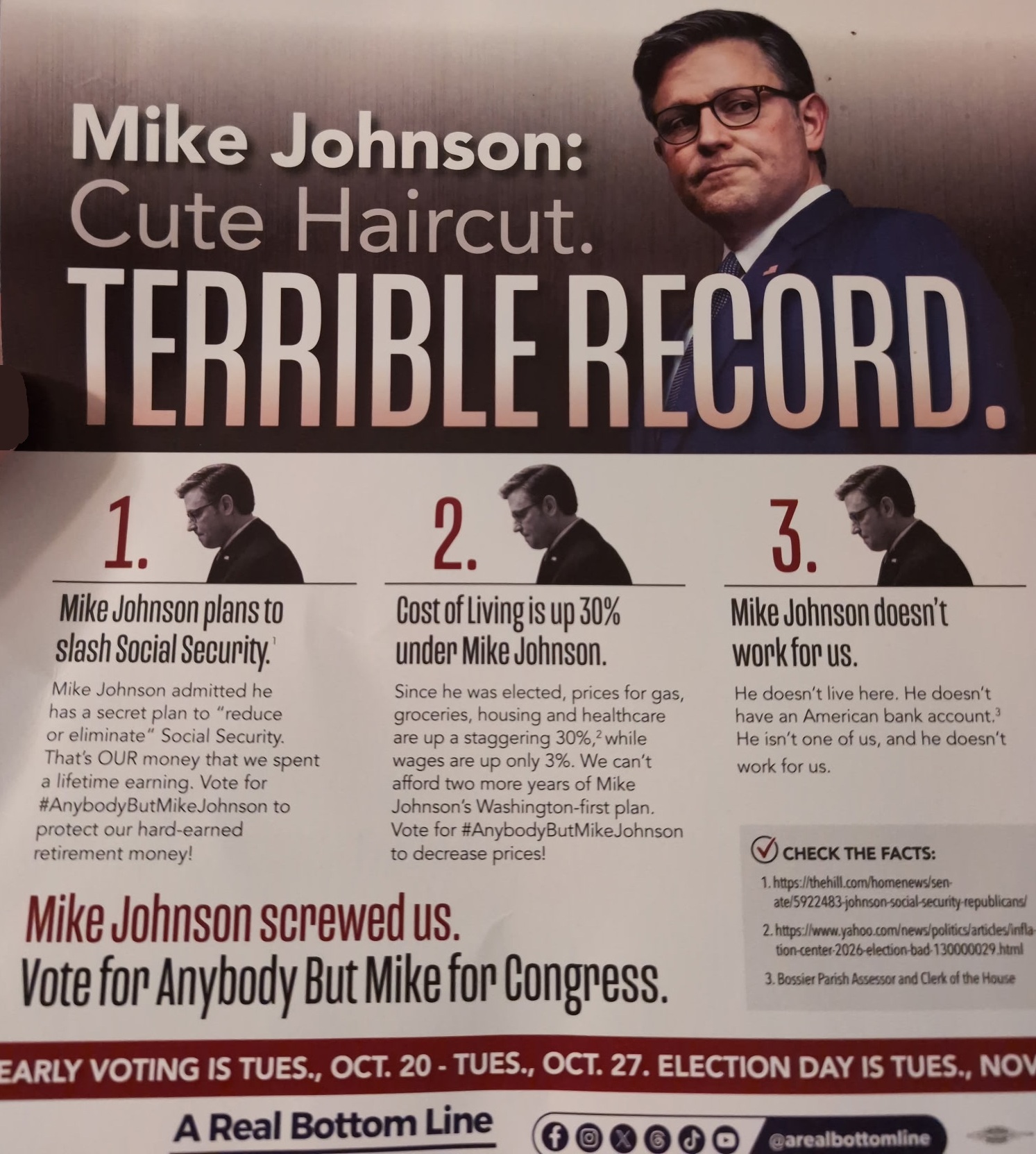

A mailer in Louisiana says House Speaker Mike Johnson has a “secret plan” to “reduce or eliminate” Social Security. One man paid for it, and I can’t find Johnson saying those words anywhere. But here’s what should really scare you: under current law, your Social Security check is scheduled to be cut about 22% in 2032, and neither party has lifted a finger to stop it.
Last week, I wrote about a fake transgender mailer that hit Texas homes on the first day of early voting. This week, a reader sent me one that landed in Speaker Mike Johnson’s own district in northwest Louisiana. Different state, different target, same playbook: scare people first, explain nothing.
Social Security trust fund: the reserve that covers the gap when payroll taxes don’t bring in enough to pay full benefits. When it runs out, the law only lets Social Security pay what comes in, which means an automatic, across-the-board cut.
Editorial: This Dispatch contains my opinion, clearly marked as such, alongside sourced reporting.
The Mailer
The glossy piece reads “Mike Johnson: Cute Haircut. TERRIBLE RECORD.” and makes three claims:
- “Mike Johnson admitted he has a secret plan to ‘reduce or eliminate’ Social Security.”
- “Cost of Living is up 30% under Mike Johnson… while wages are up only 3%.”
- “He doesn’t live here. He doesn’t have an American bank account.”
It closes with “Vote for Anybody But Mike for Congress,” and lists Louisiana’s early voting dates. Johnson faces two Republicans and two Democrats in the November 3 open primary. If no one gets more than 50%, the top two go to a December 12 runoff.
Who Paid for It
The mailer is signed “A Real Bottom Line.” According to Federal Election Commission records:
- It’s a super PAC, which can spend unlimited money as long as it doesn’t coordinate with a campaign. It registered on August 6, 2026, about three months before the election.
- From July through October 14, it raised $999,927.94.
- Every dollar came from one person: John Ratcliff of Shreveport, in 14 contributions ranging from $1,000 to $200,000.
- It had spent about $794,000 by mid-October.
The group’s website says it wants to keep Johnson below 50% to force a runoff, then elect the Democrat. That’s a legitimate political goal. But the mailer doesn’t say “vote Democrat.” It says “Anybody But Mike,” and it hides behind a name that sounds like a grassroots taxpayer group funded by a single wealthy donor.
Checking the Mailer’s Claims
Claim 1: Johnson “admitted he has a secret plan to ‘reduce or eliminate’ Social Security.”
The mailer’s source is a Hill article headlined “GOP split over Speaker Mike Johnson’s call to reform Social Security.” Here’s what Johnson actually said, in a June radio interview: mandatory programs like Social Security “have to be adjusted and fixed. We have a plan to do that next year.” He added, “desperate times call for desperate measures.” After the backlash, he posted that the coverage was “FAKE NEWS” and that “we are not talking about reducing a single benefit.”
The verdict: I found no record of Johnson saying “reduce or eliminate.” The quotation marks on the mailer are misleading. But the worry isn’t baseless. In 2019, while Johnson chaired the Republican Study Committee, its budget proposed raising the full retirement age from 67 to 69 and the early age from 62 to 64, cutting about $756 billion from Social Security over a decade. Raising the retirement age is a cut to benefits.
Claim 2: “Cost of Living is up 30% under Mike Johnson… while wages are up only 3%.”
The mailer’s source for the 30% is a Yahoo article about prices in New England, Connecticut specifically, over the past eight years. It isn’t about Louisiana, and it isn’t about Johnson. The 3% wage figure matches the most recent one-year wage growth, which means the mailer compares eight years of prices to one year of wages.
The verdict: misleading. Prices really have risen sharply in recent years, and Washington’s spending is part of the story. But no single member of Congress sets prices, and the numbers here don’t come from where the mailer implies.
Claim 3: “He doesn’t live here. He doesn’t have an American bank account.”
Johnson’s 2022 financial disclosure listed no bank account and no assets. His office told Marketplace he has a personal bank account that isn’t reportable because it earns no interest; under House rules, only interest-bearing accounts above $5,000 must be disclosed. As for “doesn’t live here,” Johnson’s home is in Benton, in Bossier Parish, inside the district. The mailer cites the Bossier Parish assessor but doesn’t say what record supposedly shows otherwise.
The verdict: misleading on the bank account and unsupported on residence.
The Real Threat Is Already on the Calendar
Forget the mailer for a minute. Here’s the part neither party puts on a postcard.
In June, Social Security’s trustees reported that the main retirement trust fund will run out in 2032, a year earlier than last year’s estimate. When it does, the law allows Social Security to pay only what comes in, and benefits drop about 22% across the board. For a married couple of average earners, that’s roughly $10,600 a year, according to the Bipartisan Policy Center. The 75-year shortfall now stands at about $30.3 trillion.
That’s not a prediction about what one party might do. It’s what happens if both parties keep doing what they’re doing now: nothing.
If you’re 62 today, you’ll be 68 when it hits.
What Republicans Have Done
- They wrote the cuts into their budgets. The 2019 Republican Study Committee budget, under Johnson’s chairmanship, proposed raising the retirement age to 69.
- Their speaker called for “fixing” it, then denied it. Johnson said there’s “a plan” for next year, then called the coverage “fake news” and promised no benefit cuts, without saying what the plan is.
- Their tax law made it worse. The trustees and the Bipartisan Policy Center say the main reason the date moved up to 2032 is the 2025 “One Big Beautiful Bill Act,” which cut taxes on Social Security beneficiaries. That lowered the income taxes on benefits that flow back into the trust fund.
- They’re split. Sen. Josh Hawley (R-Mo.) said words like “addressed” and “reformed” usually mean “cut,” and that Johnson’s comments sounded like the wealthy protecting “their tax breaks and loopholes.”
What Democrats Have Done
- They never voted on their own plan. The Democrats’ Social Security 2100 Act, which would raise benefits and extend the program’s life by taxing wages above $400,000, has been introduced in nearly every Congress since 2013. It has never received a floor vote, including the years Democrats controlled the House.
- They campaign on fear instead. Every cycle brings warnings that Republicans will gut Social Security, like this mailer. What Democrats haven’t done, even with the House, the Senate, and the White House in 2021 and 2022, is pass a plan to keep it solvent.
What They Did Together
- They expanded it without paying for it. In December 2024, Congress passed the Social Security Fairness Act, which raised benefits for millions of retired public workers. It passed the Senate 76–20 with support from both parties. The Congressional Budget Office said it would add about $195 billion to deficits over a decade and move the insolvency date up by about six months. It was a popular vote, and it didn’t come with a dollar of new funding.
- They’ve known for decades. The last time Social Security faced a crisis like this, in 1983, a Republican president and a Democratic House speaker struck a deal: Ronald Reagan and Tip O’Neill backed a bipartisan package that, among other things, gradually raised the retirement age to 67. Both sides gave something up. Forty-three years later, with a larger shortfall and a tighter deadline, nobody has proposed anything that both parties will vote on.
So Is There a Plan to Get Rid of Social Security?
Editorial: I went looking for proof that both parties are working together to kill Social Security. I didn’t find a secret plan. I found something that works out the same for you: a cut already written into law, and two parties who’ve decided it’s safer to run against each other on it than to fix it.
Think about it. If either party passed a real fix, they’d lose their best scare ad. Republicans would have to admit what “adjusted and fixed” means. Democrats would have to put their tax increase to a vote. So every two years, you get a postcard telling you the other side is coming for your check, and the clock keeps running.
They don’t need to agree to gut Social Security. They only need to agree to keep doing nothing. And on that, the Uniparty has been perfectly bipartisan.
Why Do We Keep Doing This?
If both parties are letting a 22% cut happen on their watch, it’s worth asking a harder question: why do we keep sending them back?
Most Americans already know something is wrong. In 2025, a record 45% of Americans identified as independents, according to Gallup, more than identify as Republicans (27%) or Democrats (27%). Sixty-two percent say the two major parties do such a poor job that a third major party is needed. Among independents, it’s 74%.
So why don’t we vote that way? The same Gallup survey has the answer, and it’s fear. Fifty-seven percent of Americans are extremely or very concerned about “wasting” their vote, and 59% worry about helping the candidate they like least. More than half say they’d abandon a third-party candidate they preferred if that candidate looked unlikely to win.
We vote against, not for. When Pew Research asked independents why they lean toward one party, the only reason a majority on both sides gave was that the other party’s policies are harmful to the country. Seventy-two percent of Republicans now say Democrats are more immoral than other Americans; 63% of Democrats say the same about Republicans. Both numbers have nearly doubled since 2016.
That’s not an accident. It’s the business model. A voter who’s afraid of the other team doesn’t ask why their own team hasn’t fixed anything. It’s the same fear that put a fake transgender mailer in Texas mailboxes last week and a “secret plan” mailer in Louisiana this week.
And the system is built to keep it that way:
- Winner-take-all elections punish a third choice. In a race where the top vote-getter takes everything, voters reasonably fear splitting their side’s vote. Political scientists have long observed that this kind of system pushes countries toward two parties.
- The debate stage is guarded. The Commission on Presidential Debates requires 15% in national polls to qualify, a bar few independent or third-party candidates can clear without the coverage the debates themselves provide.
- Congress punishes independence. Committee seats are handed out through the party caucuses. An independent who refuses to join one generally gets no committee assignments, which is why independents like Sens. Bernie Sanders and Angus King caucus with Democrats.
The Founders saw this coming. John Adams wrote in 1780: “There is nothing which I dread so much as a division of the republic into two great parties, each arranged under its leader, and concerting measures in opposition to each other. This, in my humble apprehension, is to be dreaded as the greatest political evil under our Constitution.” George Washington spent much of his Farewell Address warning that parties could become “potent engines, by which cunning, ambitious, and unprincipled men will be enabled to subvert the power of the people and to usurp for themselves the reins of government.”
We were warned. We built it anyway.
There Is a Way Out
Breaking a two-party lock doesn’t happen in one election. But the tools exist, and some of them are on ballots right now.
Vote for the alternatives already on your ballot. The Libertarian Party, the country’s largest third party, fields candidates across the country. In Texas, Libertarians are on the ballot for governor and the U.S. Senate. Texans also have an independent alternative for governor in write-in candidate Jenn Mack, who is endorsed by the Constitution Party of Texas and is certified by the Secretary of State, so a write-in for “Jenn Mack” will be counted. A vote for a third party or an independent that loses isn’t wasted; it’s a measurable signal both parties watch, and in close races, it’s the margin they have to earn back.
Disclosure: I’ve endorsed Jenn Mack for governor, and I’m voting Libertarian in my other races.
Back independents who refuse to caucus. A new crop of independent candidates is trying to break the caucus system itself:
- Six independent Senate candidates calling themselves the Fulcrum Caucus aim to win enough seats that neither party can run the Senate without them, then demand reforms before helping either side organize. One candidate wants an independent Senate leader with the same floor time and resources as the party leaders.
- California Rep. Kevin Kiley left the Republican Party this year, says he won’t caucus with it if reelected, and has proposed House rules that would guarantee committee seats to members outside both parties. “The committee seats should belong to the American people,” he said.
- Former Sen. Joe Manchin has launched a group to elect independents to Congress who pledge not to caucus with either party.
Whatever you think of any of these people, the idea is the point: a bloc of members who answer to voters, not to a party leader, can force votes on problems both parties would rather campaign on.
Change the rules that protect the duopoly.
- Ranked-choice voting lets you rank candidates in order, so voting for a third choice can’t “spoil” anything. If your first choice is eliminated, your vote moves to your next one. Alaska uses it with open primaries; voters there kept it in 2024 by the narrowest margin in state history, and it faces another repeal vote this year.
- Open primaries let every voter, not just party members, help choose who makes the final ballot.
- Fair ballot access and debate rules would let more candidates be heard.
- Committee seats for independents, like Kiley’s proposal, would end Congress’s penalty for refusing to join a team.
Most of all, stop rewarding fear. When a mailer tells you the other side is coming for your check, your faith or your kids, ask what the sender has actually done to fix anything. Then look at every name on your ballot and decide for yourself.
Editorial: Factions are destroying this Republic from the inside. Not because Republicans and Democrats are evil, but because the system rewards them for keeping us divided and punishes them for working together. Every two years, we’re told this is the most important election of our lives. Every two years, the same problems are still sitting there: Social Security heading for a cut, property taxes climbing, health care costing more for less. The only thing that changes the incentive is voters who stop letting fear dictate their choices. If the Republic is going to survive, it won’t be because one team finally beats the other. It’ll be because enough of us stopped playing.
Call to Action
- Look up your own number. Create an account at ssa.gov and see your estimated benefit. Then multiply it by 0.78. That’s what current law pays after 2032 if Congress does nothing.
- Ask your representative and senators one question. What is your specific plan to keep Social Security solvent before 2032, and have you voted on it? “I’ll protect it” is not a plan.
- Check every mailer. If it uses quotation marks, look for the quote. If it cites a source, read the source. This one cited an article about New England to make a claim about Louisiana.
- Look up who paid. Every super PAC’s donors are public at fec.gov. This mailer’s entire budget came from one man.
- Vote past the duopoly. Look up the Libertarian and independent candidates on your ballot. Find out whether your state or city allows ranked-choice voting or open primaries, and support efforts to bring them in. And ask any independent candidate one question: will you refuse to caucus with either party?
- Read the background. Something Stinks in Texas covers last week’s fear mailer, and Meet the Uniparty covers how both parties stall what voters overwhelmingly want.
The scariest thing in your mailbox this year isn’t the postcard. It’s the letter from Social Security that’s coming in 2032 if nobody in Washington does their job.
Sources
- Federal Election Commission, “A Real Bottom Line PAC” committee profile and receipts (C00958124) — https://www.fec.gov/data/committee/C00958124/
- A Real Bottom Line (PAC website) — https://arealbottomline.com
- KPLC, “Speaker Mike Johnson faces crowded field in La.’s District 4 race,” Oct. 22, 2026 — https://www.kplctv.com/2026/10/22/speaker-mike-johnson-faces-crowded-field-las-district-4-race/
- Wikipedia, “2026 United States House of Representatives elections in Louisiana” — https://en.wikipedia.org/wiki/2026_United_States_House_of_Representatives_elections_in_Louisiana
- The Hill, “GOP split over Speaker Mike Johnson’s call to reform social security,” June 2026 — https://thehill.com/homenews/senate/5922483-johnson-social-security-republicans/
- The Motley Fool, “Here’s What the Speaker of the House Is Saying About Cuts to Social Security,” July 1, 2026 — https://www.fool.com/retirement/2026/07/01/heres-what-the-speaker-of-the-house-is-saying-abou/
- Democratic National Committee, “Mike Johnson Says He Has A Plan for Additional Cuts to Social Security, Medicare, and Medicaid,” June 9, 2026 — https://democrats.org/news/mike-johnson-says-he-has-a-plan-for-additional-cuts-to-social-security-medicare-and-medicaid/
- CNN, “Here’s why Social Security and Medicare advocates fear Mike Johnson’s speakership,” Nov. 5, 2023 — https://www.cnn.com/2023/11/05/politics/mike-johnson-social-security-medicare/index.html
- Yahoo News, “Inflation is at the center of the 2026 election. How bad has it been?,” Oct. 6, 2026 — https://www.yahoo.com/news/politics/articles/inflation-center-2026-election-bad-130000029.html
- U.S. Bureau of Labor Statistics, “Employment Situation Summary — September 2026,” Oct. 2, 2026 — https://www.bls.gov/news.release/empsit.nr0.htm
- Marketplace, “What’s the deal with Speaker Mike Johnson’s financial disclosure?,” Nov. 9, 2023 — https://www.marketplace.org/story/2023/11/09/whats-the-deal-with-speaker-mike-johnsons-financial-disclosure
- Office of the Clerk, U.S. House of Representatives, “Mike Johnson” member profile — https://clerk.house.gov/members/J000299
- Bipartisan Policy Center, “2026 Social Security Trustees Report, Explained,” June 9, 2026 — https://bipartisanpolicy.org/explainer/2026-social-security-trustees-report-explained/
- The Money Overview, “The Social Security 2100 Act … has never reached a floor vote,” 2026 — https://themoneyoverview.com/the-social-security-2100-act-promises-71-million-people-a-2-percent-raise-and-has-never-reached-a-floor-vote/
- CBS News, “Bill to expand Social Security to millions of Americans reaches President Biden’s desk,” Dec. 21, 2024 — https://www.cbsnews.com/news/social-security-fairness-act-senate-vote-passed/
- Tax Policy Center, “Myth and Reality of the Safety Net: The 1983 Social Security Reforms” — https://taxpolicycenter.org/publications/myth-and-reality-safety-net-1983-social-security-reforms
- Gallup, “New High of 45% in U.S. Identify as Political Independents,” Jan. 12, 2026 — https://news.gallup.com/poll/700499/new-high-identify-political-independents.aspx
- Gallup, “Americans See Need for Third Party, but Offer Soft Support,” Oct. 20, 2025 — https://news.gallup.com/poll/696521/americans-need-third-party-offer-soft-support.aspx
- Pew Research Center, “As Partisan Hostility Grows, Signs of Frustration With the Two-Party System,” Aug. 9, 2022 — https://www.pewresearch.org/politics/2022/08/09/as-partisan-hostility-grows-signs-of-frustration-with-the-two-party-system/
- Federal Register, “Candidate Debates” (15% threshold) — https://www.federalregister.gov/documents/2017/03/29/2017-06150/candidate-debates
- Constitution Party of Texas, “Candidates & Leadership” — https://constitutionpartytx.org/candidates
- Texas Secretary of State, “2026 Certified Write-In Candidates” — https://www.sos.state.tx.us/elections/forms/2026-write-In-ballot-cert.pdf
- IVN, “Kevin Kiley Says He’s Done Caucusing with Republicans. Senate Independents Want to Break the Caucus System Entirely,” Sept. 24, 2026 — https://ivn.us/kevin-kiley-says-hes-done-caucusing-with-republicans-senate-independents-want-to-break-the-caucus-system-entirely/
- NPR, “Inside Joe Manchin’s new quest to elect more Independents to Congress,” July 27, 2026 — https://www.npr.org/2026/07/27/nx-s1-5906367/joe-manchin-independent-candidates-congress
- Ballotpedia, “Alaska Ballot Measure 2, Repeal Top-Four Ranked-Choice Voting Initiative (2024)” — https://ballotpedia.org/Alaska_Ballot_Measure_2,Repeal_Top-Four_Ranked-Choice_Voting_Initiative(2024)
- Ballotpedia, “Alaska Repeal Top-Four Ranked-Choice Voting Initiative (2026)” — https://ballotpedia.org/Alaska_Repeal_Top-Four_Ranked-Choice_Voting_Initiative_(2026)
- George Washington, Farewell Address, 1796 (National Archives, Founders Online) — https://founders.archives.gov/documents/Washington/05-20-02-0440-0002
- John Adams to Jonathan Jackson, Oct. 2, 1780 (National Archives, Founders Online) — https://founders.archives.gov/documents/Adams/06-10-02-0113
- V64OTD, “Something Stinks in Texas: The Politics of Fear Just Landed in Your Mailbox,” Oct. 21, 2026 — https://v64otd.com/dispatch/texas-politics-of-fear-transgender-mailers-2026/
- V64OTD, “Meet the Uniparty,” Oct. 6, 2026 — https://v64otd.com/dispatch/uniparty-congress-stock-trading-ban-senate-vote/