

[DISPATCH_LOG]
His Face on Your Money: The $250 Bill, the Law They Want to Break, and What It Actually Means
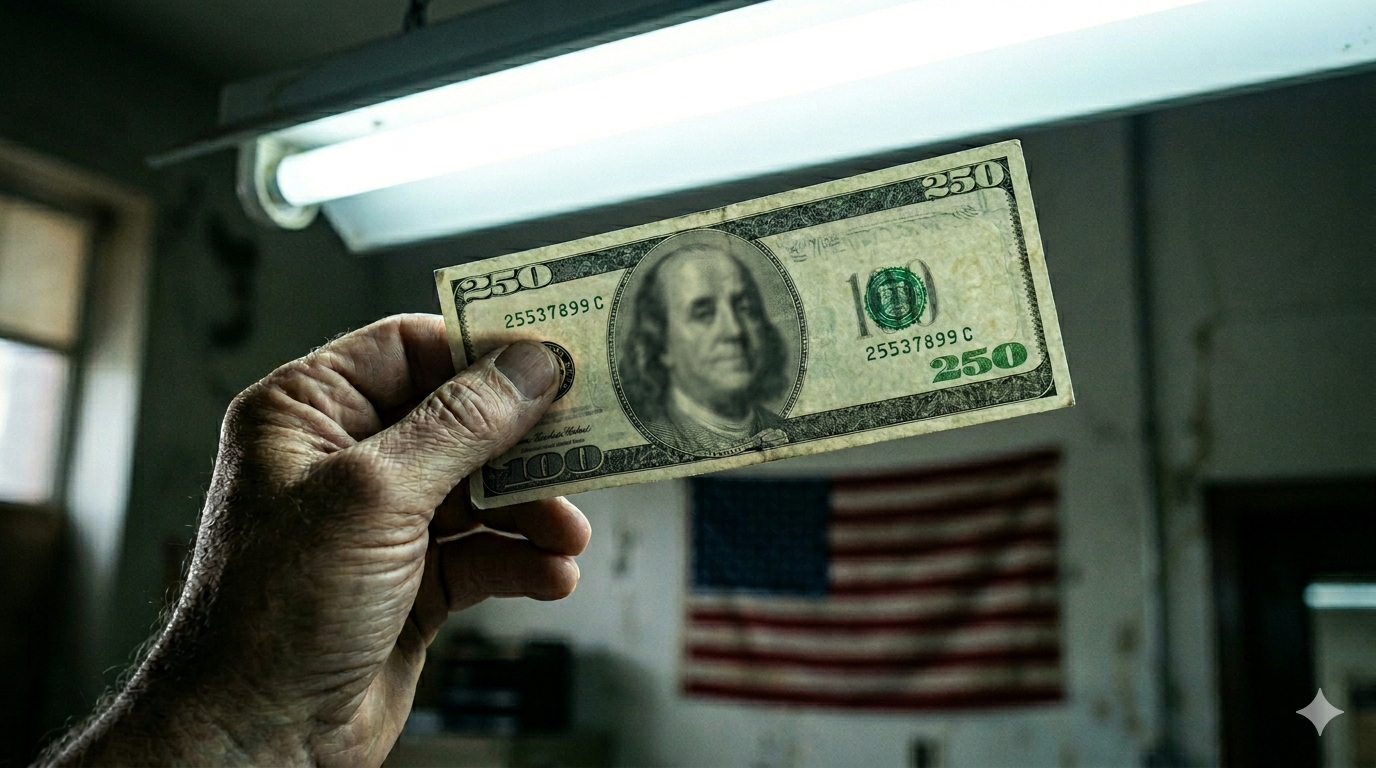
Yesterday, Treasury Secretary Scott Bessent walked into the White House briefing room and held up a mock-up of a $250 bill featuring Donald Trump's face, signature, and the phrase "250 AMERICA." He confirmed that the Bureau of Engraving and Printing has already designed the bill. He confirmed that Trump personally reviewed and approved specific design changes. He said the Treasury Department has carried out "appropriate planning and due diligence" in preparation for production. Then he said it was all up to Congress. "We will stick to the law," he said. The law he is referring to is the one he is preparing to break.
Federal law has prohibited any living person from appearing on United States paper currency since 1866. That is not a recent rule. It is not a regulatory guideline. It is a 160-year-old statute passed by Congress specifically because the republic's founders understood what it meant when a government put a living ruler's face on its money. The Coinage Act of 1792 — the first year of the American financial system — specified that coins should bear "an impression emblematic of liberty" rather than a leader's face. George Washington declined to have his portrait placed on the first US silver dollar, and that anti-monarchical principle was embedded in the republic's financial infrastructure from its opening year. Congress codified it into statute in 1866. Yesterday, the Treasury Secretary stood in the briefing room of the White House and announced the design was ready. Congress just needs to change the law first.
What Is Actually Being Proposed — And What Has Already Happened
The $250 bill is the most visible element of a broader currency personalization campaign that has been underway since the beginning of Trump's second term. In March 2026, the Treasury Department announced that Trump's signature would replace the Treasurer of the United States' signature on all US paper currency — the first time a sitting president's signature has appeared on American paper money in its 165-year history. Treasury Secretary Scott Bessent framed it as recognition of Trump's "historic achievements." The first $100 bills bearing Trump's signature are scheduled to begin production in June 2026.
The $250 bill itself is the creation of the Donald J. Trump $250 Bill Act, introduced by Representative Joe Wilson of South Carolina. The bill would create an entirely new denomination — one that has never existed in the history of American currency — specifically to feature Trump's portrait alongside patriotic design elements tied to the nation's 250th anniversary. The Bureau of Engraving and Printing has confirmed it began design work in August 2025. British painter Iain Alexander designed the mock-up. Trump personally reviewed and approved specific changes to the design. The Washington Post reported the design push was driven by Trump's own appointees — US Treasurer Brandon Beach and senior adviser Mike Brown — who pressed Bureau staff directly. A Bureau official who raised concerns about the legal issues was subsequently reassigned.
The denomination itself compounds the question. $250 is not a natural currency increment. It does not fill a gap in the existing denomination structure. It is a number chosen because 250 is the number of years since 1776. The bill is being designed not as a functional instrument of commerce but as a collectible monument — a piece of paper bearing the current president's face that Americans are supposed to hold and exchange and carry in their wallets. The stated justification is the nation's Semiquincentennial. The actual function is a portrait of a living political figure on the medium of exchange that every American is required by law to accept as legal tender.
The 1866 Law — And Why It Exists
The Thayer Amendment, passed by Congress on April 7, 1866, states that "no portrait or likeness of any living person hereafter engraved, shall be placed upon any of the bonds, securities, notes, fractional or postal currency of the United States." The law was triggered by a specific act of institutional vanity: Spencer M. Clark, Superintendent of the National Currency Bureau, had placed his own portrait on a five-cent fractional currency note rather than the intended portrait of explorer William Clark — exploiting the ambiguity in a congressional directive that only specified "Clark" should be honored. Congress was furious. Representative Martin Thayer of Pennsylvania drafted the amendment that became law, and it has governed American paper currency ever since.
The instinct behind it predated the statute by 74 years. The Coinage Act of 1792 specified that American coins should bear an impression emblematic of liberty — deliberately avoiding the monarchical tradition of placing the ruling leader's face on the realm's money. Washington declined the silver dollar portrait because that tradition felt like exactly what the revolution had been fought against. It took 74 years after that principle was established as custom for Congress to codify it as statute. It has been the law of the United States for 160 years. Representative Joe Wilson's bill and the Treasury Department's design preparation are a direct effort to end it — framed as a birthday celebration, executed as a brand expansion.
Note a specific legal boundary that the administration has already been navigating: the Thayer Amendment applies explicitly to paper currency — bonds, securities, and notes. A separate legal framework governs coins, which is why the administration has simultaneously pursued a Trump $1 coin for the Semiquincentennial under the Circulating Collectible Coin Redesign Act of 2020, using creative legal interpretation to argue that a wider illustration of Trump does not technically constitute the "head and shoulders portrait or bust" prohibited by a 1996 commemorative coin law. The $250 bill requires eliminating the Thayer Amendment directly. The coin required a legal workaround. Both efforts are operating simultaneously. The legal creativity being deployed across both tracks is itself the signal.
The Broader Pattern: When the State Becomes the Brand
The $250 bill does not exist in isolation. It is one element of a systematic campaign to embed Trump's personal identity into the physical and symbolic infrastructure of the American state in ways that have no modern precedent. Trump's signature is going on all US paper currency in June. His portrait hangs on banners on the Department of Justice building and other federal buildings in Washington. His name and image have been placed at the center of the nation's 250th anniversary commemorations. The Kennedy Center for the Performing Arts — renamed — features his appointees. A gold commemorative coin bearing his likeness has been approved by a federal arts commission. His face has been proposed for the $1 coin. And now his portrait, approved by him personally, is ready for a new denomination of legal tender pending a congressional vote to eliminate a 160-year prohibition.
Each of these moves has been presented individually as a specific commemoration, a celebration, a milestone, an honor. Taken together they represent something that has a name in the study of political systems: the conflation of the state with the person of its current leader. The money, the buildings, the commemorations, the institutions — when all of these begin to bear the face and name of the person currently holding power, the distinction between the state and the individual has been eroded in a specific and documented way. Historians do not struggle to identify examples of this pattern. They struggle to identify examples of democracies that reversed it after it took hold.
Call to Action: The Dollar Is Not His. It Is Yours.
The $250 bill requires a congressional vote to become law. The signature on your $100 bill starting in June does not — the Treasury made that decision administratively. The coin was authorized through creative legal interpretation. The DOJ banners required no vote at all. The pattern is not one of democratic deliberation. It is one of incremental normalization — each step presented as reasonable until the cumulative result is a currency, a capital, and a set of institutions that have been personally branded by the man currently holding office.
- Contact your congressional representative on the $250 bill specifically. The Donald J. Trump $250 Bill Act requires a floor vote. Your representative must go on record — yes or no — on whether to eliminate a 160-year prohibition on living persons appearing on US paper currency to create a new denomination that serves no economic purpose other than to carry the current president's portrait. Call them. Put it in writing. Make them answer publicly.
- Ask your senator about the Trump signature on currency starting in June. The Treasury's decision to replace the Treasurer's signature with Trump's signature on all US paper currency was made administratively — no congressional vote required. Ask your senator whether they believe the executive branch has the authority to make that decision unilaterally, and whether they intend to exercise any congressional oversight over it.
- Understand what you are being asked to normalize. The principle behind the 1866 law was not a bureaucratic technicality. It was a constitutional instinct — embedded in the republic's financial infrastructure from 1792, codified into statute in 1866 — about the relationship between a republic's money and its leadership. The Founding Fathers built it in because republics require institutional guardrails against the human tendency toward self-aggrandizement in positions of power. When those guardrails are removed one exception at a time, the principle they protected does not survive the accumulation. Know what is being asked of you — and decide whether a birthday celebration is sufficient justification for trading it away.
V64OTD // WASHINGTON DECLINED TO PUT HIS FACE ON THE MONEY. THINK ABOUT WHY.
[ SHARE_THIS_DISPATCH ]