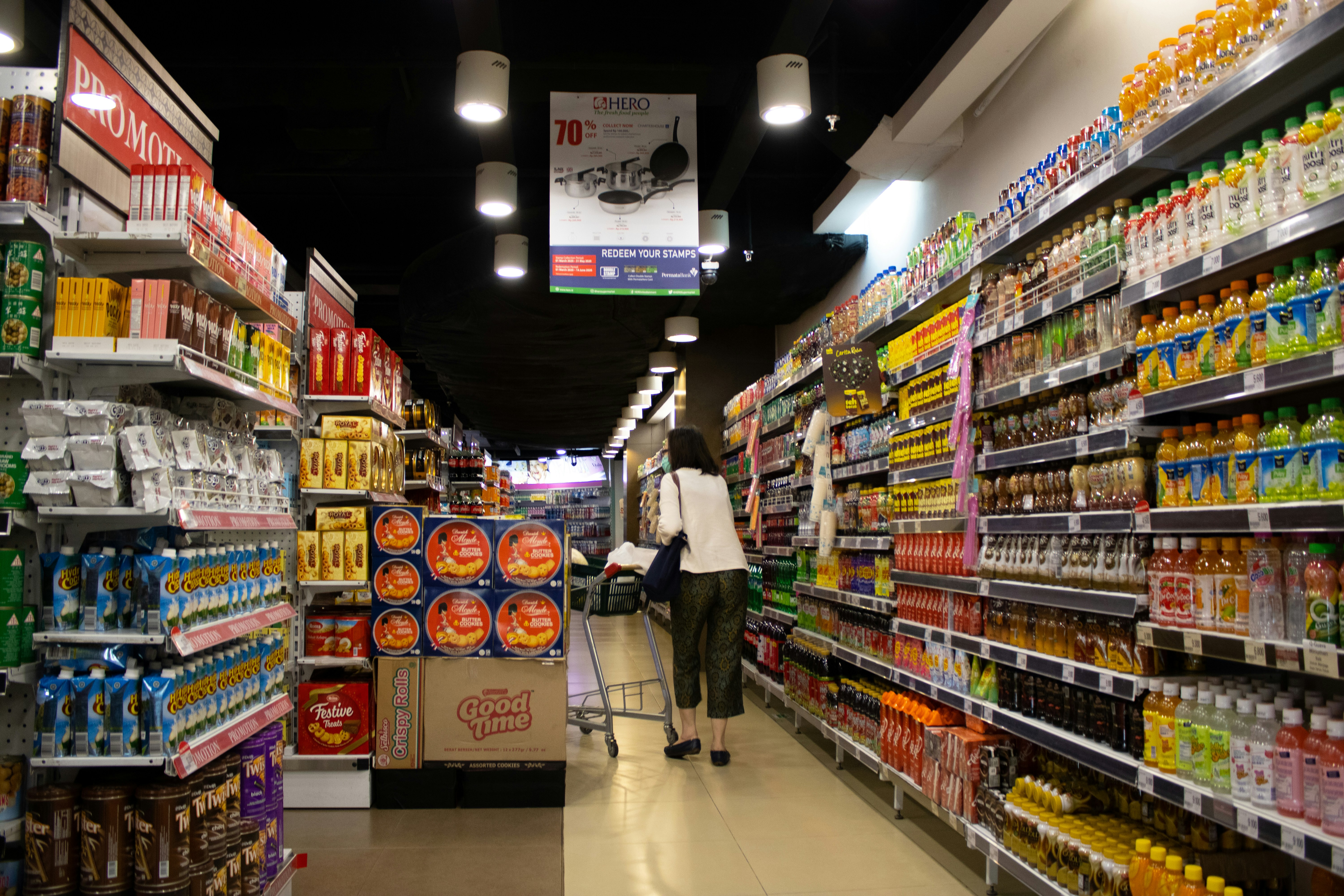

Grocery prices are up 2.7% over the past year, and food overall is up 3%, according to the Bureau of Labor Statistics — modest-sounding numbers that don't match what it feels like to push a cart through a checkout line in 2026. Part of the disconnect is that the headline inflation number measures price. It doesn't measure who controls that price, and at nearly every link in the chain that puts food on your table — the seed it grew from, the fertilizer that fed it, the plant that processed it, the diesel that moved it, the store that sold it — the answer in 2026 is: two to four companies, not a competitive market. This is a tour of that chain, link by link, with the antitrust cases, DOJ investigations, EIA and FEC filings, and the government's own findings attached to each one.
Start with a hard baseline, because "prices are up" means something different depending on which year you're measuring from. Since 2019 — the last full year before COVID — the BLS food-at-home index is up roughly 25-27%: a $150 grocery run in 2019 costs around $190 now. That average buries wide swings underneath it. Eggs are up 57% since 2019, from a $1.40 average to $2.19 — though that's the net of a much wilder ride, a spike to $6.23 in March 2025 sitting squarely inside the window Cal-Maine and the others were later accused of manipulating, then a partial fall back once they got caught. Ground beef is up about 79% (a figure that shifts somewhat depending on the exact baseline month — trackers using slightly different 2019 or 2020 starting points put it anywhere from about 72% to 81%, all pointing the same direction). Milk specifically is up about 42%, from a $3.04 average in 2019 to $4.32 now. Not everything moved in the same direction, either: chicken wings are actually down about 28% since 2019, a reminder that concentration doesn't automatically make every category more expensive — just that the categories where it happens don't have a competitive check pulling them back down afterward.
corporatocracy (noun) — a system where the penalty for getting caught fixing a price is priced in advance, sized to be smaller than the profit, and paid without anyone admitting they did anything wrong.
curated control (noun) — a system in which your choice, your access, or your outcome feels like the product of open competition, when the entity presenting it controlled the boundaries before you ever arrived; it doesn't decide for you, it decides what you're allowed to decide from, and calls the difference freedom.
The Meat Counter
Start where the concentration is most extreme. Four companies — Tyson, JBS, Cargill, and National Beef — now process roughly 85% of U.S. fed cattle, up from 36% in 1980, even though the number of independent ranchers supplying them hasn't collapsed anywhere near that much. Ranchers' share of the consumer beef dollar has fallen from 62 cents in 1980 to 37 cents today. That's not a theoretical harm: JBS agreed to pay $83.5 million, Tyson $55 million, and Cargill $32.5 million to settle lawsuits alleging the three colluded to restrict cattle supply and inflate beef prices.
Chicken has its own, larger version of the same case. Tyson, Pilgrim's Pride, and other major poultry processors were accused of conspiring to shrink breeder flocks and restrict supply, producing what the plaintiffs' complaint called record profits at consumers' expense. Tyson alone settled its piece for $221.5 million; combined settlements in the broiler chicken litigation have surpassed $400 million, and litigation trackers describe pork, turkey, tuna, and salmon processors as caught up in the same wave of cartel cases.
Then there's eggs — the case V64OTD covered directly on August 7. DOJ and 17 state attorneys general accused Cal-Maine, Versova, and Hickman's of manipulating the Urner Barry egg-price benchmark that grocery stores use to set what they pay, from June 2022 to March 2025. The settlement: $3.3 million combined. The scheme's estimated take, per antitrust writer Matt Stoller's review of the case: roughly $3 billion. Cal-Maine's own profit for fiscal 2025 was $1.22 billion, including a quarter where profit rose 718% year over year with zero avian flu detected at any Cal-Maine facility — even as the industry pointed to bird flu as the reason prices had to rise. Cal-Maine had already lost a separate egg price-fixing verdict from a 2004-2008 conspiracy, worth $53 million after trebling, and was still fighting to overturn that judgment when the second scheme was already running.
What Goes Into the Food Before It's Food
Move one step further back, to what farmers plant and feed their fields, and the concentration is just as tight. Bayer and Corteva together control roughly 65-72% of U.S. corn and soybean seed sales. Corn seed costs per planted acre rose from $26.65 in 1990 to $93.48 in 2019 — about 350%, far outpacing general inflation, in the years following the wave of seed-company mergers that created that duopoly. And in July 2026, corn growers petitioned the DOJ to investigate whether the major fertilizer producers — Nutrien, Mosaic, CF Industries, and Koch — colluded on nitrogen, phosphate, and potash prices, an investigation DOJ has confirmed is active. If substantiated, that's not a single-commodity problem; fertilizer collusion would inflate the cost of growing nearly every crop in the country at once, before any grocery shelves are involved.
Processed and frozen foods have their own live case: Cavendish Farms, Lamb Weston, McCain Foods, and J.R. Simplot — the four companies that make most of the country's frozen fries, hash browns, and tater tots — are being sued for allegedly sharing pricing data and coordinating increases starting in 2021, the same window nearly every other price-fixing allegation on this list traces back to.
The Store Itself
Even if every producer behind the shelf were playing fair, the store selling it to you is its own chokepoint. Four chains — Walmart, Costco, Kroger, and Ahold — control more than 70% of grocery sales in most major U.S. metro markets. The country has roughly a third fewer grocery stores than it did 25 years ago. And when Kroger tried to buy Albertsons in 2022 — a $24.6 billion deal that would have been the largest supermarket merger in U.S. history — the FTC sued to block it in February 2024, finding it would raise prices and weaken workers' bargaining power. The deal collapsed. That's one of the few places on this list where the system actually stopped a merger before it happened, rather than settling with the companies after the fact.
The Diesel Tax on Everything
Every link covered so far — the seed, the fertilizer, the slaughterhouse, the frozen-potato plant, the distribution center, the store — shares one more cost sitting on top of it: getting the product from one link to the next, almost entirely by diesel truck. Worth being precise about why diesel costs what it does, because the common explanation — that diesel is a less-refined fuel and should therefore be cheaper — has the mechanics backward. In the base distillation of crude oil, diesel is actually the easier fraction to produce: it comes off as a "middle distillate" requiring less cracking and reforming than gasoline does to become a usable, high-octane fuel. For most of the 20th century, diesel was the cheaper product at the pump for exactly that reason. What changed is regulation, not chemistry. Starting in 2006, the U.S. phased in ultra-low-sulfur diesel standards requiring deep hydrotreating — more hydrogen, hotter reactors, faster catalyst turnover — on top of a federal excise tax that's higher on diesel (24.4 cents/gallon) than gasoline (18.4 cents), and global demand that pulls diesel toward winter heating-oil markets and Europe's much larger diesel-passenger-car fleet. Diesel isn't inherently the "unrefined" fuel; it became the more expensive one through policy and demand, not physics — and that distinction matters, because the real explanation is more durable than the wrong one.
The price history, per EIA's own retail data, tells the "2019 vs. now" story on its own: diesel averaged $3.056 a gallon in 2019, dropped to $2.551 during the 2020 COVID collapse, then climbed almost every year after — $4.989 at its 2022 annual peak, easing to $3.660 by 2025, before spiking again to $5.60 a gallon by May 2026 — up 60% from May 2025, per the Bureau of Transportation Statistics' own monthly tracking, the single steepest year-over-year jump in this entire dataset. Fuel runs about 21% of a trucking company's total cost per mile, and food specifically gets hit harder than general freight, because refrigerated ("reefer") trailers burn diesel twice — once for the tractor, again to run the refrigeration unit continuously for the entire trip, whether the truck is moving or sitting still. That cost doesn't pass through to shelf prices instantly, either: during this spring's spike, a typical 55-truck fleet on a standard monthly fuel-surcharge schedule still failed to recover roughly $168,000 in fuel costs, and fleets on slower, quarterly-reset contracts lost more than $400,000 before their rates caught up — meaning carriers eat the increase first, and it shows up in shipping contracts, then on the shelf, weeks or months later.
Is there any evidence of collusion behind those numbers? Worth asking directly, and worth being honest about what turned up: nothing pointing to U.S. diesel-refining price-fixing specifically. What does exist: DOJ and the FTC sent a joint letter to state attorneys general on July 3, 2026, specifically asking them to investigate petroleum markets for price-fixing and market manipulation — regulators signaling they see enough smoke to ask the question, not proof of anything on its own. More concretely, the City of Baltimore filed an antitrust lawsuit in August 2024 against major U.S. shale oil producers, alleging they colluded to restrict crude output and inflate prices — that's upstream of both diesel and gasoline, since both come from the same barrel, and the case remains unresolved, an allegation rather than a finding. That's the honest state of the evidence: one filed, unproven allegation at the crude-production level, nothing found at the diesel-refining level specifically.
Was the Pandemic the Excuse?
This is worth asking directly, because it's the hardest thing on this list to prove and the easiest to overstate. The FTC's own March 2024 report on the grocery supply chain found that retailer revenue over total costs ran about 5.6% at its pre-pandemic high in 2015, rose past 6% in 2021, and kept climbing to over 7% for the first three quarters of 2023 — well after the actual pandemic supply disruptions had eased. The FTC's language was that "dominant firms used this moment to come out ahead," not that they were simply passing along higher costs. That's about as close to a regulator confirming the "pandemic as pretext" read as you're likely to get on the record. It doesn't mean every price increase since 2020 was manufactured — real shocks happened, from avian flu culls to drought-thinned cattle herds to genuine shipping disruption — but the FTC's own data shows margins kept expanding well past the point those shocks could explain, and the frozen-potato cartel's alleged start date of 2021 sits squarely inside that same window.
The Buyout Math: Is This By Design?
There's a version of this story that isn't about any single company withholding supply or fixing a benchmark. It's about what happens after two companies merge, and whether the debt used to do it quietly keeps prices from ever coming back down. Worth working through carefully, because the honest answer complicates a clean story rather than confirming one.
Start with the clearest example. Kraft and Heinz merged in 2015, in a deal engineered by 3G Capital and Berkshire Hathaway, financed with enough leverage that the combined company started at 4.0x debt-to-EBITDA — and never brought it down. By 2019, it had climbed to 4.6x, even after 3G's playbook (zero-based budgeting, seven plants closed, over 5,100 jobs cut in the first four months alone) pushed EBITDA margins to 30%, a level unheard of in the food industry. The cost-cutting and margin extraction happened; it wasn't enough. In 2019, Kraft Heinz took a $15.4 billion write-down on its own Kraft and Oscar Mayer brands, cut its dividend, and its stock is down more than 68% since the 2015 merger closed. In September 2025, the company announced it would split back into two separate companies, reversing the 2015 deal outright. Then, in February 2026, it paused that split, after posting a $5.85 billion net loss for 2025, driven by $9.3 billion in non-cash impairment charges.
Worth correcting a natural assumption here: that write-down didn't eliminate any debt. A goodwill impairment charge is an accounting entry — it reduces the book value of an asset (the brand) and equity on the balance sheet, and doesn't touch a single dollar of what the company actually owes its bondholders. "Write it off, then split it up" isn't a mechanism for erasing a bad buyout's debt; the debt is still there, still needs servicing, regardless of what the accountants do to the brand's paper value. What splitting actually does — a well-documented, ordinary corporate-finance strategy, not a hidden trick — is address the "conglomerate discount": Wall Street frequently values a bundle of unrelated brands lower than it would value each one separately, so breaking a company apart can genuinely lift share price even when nothing about the underlying debt has changed. That's a more mundane explanation than "eliminate the debt" for why the same playbook — merge, load with debt, extract margin, eventually split — keeps recurring, and a more accurate one.
Kraft Heinz isn't the only current example carrying that kind of weight. Albertsons is still operating under roughly $12 billion in debt left over from its own 2015 leveraged buyout of Safeway, a burden cited directly as a constraint on its ability to lower prices or invest in the business — and it was still carrying that load when it tried and failed to merge with Kroger. The newest mega-deal in the sector, Mars's $36 billion acquisition of Kellanova, wasn't a cash purchase either: Mars issued $26 billion in new corporate bonds to help fund it, a debt load large enough that S&P downgraded Mars's own credit rating from A+ to A in February 2025, even though Mars is privately held rather than PE-owned. The debt-financed merger playbook isn't limited to Kraft Heinz's specific outcome. It's the standard way these deals get done across the sector, whoever's doing the buying.
So: by design, stupid, or a broader conspiracy? The evidence points to a fourth answer, less satisfying than any of the three but better supported. It isn't a conspiracy in the collusion sense — nothing here suggests Kraft Heinz, Mars, and Albertsons coordinated with each other on this playbook; they're independently running the same well-known Wall Street formula because the same incentive structure rewards all of them for running it. Executive compensation tied to stock performance rewards the short-term price pop that comes with announcing a big deal or a split, regardless of whether the underlying business gets healthier. Activist investors push for breakups specifically because the sum of the parts often trades at a higher price than the conglomerate did, independent of any real change in earnings power. And it isn't simple stupidity, either: a rigorous academic study (Fracassi, Previtero, and Sheen, tracking post-buyout firms against matched non-buyout competitors) found that price increases on existing products after a leveraged buyout were modest — around 1% on average — and that most of the sales growth actually came from new product launches and geographic expansion, not from squeezing shoppers harder. What the debt more reliably does is narrower, and in its way more durable: it constrains a heavily leveraged company's ability to compete on price at all, because a company servicing billions in acquisition debt can't afford a price war the way a debt-free competitor could, and can't easily walk a price back down once raised without threatening its own loan covenants. That's not a room full of executives agreeing to keep prices high. It's a financial structure that makes keeping them high the only move that doesn't put the company's survival at risk — adopted independently and repeatedly by nearly everyone playing the same game, which is what makes it a pattern worth naming even without a conspiracy behind it.
It's Not Just the Price. It's What You're Actually Getting.
Two separate problems are showing up on the same receipt. The first is shrinkflation: roughly a third of grocery items have shrunk in size without a matching price cut, with tracked national brands averaging 14.8% smaller. A GAO analysis found that per-unit price increases from shrinkflation alone ranged from 12% to 32% between 2019 and 2024, depending on the category. Three-quarters of Americans say they've noticed it; nearly half say they've abandoned a brand over it. A peer-reviewed study found that companies prefer shrinking the product rather than raising the sticker price because consumers respond less to a smaller box than to a higher number, so sales actually rose 6% when a product shrank, rather than when its price rose by an equivalent amount.
The second is closer to outright fraud, and it's a genuinely different mechanism worth understanding on its own terms: nobody enforcing what "avocado oil" has to mean. The FDA has never adopted a "standard of identity" for avocado oil the way it has for olive oil, so there's no required fatty-acid profile, no mandated freshness testing, and no real enforcement hook for a bottle labeled "100% avocado oil." A UC Davis study published in July 2026 tested avocado-oil-labeled products and found 93% of the chips, 71% of the mayonnaise, and 100% of the salad dressings tested were adulterated — cut with soybean, canola, or safflower oil, all far cheaper. That's consistent with the same lab's 2020 finding that 82% of bottled avocado oils were rancid or blended, and a follow-up finding 70% of private-label bottles were adulterated. Consumers are reportedly paying premiums of 500% or more over conventional oil for a product that, more often than not, isn't what the label says it is. Concentration didn't cause that one directly — but a market with only a handful of major buyers setting standards, and a regulator that's never bothered to define the product, produces the same outcome from a different direction: you pay more, for less, and have no real way to verify it before you buy.
Where This Leaves You
None of the individual pieces here required the same conspiracy. Tax-write-off content cuts, shrinkflation, benchmark manipulation, flock restriction, cattle-supply collusion, seed-market consolidation, an undefined oil label, a fuel tax structure decades old, a decade of merger debt nobody's paying down — these are different companies, different mechanisms, different regulators, and in the debt case, not a conspiracy at all, just the same incentive structure independently pulling every player toward the same outcome. What they share is the condition that makes all of them possible at once: at nearly every layer between a seed and your shopping cart, the number of companies you could theoretically switch to has been shrinking for decades, and the settlements piling up — JBS, Tyson, Cargill, Cal-Maine, Pilgrim's Pride, and counting — are what it looks like when that shrinking finally gets caught, not what it looks like when it's prevented.
Corporatocracy doesn't need a single monopoly to work. It needs enough of them, stacked at every link in the same chain, that "buy the competitor's version instead" stops being a real option by the time the product reaches your cart.
Curated control looked, a generation ago, like a grocery aisle stocked by dozens of competing farms, processors, and brands. It looks now like the same aisle, restocked by the same four or five companies at every layer behind it, still arranged to look like choice.
Corporatocracy doesn't require a conspiracy to explain the debt, either. It requires the same leveraged playbook, rewarded often enough by enough independent boardrooms, that nobody has to agree to keep prices from coming back down — the incentive structure does so for them.
What You Can Actually Do
Several organizations focus specifically on food-system concentration and consumer protection — some are research nonprofits, one is a federal political action committee, and a couple are farmer-led groups that are themselves plaintiffs in the antitrust cases above. Worth knowing the difference before you give: donations to a 501(c)(3) are generally tax-deductible and fund research, litigation, and public education; donations to a 501(c)(4) or a PAC are not tax-deductible, but they're what fund direct lobbying and, in the PAC's case, support or opposition to specific candidates.
Research and advocacy nonprofits (501(c)(3), donations typically tax-deductible):
- Farm Action — farmer-led watchdog researching and publicly documenting agricultural consolidation; source for several of the seed and fertilizer figures above.
- Food & Water Watch — research and public-education arm covering food-system corporate control.
- Open Markets Institute — antitrust and monopoly-policy research across industries, including food and agriculture.
- American Economic Liberties Project — anti-concentration policy advocacy; explicitly does not accept corporate funding.
- American Antitrust Institute — legal and economic research specifically on food and agriculture antitrust enforcement.
- Consumer Federation of America — an umbrella of roughly 250 member consumer organizations, including food-specific advocacy.
- Public Citizen Foundation — the research and litigation arm of Public Citizen (its sister organization, Public Citizen Inc., is the 501(c)(4) lobbying arm — see below).
- Farm-to-Consumer Legal Defense Fund — legal defense for farmers and consumers in direct commerce and food-access disputes.
Lobbying and political advocacy arms (501(c)(4), donations not tax-deductible, fund direct legislative lobbying):
- Farm Action Fund — the political arm of Farm Action, building legislative pressure at the state and federal levels.
- Food & Water Action — the lobbying arm of Food & Water Watch.
- Public Citizen Inc. — the lobbying half of Public Citizen, working with Congress and federal agencies directly.
Federal PAC (donations not tax-deductible, funds support or opposition to specific candidates):
- Food & Water Action PAC — an FEC-registered Super PAC (independent-expenditure only, ID C00801910), the electoral-spending arm connected to the Food & Water Watch/Food & Water Action network. Worth knowing going in: as of mid-2026, its FEC filings show it's a small operation — a few thousand dollars raised and spent this cycle — so it's a values statement and a way to fund future candidate-level spending on food-system issues, not yet a large-scale political operation.
Farmer and rancher membership associations (litigants in several cases above, not tax-deductible, dues- and donation-funded):
- R-CALF USA — an association of independent cattle ranchers and the lead plaintiff in the 2019 antitrust suit against Tyson, JBS, Cargill, and National Beef.
- National Farmers Union — broader independent-farmer advocacy organization, distinct from and often at odds with industry-aligned groups on market-concentration policy.
One specific warning: the National Cattlemen's Beef Association (NCBA) sounds, by name, like the natural ally here. It isn't. Despite drawing 62% of its 2024 income — $35 million — from mandatory rancher fees paid through the beef checkoff program, NCBA's policy positions have consistently aligned with the interests of multinational meatpackers rather than independent cattlemen, including opposing mandatory cash-market legislation that both R-CALF and the National Farmers Union supported. If the goal is backing independent ranchers against packer concentration, R-CALF and NFU are the groups actually suing and lobbying on that side; NCBA is not.
The other lever: buy less of what they're selling you. Every advocacy dollar above works upstream, on the market structure. There's also a direct, immediate move available at home — a meaningful share of what sits in a shopping cart is water, salt, and a handful of shelf-stable ingredients marked up for the branding, the packaging, and the plant that made it, and the price gap is even bigger against fast food specifically. That's substantial enough, in dollars and in specifics, that it gets its own full companion piece rather than a paragraph here: "Skip the Markup: Make Your Own Condiments and Fast-Food Favorites for Less" — homemade condiments, meal-prepping, and fast-food alternatives, with cost breakdowns and specific recipe resources, for the reader who wants the practical follow-through, not just the diagnosis. → https://v64otd.com/lifestyle/skip-the-markup-homemade-condiments-fast-food/
Sources
Bureau of Labor Statistics. Consumer Price Index Summary, June 2026.
Keeping Up With Inflation and USinflationcalculator.com. 2019-vs-2026 grocery price comparisons.
Farm Action. Meatpacking: Four Corporations, Total Control.
Investigate Midwest. Fact-check coverage of meatpacking concentration and the 2025 JBS, Tyson, and Cargill antitrust settlements.
Cohen Milstein. In re Broiler Chicken Antitrust Litigation case study; PYMNTS, Bloomberg Law, and Food Business News coverage of the Tyson and Pilgrim's Pride settlements.
V64OTD Dispatch, August 7, 2026 — The Fine Was $3.3 Million. The Scheme Made Them an Estimated $3 Billion. And Cal-Maine's Been Here Before.
USDA Economic Research Service. Two companies accounted for more than half of corn, soybean, and cotton seed sales in 2018-20.
Iowa Capital Dispatch. Corn growers urge DOJ investigation into 'collusive' fertilizer industry practices, July 2026.
Washington Post. 'Cartel' of potato producers conspired to price fix, lawsuit says, November 2024.
American Economic Liberties Project. Myth vs. Fact: The Kroger-Albertsons Merger; NBC News and FoodPrint coverage of the FTC's February 2024 lawsuit blocking the merger.
Federal Trade Commission. FTC Releases Report on Grocery Supply Chain Disruptions, March 2024.
U.S. Government Accountability Office. Consumer Prices: Trends and Policy Options Related to Shrinking Product Sizes, GAO-25-107451, July 2025. Capital One Shopping and DontPayFull, shrinkflation prevalence statistics.
UC Davis. Authenticity of avocado and olive oils used as ingredients in commercially processed foods, Applied Food Research, July 2026, with UC Davis's 2020 study and follow-up study, via UC Davis News and Forbes coverage. Seed Oil Free Alliance, coverage of the FDA's absence of a standard of identity for avocado oil.
FEC.gov. Food and Water Action PAC — committee overview.
Food & Water Action. About Us.
Guidestar/Charity Navigator. Nonprofit filings for Public Citizen Inc. and Public Citizen Foundation.
Farm Action. Organizational description of the Farm Action / Farm Action Fund dual-entity structure.
TSLN.com and Morning Ag Clips. Coverage of R-CALF USA's 2019 antitrust lawsuit against Tyson, JBS, Cargill, and National Beef, and its ongoing antitrust advocacy through 2026.
National Farmers Union. Coverage of NFU's 2021 talks with cattle producer organizations on marketplace reform; AgAmerica and Wikipedia coverage of NCBA's checkoff-program funding structure and its policy divergence from NFU and R-CALF on cash-market legislation.
U.S. Energy Information Administration. U.S. No 2 Diesel Retail Prices, annual historical data. DTN, Forbes, and Fuel Logic — explainer coverage of diesel pricing dynamics.
C.H. Robinson, Commercial Carrier Journal, and Tank Transport. Coverage of the spring 2026 diesel price surge and trucking fuel-cost dynamics.
U.S. Department of Justice and Federal Trade Commission. Joint letter to state attorneys general, July 3, 2026, via National Law Review coverage. City of Baltimore v. major U.S. shale oil producers, antitrust complaint filed August 24, 2024.
CNBC, CNN Business, Forbes, and Kraft Heinz's own investor communications. Coverage of the 2015 Kraft-Heinz merger, 3G Capital's cost-cutting record, the company's debt trajectory, the Kraft/Oscar Mayer write-down, the September 2025 split announcement, and its February 2026 pause. Robert H. Smith School of Business (University of Maryland) and The Lawyer Portal — analytical coverage of 3G Capital's playbook and its limits.
PwC, Corporate Finance Institute, and Wall Street Oasis. Explainers on goodwill impairment accounting.
CEPR (Center for Economic and Policy Research) and SeafoodSource. Coverage of Albertsons' debt remaining from its 2015 leveraged buyout of Safeway.
Bloomberg, Cravath Swaine & Moore, and FoodNavigator. Coverage of Mars's acquisition of Kellanova and its financing.
Fracassi, Previtero, and Sheen. Barbarians at the Store? Private Equity, Products, and Consumers, The Journal of Finance, vol. 77(3), 2022, pp. 1439-1488.
Bureau of Transportation Statistics. Motor Fuel Prices – May 2026.
S&P Global Ratings. Research Update: Mars Inc. Downgraded To 'A' On Kellanova Acquisition, February 27, 2025.