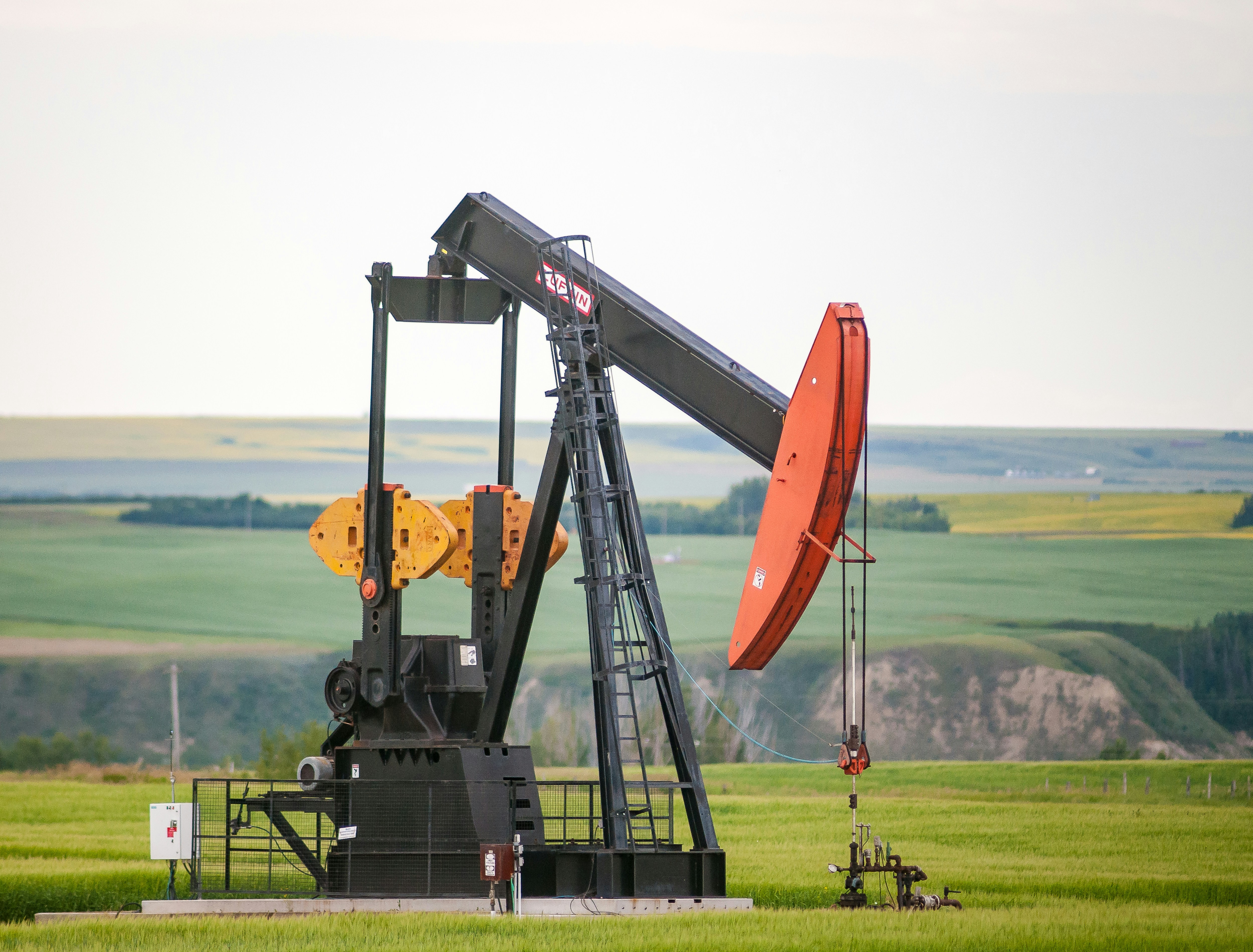

The Strait of Hormuz is effectively closed. The IEA calls it the largest supply disruption in the history of the global oil market. Gas is $4.43 a gallon and climbing. And the administration's answer — a country producing 1.2 million barrels a day trying to cover an 8-million-barrel-a-day hole — doesn't survive fifth-grade math.
oil shock (noun) — a sudden, severe disruption to the global oil supply that sends prices sharply higher in a short window, typically triggered by war, embargo, or the loss of a major producing or transit region. The term was coined after 1973 and has been applied since to 1979, 1990, and 2022. Economists are now applying it, without hedging, to what's happening right now.
The following contains editorial analysis and opinion clearly labeled as such, alongside verified reporting. This Dispatch does not pull punches on who's to blame. It also takes on the "Great Reset" framing directly, held to the same evidentiary standard as everything else in this outlet, which means it says plainly where the evidence does and doesn't go.
What's actually happening right now
The Strait of Hormuz — the 21-mile-wide chokepoint through which roughly a quarter of the world's seaborne crude oil and about a fifth of its liquefied natural gas normally passes — is effectively closed. Vessel traffic that used to run 85 to 100-plus ships a day has collapsed to single digits: 8 ships transited on September 13th. Crude exports out of the Gulf region have fallen by 47%, from about 17 million barrels a day before the war to roughly 9 million barrels a day as of August. As of September 11th, Brent crude was trading at $104.61 a barrel and WTI at $100.05 — up sharply from where they sat before the war, and still moving. The International Energy Agency has called this "the largest supply disruption in the history of the global oil market" — not "one of the largest." The largest, full stop. The IEA's own executive director has drawn a direct comparison to the 1970s oil shocks, a parallel that this Dispatch draws out in detail below.
Here at home, the national average for a gallon of regular gasoline hit $4.43 on September 17th — up nearly 30% from a year earlier. Diesel is running considerably higher than that (more on exactly why below). And the cushion the country would normally lean on in a crisis like this isn't there: the Strategic Petroleum Reserve held 285.0 million barrels as of September 11th, just 39.9% of its authorized capacity and the lowest level since November 1982 — down almost 120 million barrels, roughly 30%, from where it stood a year ago.
It's not just the Strait — Iran has been hitting the oil itself
Hormuz gets most of the headlines because it's a shipping chokepoint, but that's only half the story. Since February 28th, Iran and Iran-aligned groups have been directly striking the physical oil and gas infrastructure of the Gulf states themselves — the wells, pipelines, refineries, and export terminals that fill the tankers in the first place. This isn't a side note. It's a second, compounding source of lost supply layered on top of the Strait closure.
Saudi Arabia has taken repeated hits. On March 2nd, Iranian drones targeted Aramco's Ras Tanura refinery — the kingdom's largest, responsible for refining more than half a million barrels a day. Both drones were intercepted, and Saudi Arabia's Defense Ministry described the resulting damage as minor, but Aramco shut the plant down out of caution anyway and spent about a week rerouting output through the Red Sea port of Yanbu. On July 27th, drones hit Abqaiq — the single most important node in Saudi Arabia's oil system, the facility that processes and stabilizes up to 7 million barrels a day of crude before it goes anywhere else, and the same complex a 2019 attack knocked offline for weeks (more on that below). Satellite imagery showed burn scars around four of the six spheroid pressure vessels used in Abqaiq's degassing process; Aramco did not publicly disclose what that did to throughput. The East-West Pipeline — the 1,200-kilometer line that lets Saudi Arabia move up to 7 million barrels a day from its eastern fields to the Red Sea, bypassing Hormuz entirely, which is exactly the kind of alternate route this Dispatch cited earlier as one of the buffers keeping prices from quadrupling — was hit at a pumping station the same day, and hit again on September 10th, putting as much as 4 million barrels a day of flow at risk. As of September 15th, unnamed sources reported that the pipeline had been restored to its full 7-million-barrel capacity. Notice what's missing from that sentence: an on-the-record Saudi government or Aramco statement. That's the pattern here, not an exception to it — after a real 2019 attack briefly cut Saudi output in half, Aramco's CEO told the world the company had emerged "stronger than ever" within weeks, and 2026 has followed the same script: rapid, upbeat restoration announcements, no running public tally of what's actually been lost.
Saudi Arabia isn't the only target. According to the Armed Conflict Location and Event Data Project (ACLED), an independent, U.S.-registered conflict monitor, Iran and Iran-aligned groups have carried out at least 172 attacks on nonmilitary infrastructure across the six Gulf Cooperation Council states since the war began, and energy facilities specifically account for 48% of all of those strikes. The UAE, Kuwait, and Bahrain have actually absorbed the highest number of successful hits: Kuwait's Mina Abdullah and Mina al-Ahmadi refineries, the Bahrain Petroleum Company refinery, and ADNOC's al-Ruwais Industrial City and Habshan gas complex in the UAE have all been struck. Qatar's Ras Laffan Industrial City — the largest LNG export hub on Earth — was forced to halt production entirely at one point in March after a missile strike sparked a fire. A subsequent June explosion at Qatar's Barzan gas project killed at least 13 people, though Qatar's government attributed that specific incident to a "technical malfunction" rather than an attack, and this Dispatch isn't going to blur that distinction just because it fits a narrative. Energy analysts at Rystad Energy estimate the damage to two LNG trains at Ras Laffan alone destroyed roughly 13 million tonnes of annual capacity — three to five years and roughly $3 billion to rebuild — and that U.S. companies' overall share of oil drawn from the region is down 30-35% year-over-year, gas down closer to 40%.
Editorial: Put the two halves of this together, and the picture is worse than "a shipping lane is closed." A quarter of the world's seaborne oil can't pass through Hormuz, and some of the facilities that produce and process it have been repeatedly struck. The "alternate routes" this Dispatch cited earlier as a buffer keeping prices from 1973-style quadrupling — the East-West Pipeline chief among them — have themselves been direct targets, more than once, in the same six-month window. And there is no single authoritative public number for how much Gulf production capacity is offline at any given moment. Saudi Arabia's public posture, consistent with how it handled a real attack on this exact facility in 2019, is rapid restoration announcements and minimal disclosure of damage, not transparency. What we actually know is pieced together from satellite imagery, an independent conflict-monitoring nonprofit, and industry analysts — not from a running tally any Gulf government has chosen to publish. That gap in public information is itself worth naming, for the same reason this Dispatch already flagged the lack of transparent SPR reporting at home: when the people making the decisions control the only detailed damage assessments, the public's picture of how bad this actually is will always run behind reality, not ahead of it.
What an oil shock actually is, and how this one stacks up against history
An oil shock isn't just "gas got more expensive." It's a specific, recognized category of economic event: a sudden, severe supply disruption, usually geopolitically triggered, that moves prices sharply in a short window and ripples through the entire economy — transportation, food (which has to be shipped and, in modern agriculture, is fertilized with natural-gas-derived inputs), manufacturing, heating, everything. There have been four widely recognized oil shocks before this one:
1973 — the OPEC embargo. Arab members of OPEC cut off oil to the U.S., Europe, and Japan in retaliation for Western support of Israel during the Yom Kippur War. The actual supply cut was only about 5% of global output. Prices still quadrupled, from roughly $3 a barrel to $12 by early 1974, because the market had essentially no slack to absorb even a small shortfall.
1979 — the Iranian Revolution. The overthrow of the Shah halted Iran's roughly 5 million barrels a day of exports. WTI crude reached about $35 per barrel by 1980, roughly $130 in today's dollars.
1990 — the Gulf War. Iraq's invasion of Kuwait knocked out both countries' exports. Oil rose from about $17 a barrel in July to $36 by October — a real shock, but shorter and less extreme than 1973 or 1979.
2022 — Russia's invasion of Ukraine. Sanctions cut off roughly 8 million barrels a day of Russian exports from Western markets, pushing crude toward $120 a barrel by March 2022.
A smaller, directly relevant precedent — September 2019. This one didn't make the "widely recognized" list above because it was resolved in weeks, not months, but it's the closest thing history has to a preview of this Dispatch's infrastructure-attack section. A drone and missile strike knocked out Abqaiq and the nearby Khurais field — the same Abqaiq complex hit again in July 2026 — and briefly cut roughly half of Saudi Arabia's total oil output, about 5% of global supply, in a single day. Oil jumped nearly 15% in one trading session, the largest single-day move in decades at the time. Saudi Arabia restored production within about three weeks by drawing down its own reserves and working around the clock, and its energy minister and Aramco's CEO both publicly framed the recovery as proof of the kingdom's resilience rather than detailing the damage. It's a small-scale, short-duration version of exactly what's playing out across the Gulf right now, and it's worth remembering that the 2019 recovery was faster and the damage smaller than most of what's been hit in 2026.
2026 — right now. The Gulf region has lost roughly 8 million barrels a day of exports — a volume disruption comparable to or larger than any prior shock in absolute terms — because the Strait of Hormuz, which normally carries about a quarter of the entire world's seaborne crude, is functionally closed. The reason prices haven't (yet) quadrupled the way they did in 1973 is that the world today has things it didn't have then: larger strategic reserves globally, more spare production capacity among non-Gulf OPEC+ members, and alternate shipping routes now redirecting traffic toward the Red Sea and Southeast Asia. Those buffers are real, but they're also finite, and the U.S.'s own reserve is already at a 44-year low — which is precisely why forecasts for where this goes next are so wide: Goldman Sachs' base case has Brent settling around $85; Rystad Energy is projecting north of $140 and a global recession. That's not a small disagreement. That's two credible institutions looking at the same crisis and seeing very different amounts of runway left before it gets much worse.
How we got here, and who actually made the decisions
On February 28, 2026, the United States and Israel launched coordinated strikes on Iran — "Operation Epic Fury" on the American side, "Operation Roaring Lion" on Israel's — after the collapse of renewed U.S.-Iran nuclear negotiations and, that same day, Iranian missiles fired toward Israeli territory. The opening phase of the operation targeted senior Iranian leadership directly; Supreme Leader Ayatollah Ali Khamenei and several other senior officials were killed. In the hours that followed, Iran launched a large-scale regional retaliation that expanded well beyond its own borders and closed the Strait of Hormuz to shipping.
Editorial: Iran fired the first missiles that day, and that's a fact worth stating plainly rather than burying. But a strike that specifically kills a nation's supreme leader is not a proportional response to a missile volley — it is a maximalist, decapitation-strategy escalation, and it was always going to provoke the most extreme retaliation Iran was capable of, which is exactly what happened. Israel pushed hard for this kind of strike for years; the U.S. is the one that actually flew and fired alongside them. Both governments own the consequences of that choice, including the consequence sitting in your gas tank right now. Whether killing Khamenei was worth what it triggered at the Strait of Hormuz is a judgment call this outlet is willing to make plainly: no, not based on what it has cost the world in the months since, and specifically not based on what it has cost ordinary Americans who had no vote in that decision.
The Venezuela operation: coincidence, or a planned hedge?
Was Venezuela a planned move made with foreknowledge of what would happen in the Gulf? Here's what's actually documented, rather than speculated: on January 3, 2026 — nearly two months before Epic Fury — U.S. forces carried out Operation Absolute Resolve and captured Nicolás Maduro. Washington moved quickly afterward to reopen Venezuelan crude to international markets while keeping American political control over the proceeds. That timing is not, on its own, proof of anything. But the strategic logic connecting the two operations is real and has been reported by serious analysts, not just speculated online: Iran had reportedly established drone manufacturing facilities on Venezuelan soil, and Russia had deployed military advisers there — Venezuela had functioned for nearly two decades as Iran's logistical bridgehead and safe harbor in the Western Hemisphere. Rapidan Energy Group's Scott Modell published an analysis in late 2025 — before either operation — arguing that early 2026 presented unusually favorable market conditions (soft demand growth, rising non-OPEC supply, spare OPEC+ capacity) for intensifying pressure on Iranian oil exports specifically.
Editorial: Put plainly, there's a credible, non-conspiratorial reading here: this administration likely moved on Venezuela in January in part because it anticipated a confrontation with Iran was coming, and wanted both Iran's Western Hemisphere logistics network severed and a hedge of US-controlled oil supply in place before that confrontation started. That's a real strategic sequencing argument, made by real energy and security analysts, not a hidden secret this Dispatch is uncovering. What it is not — and this outlet won't overstate it into something it isn't — is proof that officials knew the exact date Iran would fire on Israel, or that the Gulf war unfolded exactly as war-gamed. Strategic hedging and precise foreknowledge are distinct claims, and only the first has substantive reporting behind it.
Why diesel specifically has gotten so brutal
If you've filled up a diesel vehicle recently, you've likely noticed it's running well above regular gasoline's already-ugly price — and Hormuz isn't the whole story there. Layered on top of the crude oil shock is a domestic policy cost that has nothing to do with Iran: EPA's own final Renewable Fuel Standard for 2026-2027 set record-high blending mandates, requiring 26.81 billion Renewable Identification Number (RIN) credits in 2026 — equal to 15.50% of projected obligated gasoline and diesel sales — rising again in 2027. Refiners and importers who can't blend enough biofuel themselves have to buy RINs on the open market to comply, and those credits have roughly doubled in price since the start of 2026: biomass-based diesel RINs were trading near their all-time high, around $2.41, as of June. By EPA's own estimate, this program is adding $0.20 to $0.22 per gallon to diesel prices in 2026 and 2027, on top of everything crude oil is already doing — an estimated $64 billion annual compliance cost across the fuel supply system, working out to roughly 37 cents per gallon of obligated fuel at the RIN prices seen this year. None of that is Iran's fault, or Israel's, or Venezuela's. That's a domestic regulatory mandate compounding a war-driven crude shock at the worst possible moment, and it deserves to be named as its own, separate factor rather than folded silently into "gas is expensive because of the Middle East."
The Venezuela fantasy, fact-checked
Per the White House's own official release (September 2, 2026), the administration has struck what it calls "the biggest oil deal in world history," delivering U.S. "majority control" of more than 65 billion barrels of proven Venezuelan oil reserves — on top of, not instead of, the roughly 46 billion barrels of proven U.S. territorial reserves the release cites. Worth being precise here, in fairness to the administration's own framing: this is explicitly structured as a deal with a new private Venezuelan oil company (which the release says will become "the second-largest private oil company by reserves in the world"), signed by Secretary of State Marco Rubio and Secretary of War Pete Hegseth, not a direct deal with Venezuela's government — the release is emphatic that "it's not a deal with the interim government of Venezuela." The White House's own stated production numbers: the private company already produces 250,000 barrels a day today, "material production" is promised to reach the U.S. "as soon as early next year," and the administration says it will "rapidly scale over the next year," with "at-cost" oil reaching the market by the end of this year. Trump has separately said this would "substantially lower Gas Prices for all Americans." Chevron has committed $7 billion to oil investments in Venezuela as part of the broader push. But when directly asked whether prices would come down before the midterms specifically, Trump's own answer was notably less confident than his public promises: "Ultimately, prices are going to come down. Now, will it happen before the election? I can't tell you that."
That hedge turns out to be the honest part. Multiple independent outlets — the Washington Post, PolitiFact, CNBC, PBS NewsHour, Foreign Policy, and Time — all separately fact-checked the broader "lower gas prices" claim in the same one-week window in late August/early September and reached the same conclusion: it won't move gas prices anytime soon, and probably not for years. Look at the numbers the White House itself put on the record: the deal's current output is 250,000 barrels a day. Venezuela's entire national production, deal or no deal, is around 1.2 million barrels a day, down from a peak of roughly 3.5 million barrels a day in the late 1990s — its broader oil infrastructure has spent decades in disrepair under sanctions and mismanagement, and experts across the industry say meaningful production increases nationally are years away, not months, regardless of how fast this one deal scales. Meanwhile, the Gulf shortfall this Dispatch opened with is roughly 8 million barrels a day. Run the White House's own 250,000-barrel figure against that 8-million-barrel hole, and it covers about 3%. Even Venezuela's entire national output, all of it, hitting the U.S. market with zero domestic use and zero other buyers — a scenario nobody involved is actually proposing — would cover roughly 15% of the Gulf shortfall. One outlet covering this fact-check directly titled its piece "Venezuela Does Not Produce Millions of Barrels a Day for the US," which is about as blunt as a headline gets.
Editorial: This isn't a case of a policy that might work slowly. It's a case of a scale mismatch — using the administration's own published numbers, not a hostile outside estimate — being sold to the public as a solution to a much bigger problem, timed suspiciously close to a midterm election. Say what you want about whether the Venezuela operation was strategically sound — the separate claim that it "fixes" your gas prices is not supported by the numbers Trump's own White House put in writing.
What to expect: 3, 6, 12 months and beyond
This section is forward-looking analysis and scenario-building, not a settled fact — treat it accordingly.
Next 3 months: Expect continued volatility rather than a clean trend in either direction. If Hormuz traffic stays near current single-digit ships-per-day levels through the winter heating season, expect gasoline to push past $4.50-$5.00 nationally in high-demand states, with diesel running meaningfully higher given the RFS compliance costs layered on top. Watch the Goldman-versus-Rystad gap ($85 vs. $140+ Brent) narrow as more data comes in — that gap itself is a signal of how genuinely uncertain professional forecasters are right now.
6 months: If the conflict doesn't resolve or de-escalate meaningfully, expect the SPR conversation to become politically unavoidable — a reserve already at a 44-year low doesn't have much room left to be drawn down further without becoming a national-security liability in its own right. Expect European gas and LNG competition with Asia to keep intensifying, since Europe is now leaning on the U.S. for roughly two-thirds of its LNG imports even as domestic U.S. gas demand and prices are also climbing — that's a direct transatlantic bidding war for a finite number of cargoes, and Americans and Europeans are, functionally, competing against each other for the same fuel.
12 months and beyond: If Hormuz reopens fully and quickly, expect a sharp but not complete price retracement — some of what's happened (SPR depletion, shipping-route realignment toward the Red Sea and Southeast Asia, new biofuel mandate baselines) doesn't simply reverse once the war ends. If Hormuz stays constrained in the longer term, expect a structurally higher floor under global energy prices for years, similar to how 1979's shock reset expectations for most of the 1980s. Either way, don't expect a return to pre-February-2026 prices on any short timeline — several of the cost layers stacked into this crisis (the RFS mandate, the depleted SPR, the realigned shipping routes) are now durable, not temporary.
How this actually hits America — despite what you're being told
Put together: Americans are facing a genuine, multi-layered energy shock — a war-driven crude disruption of historic scale, a domestic biofuel mandate compounding diesel costs specifically, a depleted strategic reserve with limited room to cushion further shocks, and a competing claim on U.S. natural gas exports from a Europe that's more dependent on American LNG than ever. The Venezuela deal, whatever its other merits or strategic logic, is not going to meaningfully offset any of that on a timeline that matters to your monthly budget. And if European gas competition continues to intensify as current trends suggest, don't be surprised if political pressure builds for the U.S. to effectively subsidize NATO allies' energy security — whether through formal aid, expedited export approvals, or price interventions — even as American consumers are independently absorbing record pump prices. That specific subsidization hasn't been implemented as a formal policy as of this writing; it's a highly plausible near-term scenario given the trendlines above, not a confirmed fact, and this Dispatch is labeling it exactly that.
Is this the "Great Reset"? Handled honestly, not lazily
Is this part of "the Great Reset" and "Agenda 2030"? Those are real things with real primary sources, so let's start there rather than with speculation.
The World Economic Forum launched its "Great Reset" initiative in July 2020, explicitly framed as an opportunity to use the COVID-19 recovery to rebuild the global economy differently. Klaus Schwab described three components directly: building a "stakeholder economy," rebuilding around environmental, social, and governance (ESG) metrics, and harnessing "Fourth Industrial Revolution" technologies for public benefit. In 2017, the WEF published a paper titled "We Need to Reset the Global Operating System to Achieve the [UN Sustainable Development Goals]," and in June 2019, the WEF signed a formal Memorandum of Understanding with the United Nations. The UN's own 2030 Agenda for Sustainable Development is a real, publicly available 2015 UN resolution that lays out 17 broad development goals — poverty reduction, climate action, and so on — adopted by consensus among member states and non-binding on any individual government.
Editorial, held to the same evidentiary bar as everything else in this Dispatch: This outlet looked directly for credible reporting or documented evidence tying this specific war — its February 28th trigger, Iran's missile launch, the decapitation strike, Iran's Hormuz retaliation — to a deliberate WEF or UN scheme to engineer an energy crisis. There isn't any. The documented cause of this oil shock is a regional war with a specific, traceable military and diplomatic timeline, not a boardroom plan. Saying otherwise would mean inventing a connection this outlet couldn't find, and this outlet isn't going to do that just because the framing was requested. What is fair to say, and is a real argument some commentators make honestly: governments and international institutions have a well-documented historical pattern of using crises — wars, pandemics, financial panics — as political cover to accelerate changes (new regulatory authority, new spending programs, new international coordination mechanisms) that would have faced more resistance in calmer times. That's a legitimate, generalizable pattern worth watching for as this crisis unfolds — new emergency energy authorities, new international coordination bodies, new "resilience" mandates are all things to scrutinize closely in the coming months, specifically because crises do get used that way. But watching for that pattern honestly is different from asserting, without evidence, that this particular war was engineered for that purpose. This Dispatch will do the former and not the latter.
Three honest ways to read this
Reading one: This is primarily a war-and-decision-making story — a decapitation strike triggered a predictable maximal retaliation, and the resulting oil shock is the direct, traceable consequence of that specific choice by the U.S. and Israeli governments, full stop.
Reading two: This is primarily a structural vulnerability story — the U.S. let its Strategic Petroleum Reserve run down to a 44-year low, layered a record-high biofuel mandate onto diesel at the worst possible moment, and left itself with far less cushion against a Hormuz-style shock than it had in past decades, regardless of who fired first.
Reading three: This is primarily a trust story — regardless of the war's strategic merits, the administration is telling the public a fix is coming (Venezuela) that the numbers don't support, on a timeline convenient to an election, and that gap between claim and math is itself the most immediately actionable thing in this entire Dispatch.
All three are true at once, in different proportions.
How do we actually get out of this?
At the policy level, honestly: there's no clean exit that doesn't involve either Hormuz reopening (which requires de-escalation this Dispatch has no ability to predict) or years of the kind of production buildout — Venezuelan, domestic, or otherwise — that nobody credible is promising on a fast timeline. What's realistic and worth demanding: transparent, regular public reporting on actual SPR drawdown plans and thresholds rather than ad hoc announcements; honest, non-election-timed communication from the administration about what Venezuelan oil can and can't do; and a real look at whether record-high biofuel mandates make sense to maintain unchanged during a historic crude shock, given that EPA's own numbers show they're adding real cents-per-gallon cost on top of an already historic price spike.
What you can actually do — politically and personally
Politically: Ask your representatives directly, by name, whether they support a temporary, transparent adjustment to the 2026-2027 RFS mandate given the current crude shock — this is a specific, answerable, non-abstract question that has nothing to do with your opinion of the war itself. Push for public SPR reporting standards, since a reserve this depleted deserves more transparency than periodic headlines. And apply the same scrutiny to claims made about the Venezuela deal that you'd apply to any other political promise: ask for the barrel-count math, not the press release.
Personally, if you drive a diesel vehicle for work, price out the RFS-driven premium specifically (roughly 20-22 cents a gallon by EPA's own estimate) so you know how much of your fuel cost is war-driven versus policy-driven — they call for different remedies and different people to call about them. If your household budget has any flexibility in driving patterns, trip-combining, or timing large fuel-cost-sensitive purchases(a move, a long haul, bulk deliveries), the next 3-6 months look like the highest-cost window based on current forecasts, not the lowest. And if you're weighing a vehicle purchase, understand you're deciding in a market where no credible party — not Goldman, not Rystad — agrees on where prices land even a year out; that uncertainty is itself useful information about how much fuel-cost risk you want to carry.
A closing word
Editorial: A supreme leader is dead, a strait carrying a quarter of the world's oil is closed, America's emergency reserve is at a 44-year low, and the public is being told a 1.2-million-barrel country is the answer to an 8-million-barrel problem. None of that requires a secret global reset to explain. It requires acknowledging, plainly, that specific people made specific decisions — to strike in a way guaranteed to provoke maximum retaliation, to let the strategic reserve run down for years without urgency, to sell a fix that doesn't survive the math — and that ordinary Americans are the ones paying for those decisions at the pump, this winter, with no vote in any of them.
Sources
- Wikipedia: 2026 Iran war fuel crisis
- Al Jazeera: Oil prices surge as US-Iran strikes intensify in Strait of Hormuz
- Bloomberg: Iran War — How High Could Oil Prices Get with Strait of Hormuz Closure?
- CBS News: U.S. forces hit IRGC-linked oil tankers as oil nears $100 a barrel
- Yahoo Finance: Oil Shock Lifts EIA Price Outlook as Hormuz Crisis Reshapes Forecast
- Al Jazeera: How a 95 percent drop in Hormuz traffic changed global shipping
- Wikipedia: 2026 Strait of Hormuz campaign
- Wikipedia: List of attacks during the 2026 Iran war
- Grokipedia: Operation Epic Fury
- NPR: Venezuela is exporting more oil after the U.S. captured Maduro
- Atlantic Council: The Venezuela-Iran connection and what Maduro's capture means for Tehran
- Geopolitical Monitor: Energy Dominance — How the Iran War Reveals America's Strategic Position
- Rio Times: Venezuela Does Not Produce Millions of Barrels a Day for the US
- Washington Post: Trump said his deal with Venezuela would lower gas prices. Will it?
- PolitiFact: US-Venezuela oil deal won't cut gas prices anytime soon
- CNBC: Trump announced a massive oil deal with Venezuela — why it won't lower gas prices anytime soon
- NPR: Chevron will invest $7 billion in Venezuelan oil as Trump tries to take on gas prices
- White House: President Trump Secures the Biggest Oil Deal in World History
- EPA: Final Renewable Fuel Standards for 2026 and 2027
- EIA: Higher blending targets drive RIN prices close to record highs
- Finance Yahoo: U.S. Strategic Petroleum Reserve hits lowest level since 1982
- CNBC: Europe's gas stores are running low — and prices could top 100 euros this winter
- IEEFA: Europe to source two-thirds of its LNG imports from US in 2026
- ECB: The new energy shock — economic scenarios and policy implications
- World Economic Forum: COVID-19 — The Great Reset
- Imprimis/Hillsdale College: What Is the Great Reset?
- Wikipedia: 2026 Aramco refinery attack
- Wikipedia: Abqaiq
- CNBC: Iran attacks on crucial Saudi pipeline and production facilities slash kingdom's oil output
- Al Jazeera: Why Saudi Arabia's East-West pipeline matters for global oil
- CNBC: Oil — what next as Saudi Arabia scrambles to restore East-West pipeline
- Al Jazeera: Saudi Arabia says key oil pipeline back to full capacity after attacks
- Al Jazeera: Mapping Iran war's strikes on Gulf energy and its impact on future of oil (ACLED strike data; UAE/Kuwait/Bahrain/Qatar facility damage; Rystad Energy figures)
- Al Jazeera: Saudi Arabia defends against drone strikes from Iran-backed groups (Abqaiq, July 27, 2026)
- Congressional Research Service: Attacks on Saudi Oil Facilities — Effects and Responses (2019 Abqaiq-Khurais precedent)