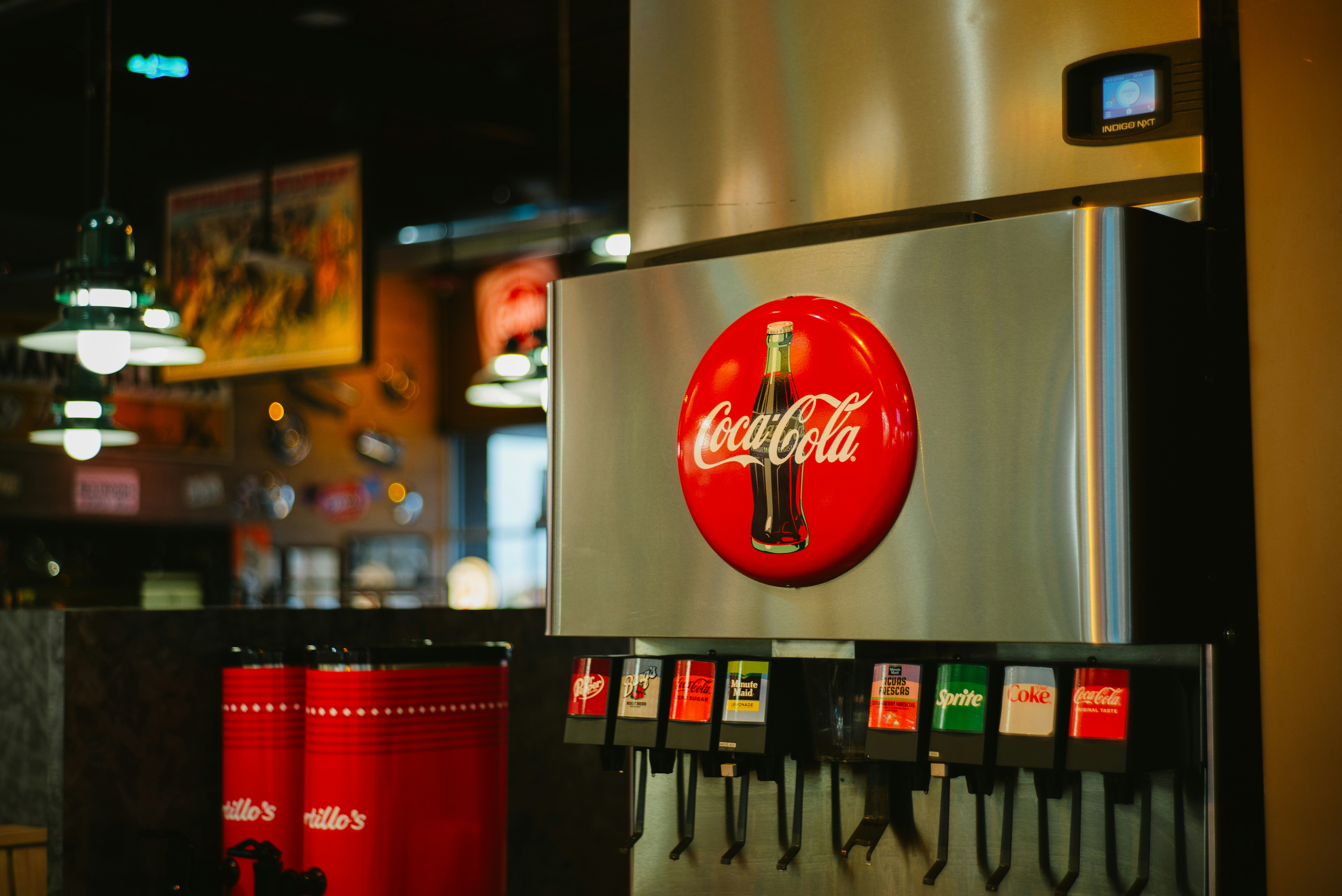

This article started as a tongue-in-cheek gripe about restaurant drink menus — the kind of thing you complain about to whoever's sitting across the table from you. It didn't stay that way. The deeper this got dug into, the clearer it became that this isn't a matter of individual restaurants making bad calls. Steakhouse, casual chain, fast food counter — doesn't matter which. It's the same handful of contracts, the same handful of decisions, repeated at every price point in the country. There are still a few holdouts in the southern states who are actually brewing their own tea, but even those are converting to whatever the soda supplier provides, one contract renewal at a time.
corporatocracy (noun) — a system of government in which corporations, financial institutions, or other business entities hold effective political power, either by directly controlling the state or by exerting decisive influence over the officials and institutions that do.
curated control (noun) — a system in which your choice, your access, or your outcome feels like the product of open competition, when the entity presenting it controlled the boundaries before you ever arrived; it doesn't decide for you, it decides what you're allowed to decide from, and calls the difference freedom.
Sit down at almost any restaurant in the country, and the fountain looks the same: Coke, Diet Coke, Sprite, Dr. Pepper, maybe a root beer or a lemonade. Coke Zero Sugar, the version that's actually winning on taste and growth, is an afterthought if it's there at all. Order unsweetened iced tea expecting something with backbone, and what you get tastes like brown tap water. Ask why, and the honest answer isn't "that's what customers want" or "that's what we chose to stock." It's that the restaurant in front of you never had a choice, and neither do you. Two companies decided on this menu before the building had a name on the door.
The Restaurant Isn't the Decision-Maker. It Signed That Away.
A commercial fountain machine has somewhere between 4 and 12 syrup valves. Most sit-down and fast-casual restaurants run 6-8. That's the whole shelf, and it gets filled by a pouring rights contract — a bundle of discounted syrup, dispensing equipment, cups, and signage that Coca-Cola or PepsiCo hands over in exchange for one thing: total exclusivity. Public examples of this exact structure exist on the record — Pepsi's fountain agreement with Red Robin, Coca-Cola's fountain agreement with the Wendy's franchisee DavCo Restaurants — and PepsiCo still runs the identical model today under its Foodservice Fountain Program.
Notice what the restaurant actually gets to decide in that arrangement: nothing. Not which cola, not which diet option, not the tea. It picks a company, once, for years at a stretch, and the company fills the valves. Call it a discount if you want. It's also a restaurant surrendering its own beverage menu to a supplier's national strategy, and calling that "the market deciding" is backward. The market never got a vote. Two corporations did.
Scale Buys a Seat at the Table. Almost Nobody Has That Scale.
That said, "the restaurant has zero say" isn't equally true for every restaurant, and it's worth being honest about where it bends. McDonald's is the proof case: Coca-Cola doesn't just ship McDonald's the same syrup bags every other chain gets. It delivers McDonald's syrup in dedicated stainless steel tanks instead of the standard bag-in-box, pre-chills the water, and adjusts the syrup-to-water ratio specifically to account for the ice melting in your cup — engineering that's the reason McDonald's Coke actually tastes different, and by most accounts, better. That's not a clause negotiated once and filed away. That's Coca-Cola running an ongoing, custom-built relationship with one account, because McDonald's volume is large enough to be worth engineering around. Chains with real scale also negotiate continuously off their own purchase-volume data, not just at the renewal date, and smaller operators can claw back some of that leverage by pooling their volume through group purchasing organizations built for exactly this purpose.
None of that changes the fountain in front of you at a regional chain or an independent diner. That restaurant signed the same generic package McDonald's did in structure, if not in scale, and gets none of the custom engineering or the ongoing seat at the table. The lesson isn't that no restaurant has power. It's that the power scales with volume, and almost nobody in the building has McDonald's volume.
Diet Coke Doesn't Hold Its Spot Because You Prefer It. It Holds the Spot Because Replacing It Costs Coca-Cola Money.
Diet Coke launched in 1982. Coca-Cola Zero Sugar didn't exist until 2005, and Coca-Cola spent the next two decades rebranding and reformulating it — Coke Zero became Coca-Cola Zero Sugar in 2017, then was reformulated again in 2021 — resetting its own product's momentum nearly every time it started to win. Diet Coke sat in the same valve, in the same contracts, the entire time.
The sales trend has already flipped: Coca-Cola Zero Sugar grew unit volume 14% for full-year 2025 and accelerated to 16% growth in Q2 2026, while Diet Coke finished 2025 essentially flat, managing just 2% growth in the fourth quarter alone. Trade coverage now calls Zero Sugar the category's breakout product. Diet Coke still holds roughly 7.8% of the U.S. soft drink market against Zero Sugar's 3.8% — nearly double, while actively losing the growth race. That gap isn't your palate. It's the inertia that Coca-Cola itself benefits from: every restaurant still pouring Diet Coke instead of Zero Sugar is one that hasn't been worth the cost of replumbing a valve and reprinting a menu board yet. The company with the losing product on the growth curve has no urgent reason to fix that at scale, because you're drinking what's already in the pipe either way.
The Tea Was Never a Choice Either
Most restaurant iced tea in this country isn't brewed. It's bag-in-box concentrate, shipped through the exact same distribution contract as the soda syrup — Coca-Cola Foodservice and PepsiCo Foodservice each bundle their own tea line into the identical exclusivity agreement that dictates the cola lineup. The restaurant doesn't pick its tea supplier separately. It's a line item inside the contract; it has already signed away its COLA choice.
The industry's own trade press has the receipts on what that costs in quality. A survey covered by Tea & Coffee Trade Journal found consumers rated fresh-brewed tea better-tasting by a 51-point margin, healthier by 55, and more natural by 46 — over concentrate. The industry knows customers can tell the difference. It sells the cheaper option anyway because fresh-brewed tea requires a dedicated brewer, daily cleaning, and a staff member to manage it, whereas concentrate means none of that. That's not a market responding to what people want in their glass. That's a supplier optimizing for its own margin, with your taste buds absorbing the difference and no line on the menu telling you that's what happened.
Pepsi Runs the Identical Playbook, Just With a Smaller Map
The same logic explains why everything past core Pepsi tends to disappoint. Pepsi's exclusivity contracts run through KFC, Pizza Hut, Taco Bell, and, under a 10-year deal announced in March 2024 and phased in starting January 1, 2025, Subway — ending Subway's nearly 20-year run with Coca-Cola. Past the flagship cola, the rest of that lineup (Diet Pepsi, Pepsi Zero Sugar, the Mountain Dew family) is built on the same valve-scarcity model as Coca-Cola's side of the business, just with fewer total restaurant chains locked into it. It's not that Pepsi makes worse drinks across the board. It's the same corporate-gatekeeping structure that is deciding what makes the cut on both sides of this supposed rivalry.
Dr. Pepper Proves It Doesn't Have to Work This Way
One drink breaks the pattern, and it's the exception that convicts the rule. Dr. Pepper appears on both Coke and Pepsi fountains, in direct competition with each company's flagship cola, because Keurig Dr. Pepper is independently owned and negotiates separately with both companies rather than getting locked into either company's exclusivity war. Nothing about physics or the market kept Dr. Pepper off either fountain. It opted out of the exclusivity fight the same way every other beverage on that fountain is prevented from doing. The scarcity you're handed at every other restaurant in the country isn't a natural feature of the beverage business. It's a condition imposed by two companies on everyone who isn't Dr. Pepper.
Say the Quiet Part
Every defense of this system — the discount, the free equipment, the operational simplicity — benefits the restaurant's bottom line and the beverage company's distribution strategy. None of it describes a benefit to you, standing at the counter, choosing between a forty-year-old formula with a metallic aftertaste and a better product that never made it onto this particular fountain. The restaurant didn't choose your options. It sold that decision years ago, for a discount on syrup. You're not picking from a menu that the market produced. You're picking from a menu that two corporations agreed to let you see.
Corporatocracy is not a market failure. It is the market succeeding — at the wrong thing, for the wrong people, on purpose.
Curated control isn't a limitation of the system. It's the system working exactly as designed — letting you choose, while making sure the outcome was never really in question.
Call to Action: What Needs to Happen Now
- Ask before you assume. If a restaurant only shows Diet Coke, ask if there's a second sugar-free cola or a brewed tea option — some locations keep a second line that isn't posted on the menu board.
- If you run a beverage program, price a dedicated tea brewer against your bag-in-box contract. The industry's own data says customers notice the difference and rate it meaningfully higher.
- When a chain switches beverage suppliers — Subway's 2025 move to Pepsi is the current example — ask a manager whether the tea changed too. It almost always does, because it's bundled into the same contract as the cola.
- Notice when Dr. Pepper shows up on a fountain otherwise loyal to one cola brand. That's not an accident. It's the one visible proof that exclusivity is a choice corporations make, not a rule the market imposes.
- Complain to the source, not just the waiter. Coca-Cola and PepsiCo both run consumer contact lines and web forms for exactly this kind of feedback. If you want Coke Zero Sugar on more fountains, tell Coca-Cola directly that a restaurant you go to doesn't carry it. The restaurant didn't make that call, and can't fix it. The company that decided the lineup can.
- Tell restaurant management, too, but calibrate your expectations based on who you're talking to. At an independent restaurant or a small regional chain, a manager can't override an existing exclusivity contract on the spot — a written complaint or comment card is one more data point for the next renewal, a small lever, not a fix. At a chain with real national volume, management has an ongoing relationship with its beverage supplier, as McDonald's does, and enough customer pressure can realistically factor into decisions well before any renewal date.
Sources
Justia Contracts. Fountain Beverage Sales Agreement between Pepsi-Cola Company and Red Robin International, Inc. (April 1, 2000).
Justia Contracts. Fountain Beverage Supply and Marketing Agreement between DavCo Restaurants, Inc. and Coca-Cola USA Fountain (1997-2004).
Ad Hoc News. The PepsiCo Foodservice Fountain Program — B2B Soda Offering Shapes Restaurant Margins.
Chowhound / Yahoo Lifestyle / Reader's Digest. Coverage of why McDonald's Coca-Cola tastes different — dedicated stainless steel syrup tanks, pre-chilled water, adjusted syrup-to-water ratio for ice melt, and custom straw design.
NetSuite / Dining Alliance / Entegra. Industry coverage of restaurant supply-chain leverage, volume-based supplier negotiation, and group purchasing organizations (GPOs) that let smaller chains pool volume for negotiating power they couldn't get individually.
Food Republic / The Takeout / Chowhound / Yahoo Lifestyle. Coverage of Coke vs. Pepsi restaurant exclusivity contracts and chain-by-chain breakdowns (2025-2026).
TODAY.com. Subway Is Switching to Pepsi From Coca-Cola Products.
CBS News. Subway Will Replace Coca-Cola Products With Pepsi in 2025.
Nation's Restaurant News. Subway to Shift Beverages From Coke to Pepsi Jan. 1 (10-year PepsiCo deal, announced March 2024, effective January 1, 2025).
Headcount Coffee. The Coca-Cola vs. Pepsi Fight for Restaurant Exclusivity (Dr Pepper's cross-platform positioning).
WebstaurantStore / ChefsDeal / Soda Dispenser Depot. Commercial soda fountain equipment listings and valve-count specifications (4-12 valve configurations).
Adweek. The Soda Category's Breakout Star Is Coca-Cola Zero Sugar.
eMarketer. Coca-Cola Leans Into Wellness With Zero-Sugar Momentum.
Accio. Coca-Cola Zero Sugar Market Performance Trend 2026 and What Sells More, Coke or Diet Coke? 2026 Sales & Stats (unit growth and market-share figures).
Statista. U.S. Market Share of the Diet Coke Brand.
The Washington Post. Coke Zero Is Getting a 'Refresh,' and Fans Are Bracing Themselves (2021 reformulation).
BeverageDaily. Coca-Cola Launches Reformulated Coca-Cola Zero Sugar in the US (2021).
Food Manufacturing. Coke Zero Gets Makeover as Coke Zero Sugar (2017 rename and reformulation).
Tea & Coffee Trade Journal. Restaurants & Foodservice: Please Consider Premium, Freshly Brewed Iced Tea.
Iced Tea Lover. Understanding Restaurant Iced Tea and Restaurant Iced Tea (bag-in-box vs. fresh-brewed breakdown).